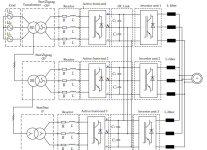
2 Transformers with series connection to fed one MV drive

...
I need to think more about how the different phase angles of the rectification pulses play with the phase shift of these _series_ primary coils. You can't have current flowing in a 'left' phase without current flowing at the same time in corresponding 'right' phase, and vice-versa.

-Jonathan

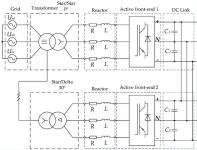
Perhaps the rectification is being done synchronously with PWM using an "active front end". That way the two rectifier circuits having drive voltages 30 degrees apart can be drawing current at the same time, unlike with diode based 12-pulse rectifiers.

An example is in the picture below:
 

Attachments

  • Phase_shifted_active_rectifier.png
    Phase_shifted_active_rectifier.png
    847.2 KB · Views: 5
Maybe. The two transformers would be parallel on the primary, not series, and one can be reconnected as needed...but then I think there would be a parallel connection to the supply bus, not supply bus to xformer 1 then xformer 1 to 2.
Without knowing the distance from the MV supply it is hard to tell. The connection may simply be a 'subfeed'.

If you have the two _primaries_ in series you need to have the same current flow in each secondary coil.
Which is why I question them being in series
 
Perhaps the rectification is being done synchronously with PWM using an "active front end". That way the two rectifier circuits having drive voltages 30 degrees apart can be drawing current at the same time, unlike with diode based rectifiers 12-pulse rectifiers.

An example is in the picture below:

Interesting find, and that diagram seems to show the exact sort of series arrangement suggested by the original diagram. The upper transformer uses the |||/wye icons, but is labeled star/star. The lower transformer uses the wye/delta icons, labeled star/delta.

But if the rectifiers are drawing current at the _same_ time, how does this give harmonic mitigation? As I said, I think I need to build a model and graph out the phase current to say anything more.
 
Interesting find, and that diagram seems to show the exact sort of series arrangement suggested by the original diagram. The upper transformer uses the |||/wye icons, but is labeled star/star. The lower transformer uses the wye/delta icons, labeled star/delta.

But if the rectifiers are drawing current at the _same_ time, how does this give harmonic mitigation? As I said, I think I need to build a model and graph out the phase current to say anything more.
Somewhere on the Eaton youtube channel there are good vids on it.
 
The secondary currents have a 30° phase shift, so they are not occurring at the same time.

The two different transformers have a relative phase shift, I get that.

But with the primaries in _series_ the must be exactly in phase. You can't have different current flows on two components that are electrically in series.
 
As I said, I _don't_ yet understand it. But the paper that @synchro found (If my image search is correct) says that the primaries are in series:
Series transformer primaries would be interesting. Would the harmonics kind of self mitigate? I wonder what the primary voltage is. Motor is supposed to be 3150.

If it's in Portugal, there is supposed to be a big "green hydrogen" project going into one of the refineries there
 
Last edited:
As I said, I _don't_ yet understand it. But the paper that @synchro found (If my image search is correct) says that the primaries are in series:
Yes, this paper clearly states the primaries windings are connected in series. This means the voltage ratio has to take the voltage drop into account, so each primary would be rated at 1/2 the L-N voltage.
 
Yes I know about HMT. This is not the case:
The 6 lead 'reconnectable' transformer is wired in a wye configuration when it is series with the 3 lead wye. This would not be significantly different than the series winding in a motor. You simply need to have the winding voltages be 1/2 of the L-N voltage.
 
My guess was an exciter for some sort of synchronous machine. It's fed from circuit T5 via AC/DC conversion. Synchronous generator in some sort of variable speed service, with a DC link to supply grid frequency?

@Joao can you give us any more information about the context of this drawing, and expand on your questions?
https://www.dca.it/media/download/img_614.pdf
Synchrounos motors with separete DC excitation
 
Top