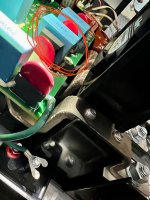
200 HP VFD Failure

I dont think so. I will have to check with the operators to confirm but, the power is turned off after processing is done. The plant should be shut down with the SCADA system, then they turn off the disconnect.
how frequently is power cycled? Seems I read precharge resistors will last longer the less you cycle power, if that is what is failing first then capacitor fails as a result.
 
how frequently is power cycled? Seems I read precharge resistors will last longer the less you cycle power, if that is what is failing first then capacitor fails as a result.
The most its power cycled is once every 8 days for clean up. Then the VFD is turned back on after 2 days.
 
Hmmm that is weird. It's a buss failure? Is it violent when it dies? Like smoke or buning or a loud bang?
Yes! Its a bang and a flash. The 400 amp OCPD at the switch board trips.

Both times it happened it was after the end of season clean up. Which is two days of hosing things out with salt water and using chemicals to clean the equipment in place (CIP). The motor is wrapped in plastic and both times the terminal box was dry.

That's why I am leaning towards water getting into the drive, even though its in a control room and a control panel.
 
In the older days of telcom they used to run these pressurized cables, you can still find them in service, they run at at about 1-10 PSI. I always thought that was a cool system. If you ever see what looks to be a little propane tank next to some old phone equipment along side the road there is probably like a 2400 pair cable buried there and that device is probably a Pressure Transducer measuring pressure at that splice. I always thought pressurized electrical systems could be used more, there are some in hazardous location stuff in oil and gas work and MV and HV work but not as common as in telcom. I would think it would be especially well suited for aboard a ship in a area like you describe that gets washed down.
I know nothing about ship electrical or VFD's, but if you can pressurize it even to .3 PSI you'll know if you have a leak.
Man, I haven't seen that type of setup in years....!
 
A 200 HP VFD may have SCRs in the rectifier bridge that are phase controlled to slow down the charging of the bus capacitors, instead of using a precharge resistor. Perhaps condensation has gotten on the control circuits for the SCRs and causing them to conduct when they should not and cause damage. Control circuits for SCRs and also for the VFD output IGBTs are relatively high impedance circuits, and therefore would be more susceptible to condensation on them.

There are VFDs that have conformal coatings on their circuit boards to help prevent condensation from causing problems.

For example, as mentioned here:

 
A 200 HP VFD may have SCRs in the rectifier bridge that are phase controlled to slow down the charging of the bus capacitors, instead of using a precharge resistor.

Yes, I used to work a lot with Lenze (German) equipment and their ECS Servo Power supplies did this. They used thyristors iirc and timed the zero crossings to turn on the thyristor for only a short time, connecting the AC Mains to the rectifier bridge.

This did 2 things - it allowed the Power Supply to monitor the DC bus voltage and look for something like 20 to 30 volts DC. If it saw that voltage, it assumes the DC bus connected downstream to the Servo drives is not shorted and then it will close a set of relays to allow all 6 diodes to charge up the DC bus from the AC Mains. Having the DC bus slightly charged helps reduce the "shock" of surge current that would otherwise happen when you try and power up completely discharged DC bus caps. (Most drives use a pre-charge resistor for this). At least, that's what I remember it did.

If, however, the Power Supply does NOT see the DC bus charging to 20 or 30 volts it will not close the relays in, and the drive will indicate a specific error - alerting the user to a possible short in the DC+ to DC-, or either end to ground.

Pretty neat system, and it took a second or 2 tops at startup. It avoids the occasional disaster when there is a problem on the DC bus in a Servo and the Power Supply just comes in full beans. For example, a mis-wired DC bus is rare -but can happen - especially when commissioning a system (Sunday wired to Monday).

It did have a drawback for us though at several sites. The electronics in the Power Supply first measure the zero crossings in the AC Mains and they must pass a sort of quality test. Meaning timing and angles. The thyristors must be turned on close to the zero crossings or risk damage if switched on during some larger energized part of the sine wave. If the controls did not like "quality" of the AC Mains, they won't even start the initial DC bus test, and throw a specific error. Depending on what site we were commissioning, the AC Mains were failing this test (either poorly regulated POCO, or site's machinery creating phase shifts). Anyway, we went back and forth with Lenze Germany about this, and their reaction initially was to fix the site power issues. And we understood that stance. But in the end, they developed a new revision of firmware that had looser tolerances for our crappy "American" power.

Just guessing here of course, but like Synchro is suggesting above, if condensation got around the trigger part of an SCR and caused it to conduct at start up when it was not supposed to...

 
The blue component has dust and powder blown out of it.

It’s a specialized panel that has a cutting thru the back pane and a cutting thru the cabinet. I had forgotten about this. The drive I put in a few months ago was the right horse power and catalogue number. But it didn’t have a specialized heat sink that seals the hole cut into the panel and back pane. So when the control room got wet the VFD I installed went bad.

Apparently the wrong VFD spare was ordered in 2018 and I only verified the hp, voltage and catalogue number.
 
Thing is the boxes are small. If the cable between the driver box and the fixture was longer you would have a better chance of mounting it. My gut tells me that the boxes are allowed to float because these lights are advertised for remodel. They talk how they will fit under a joist if you have at least 1/2" sheet rock. I used some Lithonia but had a couple of failures. I usually use Halo. I see no reason they can't float they are insulation rated.
 
Thing is the boxes are small. If the cable between the driver box and the fixture was longer you would have a better chance of mounting it. My gut tells me that the boxes are allowed to float because these lights are advertised for remodel. They talk how they will fit under a joist if you have at least 1/2" sheet rock. I used some Lithonia but had a couple of failures. I usually use Halo. I see no reason they can't float they are insulation rated.
Wrong thread?
 
From the Original Post:

"This year, after end of season clean up, the operator powered up the drive with the local disconnect and he heard a big bang. The 400 amp breaker tripped and you could see that smoke and dust and soot was blown out the side of the VFD."

Not so sure that little capacitor (I think that is what it is, too) had failed as dramatically as mentioned. Maybe another component somewhere?
 
Top