215.2(A)(2) Feeder Neutral

Status
Not open for further replies.

bwat

EE
Location
NC
Occupation
EE
Is this section, 215.2(A)(2), the only piece that relates to whether or not a neutral (grounded conductor) is required to be included in a feeder circuit? I thought I remembered another section that explicitly allows, or disallows, not running a grounded conductor on a feeder. Struggling to find it. Particularly if it's a feeder running to a panel that doesn't have any L-N branch circuits.

Talking about the neutral here. Not the EGC.
 
I think its a case where you can approach it from the standpoint that it is NOT Code required so it is not necessary.
 
I cannot recall an exception of not having a grounded conductor in a circuit whether it be a feeder or branch. Though EGC installation in an early time wasn't required in a feeder to another structure - If memory servers
 
A feeder does not need a neutral but if you decide to run one in case of future use it must be sized no smaller than the equipment grounding conductor.

A service is required to have a neutral.
 
Here is the section for a service. By the way- did you ever run a feeder to two hvac units? Did you pull a neutral? Of course not.

250.24(C) Grounded Conductor Brought to Service Equipment.
Where an ac system operating at 1000 volts or less is grounded
at any point, the grounded conductor(s) shall be routed with
the ungrounded conductors to each service disconnecting
means and shall be connected to each disconnecting means
grounded conductor(s) terminal or bus. A main bonding
jumper shall connect the grounded conductor(s) to each service
disconnecting means enclosure. The grounded conductor(
s) shall be installed in accordance with 250.24(C)(1)
through 250.24(C)(4).
 
Here is the section for a service. By the way- did you ever run a feeder to two hvac units? Did you pull a neutral? Of course not.

If I ran a "Feeder" to 2 HVAC units I'd probably install a Subpanel at the end of the Feeder then branch off to the 2 units from there.
If I was going to do that, then, sure I'd pull a neutral along with the feeder just in case I wanted to derive the required service outlet from the subpanel. :)

JAP>
 
Here is the section for a service. By the way- did you ever run a feeder to two hvac units? Did you pull a neutral? Of course not.
sounds like branch circuits you are talking about - why pull 2 branch circuits when you could pull a single feeder to a panel for the branch circuit to feed out of? which 250.24 (1) thru(4) eliminates the grounded conductor in a feeder? look at exhibit 100.7 in handbook as clarification.
 
The wiring to an HVAC unit could be a feeder or a branch circuit depending on whether or not the unit has overcurrent protection incorporated into it.

Regardless, a grounded conductor is not required in the run unless it happens to be needed in the unit.

JAP>
 
If I ran a "Feeder" to 2 HVAC units I'd probably install a Subpanel at the end of the Feeder then branch off to the 2 units from there.
If I was going to do that, then, sure I'd pull a neutral along with the feeder just in case I wanted to derive the required service outlet from the subpanel. :)

JAP>


Right many of us would but you don't have to do it if you don't feel the need.
 
sounds like branch circuits you are talking about - why pull 2 branch circuits when you could pull a single feeder to a panel for the branch circuit to feed out of? which 250.24 (1) thru(4) eliminates the grounded conductor in a feeder? look at exhibit 100.7 in handbook as clarification.


No I am saying if I ran a feeder to 2 hvac units then I could set a small panel and I wouldn't necessarily need to pull a neutral.
 
No I am saying if I ran a feeder to 2 hvac units then I could set a small panel and I wouldn't necessarily need to pull a neutral.

Kind of like when your wife asks you if you left the toilet seat up.

What she's really saying is "If you leave the toilet seat up again , I'm going to rip your arms off and throw you out in the driveway on your head".... :)

JAP>
 
The wiring to an HVAC unit could be a feeder or a branch circuit depending on whether or not the unit has overcurrent protection incorporated into it.

Regardless, a grounded conductor is not required in the run unless it happens to be needed in the unit.

JAP>

One correction. If the unit has an overcurrent protective device built in then that is considered supplemental protection and it would not change the status of a branch cir. to a feeder. If the overcurrent protective device was in the hvac disconnect then it technical would change the circuit to a feeder.
 
One correction. If the unit has an overcurrent protective device built in then that is considered supplemental protection and it would not change the status of a branch cir. to a feeder. If the overcurrent protective device was in the hvac disconnect then it technical would change the circuit to a feeder.
What's the definition of a supplemental device, does it have to be integral to the equipment to still be considered supplemental?
 
One correction. If the unit has an overcurrent protective device built in then that is considered supplemental protection and it would not change the status of a branch cir. to a feeder. If the overcurrent protective device was in the hvac disconnect then it technical would change the circuit to a feeder.

Yea, I thought that also just after I hit the post button.

I would say the overcurrent protection would need to be part of the premises wiring governed by the NEC, not the supplemental protection in the equipment.

JAP>
 
What's the definition of a supplemental device, does it have to be integral to the equipment to still be considered supplemental?


I don't think it has to be an integral part of the machine....

Overcurrent Protective Device, Supplementary. A device intended
to provide limited overcurrent protection for specific
applications and utilization equipment such as luminaires and
appliances. This limited protection is in addition to the protection
provided in the required branch circuit by the branchcircuit
overcurrent protective device.
 
Thanks all. Was second guessing myself when I got questioned and then couldn't quickly find an explicit section. I thought there was somewhere that didn't leave any doubt or that, before I just looked it up again today, that 215.2(A)(2) contained the wording "..when (or if) there is a grounded conductor.." which would imply that there are certainly cases where there wouldn't be one. But I see I was wrong. Everyone just uses logic similar to augie's in #2... it doesn't say you need it.. so you don't need it.
 
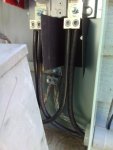
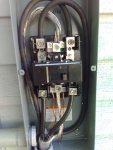
A while back, I told of a residential tankless water-heater installation I did, adding a second 200a sub-panel (outside main/inside ML panel) and SE cable, for four 40a breakers.

The inspector failed me because he had never heard of a feeder having no neutral. He called the chief inspector, who first agreed, but then called back and told him I was correct.
 
(Took too long above.)

I told him the line-side bare conductor was the neutral and the load-side bare was the EGC.

KIMG0130.JPG KIMG0129.JPG
 
Status
Not open for further replies.
Top