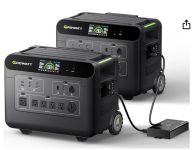
240v UPS for a well pump

Merry Christmas

Dennis Alwon

Moderator
Staff member
Location
Chapel Hill, NC
Occupation
Retired Electrical Contractor
A friend of mine was looking for a ups battery backup for a 240v pump. The system I see are basically 2- 120 volt units. The image below is the idea- that picture is a solar powered unit but how are they getting 240 if the units are not connected together, or are they. It always says 240v split phase.

1764968676153.png
 
A friend of mine was trying to do something very similar so he bought a couple of batteries, but they weren't designed to provide 240V. Then his father-in-law wired up basically a home-made extension cord with 12 gauge romex and a couple receptacles while he was in town for the holidays. The idea was he would keep the batteries plugged in upstairs and when the power would go out all he'd have to do is go down stairs and move the plug from house power to the "back-up circuit" as he called it.

He called me up after the fact because he wanted to test the system and was wondering why the plug on the pump looked weird and wouldn't fit into the receptacle. He explained the setup and I gave him the bad news. Then I managed to derail him from trying to buy a 120 volt pump by doing some real rough math and figuring the battery would only last about 20-30 minutes. Power outages last days for him in the winter. So he bit the bullet and ended up getting some powerwalls.

Then he asked me if I wanted to buy some batteries....
 
A friend of mine was looking for a ups battery backup for a 240v pump. The system I see are basically 2- 120 volt units. The image below is the idea- that picture is a solar powered unit but how are they getting 240 if the units are not connected together, or are they. It always says 240v split phase.
In a split-phase 240V setup, the two 120V inverter units are actually connected together, but not in series like batteries. They’re synchronized internally so one inverter outputs +120V (L1) and the other outputs –120V (L2). The voltage difference between L1 and L2 is what gives you 240V.
That’s why it’s called 240V split-phase.

So even though each unit is a 120V inverter, once they are paired and communicating with each other, they lock into phase and create a true 120/240V output just like the utility grid. If the inverters aren’t designed for split-phase operation, you cannot just hook two 120V units together, they must support stacking/split-phase mode. if you need, I can sent you a link 120V240V inverter specs for your reference and help you understanding.
 
Thanks @Peter-Lei that was what I was wondering and it answered my question. I would be interested in a link. Thanks. You can post it for all to see.....
OK, Let me share a random link to a 120V/240V split-phase inverter as an example: https://cmxbattery.com/product/12kw-18kpv-hybrid-inverter-charger-all-in-one-hybrid-inverter/ If you open it, you can look through the specs and the inverter description, then you’ll see exactly how 120/240V works.
If it still doesn’t make sense, just let me know. I can explain it further until it’s completely clear for you
 
I looked at the picture you sent, and it seems like this is a portable power station with a built-in inverter. So you’ll need to confirm whether that inverter is actually a split-phase inverter. A true split-phase inverter provides one neutral (N) and two hot lines (L1 and L2) that are 180 degrees out of phase. That’s how it can output both 120V and 240V. Only with this kind of split-phase output can it properly run your 240V pump
 
A customer of ours has a really interesting old battery backup system
Its a 120VAC inverter off a 48VDC 'Trace' branded solar/battery backup system, looks to be from the late 90's - early 2000's.
I have also been looking into how to update or replace that system, the batteries are massive old AGM batteries 6V each, they look exactly like Telecom tower batteries (but are not) and take up a ton of space ( I first thought was a hen house).
His pump house has a 60A 120V feeder and 120:240 transformer to step up the 120 to 240.
The Trace unit has input for a 120V generator also.
I do kinda like the old skool way of keeping the battery bank separate from the 'inverter/charger' function as the battery will surely not last as long as the inverter.

 
I looked at the picture you sent, and it seems like this is a portable power station with a built-in inverter. So you’ll need to confirm whether that inverter is actually a split-phase inverter. A true split-phase inverter provides one neutral (N) and two hot lines (L1 and L2) that are 180 degrees out of phase. That’s how it can output both 120V and 240V. Only with this kind of split-phase output can it properly run your 240V pump
I should have posted the correct picture. I know that wasn't what I was talking about for myself but it seemed to be the same type of setup to get 240v. TY
 
I should have posted the correct picture. I know that wasn't what I was talking about for myself but it seemed to be the same type of setup to get 240v. TY
Your friend will need to check a few key specs on the pump’s nameplate, such as the rated power, peak power, and the rated voltage (you mentioned it’s 240V, which is very common in the U.S.).

For the inverter, I’d recommend using a 48V pure sine wave model. Water pumps are sensitive to the waveform, and a 48V system is generally more stable and draws less current. The inverter also needs to handle the pump’s startup surge, so make sure the continuous and surge ratings are high enough.

As for the battery capacity, it really depends on how long you want the pump to run. For example, if you need about 30 minutes of runtime, a 2.5kWh to 5kWh battery is usually enough. This is just my personal suggestion, feel free to use it as a reference
 
A customer of ours has a really interesting old battery backup system
Its a 120VAC inverter off a 48VDC 'Trace' branded solar/battery backup system, looks to be from the late 90's - early 2000's.
I have also been looking into how to update or replace that system, the batteries are massive old AGM batteries 6V each, they look exactly like Telecom tower batteries (but are not) and take up a ton of space ( I first thought was a hen house).
His pump house has a 60A 120V feeder and 120:240 transformer to step up the 120 to 240.
The Trace unit has input for a 120V generator also.
I do kinda like the old skool way of keeping the battery bank separate from the 'inverter/charger' function as the battery will surely not last as long as the inverter.

Those old Trace systems still rank among the best ever built up to current production.

Still a few of them left around here when Johnny Come Lately has not come in and told the customer to rip it all out and start over. They work fine.

Can switch to lithium batteries if you reprogram the voltage set points a little bit.
 
Those old Trace systems still rank among the best ever built up to current production.

Still a few of them left around here when Johnny Come Lately has not come in and told the customer to rip it all out and start over. They work fine.

Can switch to lithium batteries if you reprogram the voltage set points a little bit.
Not to hijack this thread but do you recommend replacing the AGM batteries on these ?
 
My old commercial landlord sold used forklifts and parts. He sold like 5 20 foot container loads of 48 volt steel case FLA batteries to some guy that was taking them to south or central America for off grid usage. I guess that's a thing of the past now though. They were good because you could replace a cell kind of easy. Hell easy enough to repair a cell if you aren't worried about the environmental
 
Not to hijack this thread but do you recommend replacing the AGM batteries on these ?

I never liked AGM batteries even back when people were using lead acid most of the time.

They do not tolerate deep discharge so you had to limit them to 50% of flooded battery depth of discharge so they would not die an early death. Compound that, they cost twice as much per kWh. So 25% of your bang for buck. And even more, they are very fragile. Total discharge or gross overcharge one time and they are toast. Flooded batteries can recover from that.

Nowadays they make some pretty good lithium drop in batteries. But 24 volt anything is getting really obsolete these days.
 
Top