
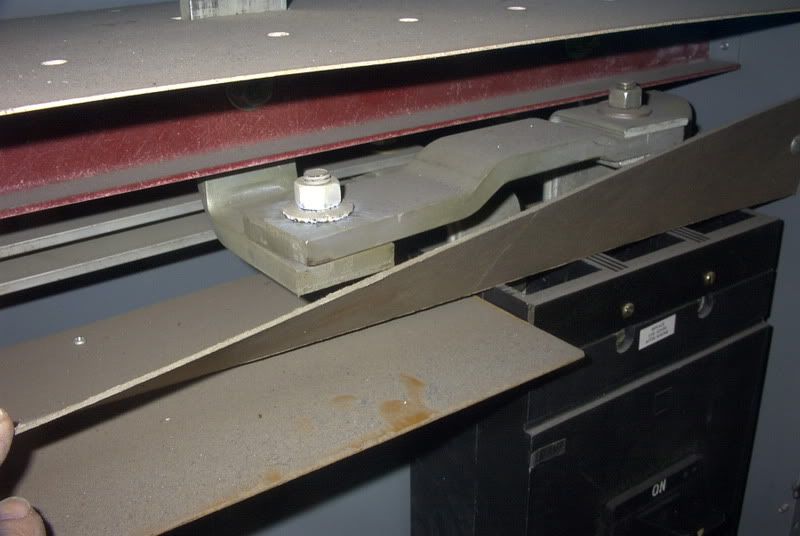
arcing buss bar

Status
Not open for further replies.

acrwc10

Master Code Professional
Location
CA
Occupation
Building inspector
chpmainbuss.jpg


I came across this and wanted comments on the best way to deal with it. I know the bolts are loose and need torquing ,but without damaging the buss how best can it be serviced. In a thread about paint on the bussing we all agreed that you can't brush it down with sand paper or a wire brush. I thought I would see what you guys thought.
The burning is in between the bolted bussing also.
 
acrwc10,

I would order new parts for the permanant job, in the mean time I'd get out

the wire wheel and clean whats there up, get new bolts, tighten it up to

spec. and wait for the new parts to show up.
 
This was just a little surprise I found with a service call that the main breaker will not shut off when the handle is pushed down. I have the new breaker and scheduled a shut down to swap it out. But something in the back of my mind said "look closer" so I opened up the dead fronts to get a good look and this is what I found. I did get all the torque specs from SQ D for the bolts, but I did not expect to find a burned buss bar.
 
The burn marking looks like the bars are separated and only the bold was passing current. I see no sign of arcing between the bars themselves.

This may even have been a factory error, presuming not field assembled.
 
Last edited:
It appeats that the bolt was never tight, and I would expect damage to the bus bar. If there is a lot of damage to the bar, it will have to be replaced before it is re-energized.
Don
 
Why do you want to be a DIYer on a project like this? If you do not have the knowledge/training to "repair" bus bars why not sub-contract a service shop that does?
 
Agreed Jim, Looks like an easy repair to me. New bolt, and some light sanding seems to be okay on this one.
 
Several items should be addressed here.

1st Temporary repairs should be made ASAP. Burnish (sanding is not recommended) the mating surfaces, replace the hardware, clean the insulating surfaces, and megger the bus phase to phase, phase to ground.

2nd Permanent replacement with replacement parts either from the manufacture or an after-market bus manufacture (manufactures are notoriously slow or not at all helpful).

3rd This gear should be EPM?s PROPERLY, I recommended an IR scan, cleaning all the insulating surfaces, (cherry insulators and insulating barriers), verify torque of all hardware, lubricate parts per the manufacture requirements, megger, micro-ohm and test GFP if applicable.

Is this 480/277 VAC? In any case BE CAREFUL, DO NOT ATTEMPT any of the above (except IR) while this switchboard is energized.
 
John,
Agreed Jim, Looks like an easy repair to me. New bolt, and some light sanding seems to be okay on this one.
Many bus bars are coated or plated and should never be sanded.
Don
 
Greg, Lightly sanding/dressing and cleaning are perfectly suited for these types of minor issues. I do agree if the bar is pitted that it should be replaced. When sanding/dressing you do not want to remove the plating. That's the key. If you remove the plating then you ruin the bar. I sometimes use a big pencil eraser. It works great and does no harm.
They also make abrasive scrub pads specifically for this purpose.
 
John,
Greg, Lightly sanding/dressing and cleaning are perfectly suited for these types of minor issues. I do agree if the bar is pitted that it should be replaced. When sanding/dressing you do not want to remove the plating.
If it looks like it needs sanding, then the plating in that area is already gone. If it only needs cleaning, then I agree that something like an pencil ereaser may be used. Given the condition of the bolt, I would expect major pitting on the bus bars.
Don
 
A burnishing tool made for dressing contacts is the ideal tool for this (as note above).

Additionally DO NOT BURNISH in the switchgear, remove the bus from the switchboard as the dust is conductive (DUH).
 
From the looks of things, the damage may be between the bolt washer bar and not bar to bar. I have seen this before. If so I would say the joint was never tightened.
 
jim dungar said:
Why do you want to be a DIYer on a project like this? If you do not have the knowledge/training to "repair" bus bars why not sub-contract a service shop that does?


Far from it. I have no intention of "sanding" the buss bar. I posted this photo to get comments from others. My conserns are that 1) the Bolt and Nut may have welded together. 2) that the buss is burned inbetween the connection. The rest of the switchgear does not appear to have any other bad connections. Retorquing all of the bolted connections was part of what we were going to do. I have installed many switch gear and have not seen this type of failure on a factory connection before. Although I did get a Cuttler Hammer gear once that had 6 distribution breakers in it that were not all phased the same, 4 with clockwise rotation and 2 with counter clockwise rotation. Nothing like quality control.
 
I have seen several loose factory connections, if I run accross any pictures from our IR reports I will post them.

If you think about it the gear is shipped cross country (in many cases), handled by professional riggers and non-professional riggers (electricians), bounced, sometimes dropped, left outside in the heat cold, exposed to construction dirt and dust, it is a wonder there are not more problems.
 
brian john said:
I have seen several loose factory connections, if I run accross any pictures from our IR reports I will post them.

If you think about it the gear is shipped cross country (in many cases), handled by professional riggers and non-professional riggers (electricians), bounced, sometimes dropped, left outside in the heat cold, exposed to construction dirt and dust, it is a wonder there are not more problems.


True. But you have to concede that the wiring in the C-H gear didn't change rotation due to shipping:grin:
 
John Valdes said:
Agreed Jim, Looks like an easy repair to me. New bolt, and some light sanding seems to be okay on this one.
we do just that with the same situations on 6.9 kv under direction of our engineer all the time. If you have doubts silver paste it.
 
Status
Not open for further replies.
Top