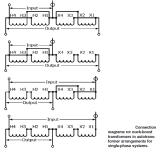
Buck/Boost transformer in buck autotransformer mode

autobuck

Member
Location
Paris
Occupation
Eng
The utility company has been very generous with voltage, I would like to try a 12v bucking using a Hammond Q1C0ERCB. The voltage is slightly 250 and I'm trying to drop it to 238v

Wiring diagram #3 seemed what Hammond wants me to follow according to their documentation. https://documents.hammondpowersolut..._selector_wiring_diagrams/HPS-Buckboost-3.pdf

Could someone please explain how I'm supposed to connect this one in bucking autotransformer mode please?

The utility company gives me 1Ph 2 wires cable, 1 Hot and 1 Neutral.

From the diagram I see that:

  • H2 & H3 need to get connected, and so do X1 & X3 and X2 & X4
But then I get stuck. I understand that has to go inline, so I cut the hot cable and I end up with one end I call Utility side, and the other I would call Panel side.

If you had done this before, can you guide me through it please.
 
Connect the HV terminals to the HV stuff and the LV terminal to the LV stuff.

If your source is the HV then you are bucking down to the LV.
If your source is the LV then you are boosting up to the HV.
 
Simple lesson:

1. Connect the primaries in series or parallel to suit the nominal voltage range. Series for your situation.

2. Connect the secondaries in series or parallel for the desired voltage change. Parallel for your situation.

3. Connect the primary group in series with the secondary group, observing polarity.

4. Connect the higher voltage, in or out, to both of the far ends of the two groups in series.

5. Connect the lower voltage, in or out, to the primary/secondary junction and to the other end of the primary.

Just pay attention to one junction at a time as you're making connections per the diagram. If you have no extra or missing wires when you're done, you're golden.

You want the third diagram shown here, because you want the higher line voltage and the lower buck/boost voltage. Note that input and output are basically interchangeable.

1770605781282.png
 
Thank you very much Larry, the way you explained it is amazing!

Simple lesson:

1. Connect the primaries in series or parallel to suit the nominal voltage range. Series for your situation.

2. Connect the secondaries in series or parallel for the desired voltage change. Parallel for your situation.

3. Connect the primary group in series with the secondary group, observing polarity.
How can we observe polarity in this case please, how is the diagram different from having the the connection on the opposite side X2, X4? Is this junction that will decide -12v vs +12v?
4. Connect the higher voltage, in or out, to both of the far ends of the two groups in series.

5. Connect the lower voltage, in or out, to the primary/secondary junction and to the other end of the primary.
In my diagram, if H1 taps the Neutral, do you agree that I would be left with just connecting utility's hot to (X4,X2) and panel supplier to (H4, X1, X3)
Just pay attention to one junction at a time as you're making connections per the diagram. If you have no extra or missing wires when you're done, you're golden.

You want the third diagram shown here, because you want the higher line voltage and the lower buck/boost voltage. Note that input and output are basically interchangeable.

View attachment 2581891
Oh, do you mean that the third diagram that you provided is the bucking wiring, and not the one I posted?
 
Top