
Buck Boost Transformer

alyoshak24

Member
Location
Chicago
Occupation
Electrician
Hello All i have a question that i cannot figure out and i saw similar posts from Mike Holts Forum but i couldnt wrap my head around it without a visualization.

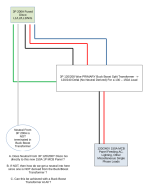
I have an engineer who is requesting we install a split phase buck/boost transformer to serve a 150A SP Load. Currently an overhead transformer 120/208y 3P is feeding meter, meter to fused disconnect, disconnect to 3Phase MCB.

We are replacing the 3Phase MCB to a single phase panel 120/240 150A (owner of building purchased appliances that only work with 240V). But i get stuck with the neutral, since the buck/boost transformer secondary is a delta 120/240 with NO derived neutral, do i just use the neutral from the 120/208y ? if not, then were am i getting the neutral from to connect to the bus bar into my new Single Phase Panel ?

Ive attached a screenshot of with the wiring diagram below as well as a pdf file of the same image just in case the image wont generate.

Thank you for the help gents.
fgffgScreenshot from 2026-02-24 11-13-12.png
 

Attachments

  • BuckBoost.pdf
    20.3 KB · Views: 7
If you use a buck-boost to go from three phase to single phase you cannot get a true 120/240V output.
The buck-boost does not create a separately derived system so your LV neutral will also exist on the HV. When you raise the 208V up to 240V you will also raise the L-N and L-G voltages.
 
With 130-150 amps of load wouldn't a 240/120 volt, 3phase, 4 wire Delta secondary be easier? Then you could use 3 phase for loads that do not need 120 volts.
So are you saying to just do away with the Buck Boost Transformer altogether and request for Utility to reconfigure transformer or replace transformer altogether to a 240/120 volt, 3phase, 4 wire Delta secondary ?

Sometimes i do not want to challenge the engineer cause you know a pissing contest could turn into a whole crew being replaced.
 
So are you saying to just do away with the Buck Boost Transformer altogether and request for Utility to reconfigure transformer or replace transformer altogether to a 240/120 volt, 3phase, 4 wire Delta secondary ?
Some utilities here refuse or resist doing new 240/120 delta services, but it cant hurt to ask them.
There is a chain of fuel/convenience stores here that always wants a 240V service at every new store, as all their equipment is 230v, In some locations they have to pay the utility some pretty big fees to not be on a 208 network but its worth it to them.

I recently worked for a company that moved from a 240D building to a new location that had 208, I got the utility to adjust its 208 bank to 218/126 wye, as 218V is just barely within spec for 230V loads, especially if you keep an eye on voltage drop, they actually ended up with closer to 220. The wye system is better for their newer equipment that has VFD's.
 
Thank you guys, i just spoke with the Distribution Engineer over at the POCO and he said there's no way theyre going to update the existing to a 4 wire delta transformer. So the hunt continues
 
Thank you guys, i just spoke with the Distribution Engineer over at the POCO and he said there's no way theyre going to update the existing to a 4 wire delta transformer. So the hunt continues
Can you just add a customer owned 240/120 volt Delta transformer after the 208 volt service?
 
Thank you guys, i just spoke with the Distribution Engineer over at the POCO and he said there's no way theyre going to update the existing to a 4 wire delta transformer. So the hunt continues
Did you ask them if they can tap 208 up 5% to 218/126 wye ?
What is the average voltage they actually deliver?
Some may be closer to 115 some 125.
Will the building have any VFD's?
 
Can you just add a customer owned 240/120 volt Delta transformer after the 208 volt service?
Probably the easiest and cleanest way.

Or you could add a second panel that is 240 only without a neutral, and use a boost-buck before that panel.

But I like the 208 primary, 120/240 secondary idea better
 
Or go Philly style and install a Scott-T, 208 primary, 5-wire 240/120 secondary, that will make two 120/240V split phase feeders that balance precisely on all three phases. Keep a 208 panel for your 3-phase loads.
 
I have an engineer who is requesting we install a split phase buck/boost transformer to serve a 150A SP Load. Currently an overhead transformer 120/208y 3P is feeding meter, meter to fused disconnect, disconnect to 3Phase MCB.

We are replacing the 3Phase MCB to a single phase panel 120/240 150A (owner of building purchased appliances that only work with 240V). But i get stuck with the neutral, since the buck/boost transformer secondary is a delta 120/240 with NO derived neutral, do i just use the neutral from the 120/208y ?

Okay, you have some language confusion that you need to clear up, not to be pedantic, but because it isn't clear what you actually have. If you can post a picture of the transformer nameplate or a link to the datasheet that will help clear things up.

The term 'buck/boost' transformer generally means a transformer connected without separate primary and secondary circuits. You can think of the winding as a single winding with taps to couple the different voltages. There is no electrical isolation between voltages. The technical term for this type of transformer is 'autotransformer'. With an autotransformer you can always find a path and defined voltage between the input and output terminals.

With a common 208 to 240V buck/boost configuration, you start with 3 terminals all 208V L-L and all 120V L-N. The output side of the transformer gives 236V L-L (yes, the typical arrangement used for '208 to 240V' really gives 236V; why is for a different conversation). In this configuration it is generally a bad idea to use the neutral, but the L-N voltages are well defined: one output terminal is still 120V L-N, but the other two output terminals are now 145V L-N. With this sort of transformer setup you only use the L-L voltage on the output. If you have a straight 240V load this is just fine. If you have a 120/240V load you run the risk of supplying 145V (L-N) to a terminal that expects to see only 120V.

The other type of transformer is an 'insulating' or 'isolating' transformer. This type of transformer has completely separate primary and secondary coils and separate primary and secondary circuits. There two circuits are electrically isolated, and the L-N voltage of the secondary is not connected in any way to the primary supply. An insulating transformer can only define the L-N voltage if it has a neutral tap or terminal. If the secondary doesn't have a neutral, then you simply do not have a neutral available for that derived voltage.

Why is there confusion? Because you say that the 'buck/boost transformer secondary is a delta 120/240V'. You say buck/boost but the description matches an insulating transformer with a delta secondary that has a neutral tap.

IMHO your next steps: define what the voltage requirements are for the equipment. Does the equipment require straight 240V or 120/240V?

If the equipment only needs straight 240V then you can use buck/boost transformers and you simply don't bring the neutral to the equipment.

If the equipment requires 120/240V then you need to use an insulating transformer that has a neutral tap. (Yes, there are oddball autotransformer arrangements that could give 120/240V, but these are oddball and I doubt ever used.)

-Jonathan
 
(Yes, there are oddball autotransformer arrangements that could give 120/240V, but these are oddball and I doubt ever used.)
As an aside, the one I was thinking of would give you, for a PF=1 240V load, equal current on all 3 wye ungrounded conductors, but on two of them the phase angle between current and voltage would be 60 degrees. Namely a 208V center tapped coil between say B and C, to derive the center point D which is 60V from N and in phase with A-N. And a 120V center tapped coil with one end connected to N, center tap connected to D, and far end resulting in E, 120V from N. Then A-N-E is 120/240V single phase. This arrangement requires two different transformer cores (e.g. two different transformers) because the voltages on the two autotransformer coils are 90 degrees out of phase.

But if my sense of the "quantity" of transformer is correct, this would not "save" any transformer over just using a 208V : 120/240V isolation transformer which loads only two legs of the wye supply. The only advantages I see would be if you need your 120/240V to be in phase with A-N, rather than 30 degrees out of phase, or if you are current limited on the wye side, and so prefer to load all 3 wye legs to 100% of the 240V current, rather than just loading two of them to 115% of the 240V current.

Cheers, Wayne
 
The only advantages I see would be if you need your 120/240V to be in phase with A-N, rather than 30 degrees out of phase, or if you are current limited on the wye side, and so prefer to load all 3 wye legs to 100% of the 240V current, rather than just loading two of them to 115% of the 240V current.

Cheers, Wayne
Good points
The op stated they have a 36kVA single phase 120/240 load (150A), but we dont know how much headroom is on the 208 system or how the load can be broken up?
If say there is only 36kVA to spare on the 208 system and the 36kva load has to be perfectly balanced on all three phases then the largest single phase 120/240 split phase loads can be 18kVA on each of two 120/240 feeders tapped off a Scott-T,
That is the main application of a Scott-T outside legacy two phase, such as electric smelters large boilers, or electric rail substations, not your common every day stock supply house item, but not as rare as you might think.
I used to say 99% of the time its a misunderstanding and really 208 is fine, but with one particular large single phase load the load balancing is more of a factor.
(Yes, there are oddball autotransformer arrangements that could give 120/240V, but these are oddball and I doubt ever used.)
Transformer manufacturers can make a Scott-T, its oddball but not custom, just a 86% tap on a single phase core. I think Penn transformer still stocks a 208 - 240 model that can go in both directions. It is a widely known configuration.
In 2026 I'd personally just step it up to 220/127. Then at equipment you have 218/126 and all your 230V stuff is happy, as long as that 36kVA can be balanced.
 
Last edited:
owner of building purchased appliances that only work with 240V
You could get more meaningful responses providing a link or a manual to the equipment that you are tasked with powering from the existing service

I have an engineer who is requesting we install a split phase buck/boost transformer to serve a 150A SP Load.
This person may not have an understanding of what is actually required. detailed Equipment specifics could clear up what is really required in the particular situation. The suggestion of using a buck boost transformer to go from 208/120 to 240 1Φ suggests this to me. And how many of these appliances need to be connected.
 
If say there is only 36kVA to spare on the 208 system and the 36kva load has to be perfectly balanced on all three phases then the largest single phase 120/240 split phase loads can be 18kVA on each of two 120/240 feeders tapped off a Scott-T,
Agreed.

Transformer manufacturers can make a Scott-T, its oddball but not custom
But winnie mentioned, and I described, an autotransformer arrangement to provide 120/240V. Scott-T is an isolation transformer arrangement. Although they both involve two coils with the voltages on the coils 90 degrees apart.

Cheers, Wayne
 
Top