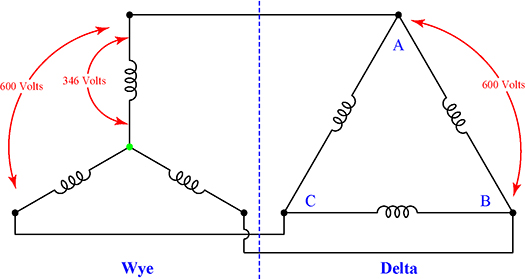
Commerical water tank ( Wye Connection)

Status
Not open for further replies.

Axxus

Member
Hi guys

Can someone help me out on a commerical water tank 100 gallon
600 Volts on electrical diagram.

I have 6 (6000 W )heater element ( 3 on the bottom and 3 on the top )

Right now the element are connect to Delta (Triangle) I need to convert it to
Wye.

In order hand i need to connect those element like 347 Volts.

I hope someone could help

Keep the good work guys

Axxus Electric
Canada , Montreal
 
Axxus said:
Hi guys
Can someone help me out on a commerical water tank 100 gallon
600 Volts on electrical diagram.
Are you saying the system voltage is 600 volts wye?

Axxus said:
I have 6 (6000 W )heater element ( 3 on the bottom and 3 on the top )
Right now the element are connect to Delta (Triangle) I need to convert it to
Wye.In order hand i need to connect those element like 347 Volts.
If the system voltage is 600 volts wye, you will not get the proper wattage if you connect the elements to 347 volts. It sounds like the elements were
made to connect to 600 volts which would be a delta connection.
This question should be moved to Electrical Calculations/Engineering
 
Last edited:
Correct BryanMD
It is only a matter of how the 'links' between the elements are arranged!

The Technician of mfg is lost and he is unable to awser my question !
Its saturday night and its close.

I know I can to convert but I cant find any electric diagram on the net !


For BoB Question

Quote : " Are you saying the system voltage is 600 volts wye? ""Righ

now the element are link by Delta connection ( triangle )
 
I think I understand his question. His heating elements are only rated for about 350 volts, so connecting them in a wye configuration will cut the voltage by square root 3..... 600/sqrt(3) = 346 volts. It won't matter if you actually have a neutral wire or not, but you just need to connect all three heating elements together at one point. Remove one end of each heating element from its adjoining phase and tie all three loose ends together as shown below.

Y-DHeaters.jpg
 
Merci Beacoup !

Right now each element pull about 25 Amps each
by doing this conversion it will only pull about 14 Amps.

Can you forward me a schematic just to be sure !

Cause im writing you guy with my blackberry
and the wife is waiting for me at home :)


Vito R.
axxus electric
Canada , Montreal
 
When you get home, see if you can clear this up. What is the heater voltage rating? I could not get the amperage you showed in your post.
 
Let me step in here for a min something i rember simuair set up what Vito R. is describing.

if current delta bank each heating element is 2,000 w [ at 600 v ] each but change over to wye it will change the wattage will drop down about 1200 watts if keep the same element.
which it will result a drop of amparge useage.

Merci, Marc
 
Axxus said:
Right now each element pull about 25 Amps each
by doing this conversion it will only pull about 14 Amps.

It would be interesting to know what the elements are rated (in voltage terms). If it came wired Delta, I bet they are rated for 600-volts. If you change to Wye, your power consumption (and heating ability) will be about 1/3 of the Delta configuration.
 
Correct Marc !

By doing this change over the power consumption will be 1/3 of delta configuration.


Note : Each element is rated 600Volts @ 6000 Watts


I just need a schematic in order to do this change over !

regards !
 
Axxus said:
By doing this change over the power consumption will be 1/3 of delta configuration.

It will also take 3 times longer to heat the water (maybe more).

I'm not educated enough to know the answer to the following question (and may not be able to ask it very well).

It seems to me that most of the usuable heat from a heating element comes after the element is being overloaded. The element will give off heat, but if you were to push 1-amp through that element, would you get 10% of the heat output that you would if you pushed 10-amps through that element? My gut tells me no, because the element will absorb most of the heat. If my gut is right (and this is a big if), then the heat output of a resistance element is not liner to the current. If that is the case, then pushing 5.8 amps @ 347-volts through this element will result in the water maybe never getting hot.

I look forward to those that get my thinking straight.
 
Axxus said:
Correct Marc !
By doing this change over the power consumption will be 1/3 of delta configuration.
Note : Each element is rated 600Volts @ 6000 Watts

In your first post you said
Axxus said:
have 6 (6000 W )heater element ( 3 on the bottom and 3 on the top )
Are each of the heater elements 6000 watts or is the top element 6000 w(3 heaters) and the bottom 6000 w(3 heaters)?

You seem to be missing the point. If the elements are rated 600 volts
and you convert them to wye(346 volts), it will take a long time(something short of forever) to heat the water back up to the original temperature at 600 volts. Does that matter?
 
Last edited:
hardworkingstiff said:
It will also take 3 times longer to heat the water (maybe more).

I'm not educated enough to know the answer to the following question (and may not be able to ask it very well).

It seems to me that most of the usuable heat from a heating element comes after the element is being overloaded.

Any heat produced in the element has to go _somewhere_. The choices are into the water or leaking out the end to heat up the outside of the tank and the air. IMHO _most_ if the heat will go into the water.

The heating element is simply a resistor, and since the temperature doesn't change too much, the resistance is constant. If you operate with 1/2 current, that only takes 1/2 voltage (Ohm's law), so your element will only consume 1/4 the power, all of which gets converted into heat, most of which ends up in the water.

The heat produced by the element is _not_ linear with current; it is proportional to the _square_ of the current.

Going from delta to wye, the voltage on the heating element goes down to 1/sqrt(3), so the heat developed goes down to 1/3 of the original value.

If the now greatly reduced heating rate is sufficient for the process, then what will probably happen is that some thermostat or regulator will keep the elements energized for 3x the previous duration, using the same total energy but over a longer time period at lower power.

-Jon

If you operate the heating element at 1/2 current
 
winnie said:
The heat produced by the element is _not_ linear with current; it is proportional to the _square_ of the current.

Poor choice of words on my part. Based on your response winnie, would it be safe to assume that the same % of heat will be generated at all levels of power consumption (P=EI). In other words (in the OP example), the amperage is droped by 58% and the power is droped by 34% so the heat transfered to the water will be 34% of what it would be at 600-volts?

Thanks,
 
hardworkingstiff said:
Poor choice of words on my part. Based on your response winnie, would it be safe to assume that the same % of heat will be generated at all levels of power consumption (P=EI).

I believe that this will be true for a simple immersion resistance heater. There just isn't any place else for the heat to go.

To be fair, this is my engineering hunch, and I can imagine other systems where it wouldn't be the case.

-Jon
 
Axxus said:
Right now each element pull about 25 Amps each
by doing this conversion it will only pull about 14 Amps.
Something isn't right with the loads here. 25 amps at 600 volts works out to 15kW per heater. However, I suspect he is measuring the line current leading to the delta, not the phase current going through the delta. As a result, he might be thinking that he is grossly overloading the heaters, when they are only slightly above their rating. A line current of 25 amps averages out to be about 8.6 kW per element. I believe that there is only 14 amps going through each element right now.
 
winnie said:
...since the temperature doesn't change too much, the resistance is constant...
Are you sure? As a first thought, I would think it changed. Seems like I checked something like this on a light bulb years (decades?) ago when I was trying to use it as a high wattage resistor in a circuit and the resistance changed. If you are not sure, maybe I could play around with my hot water heater element here at the house (buried under the stairs!).
 
winnie said:
I believe that this will be true for a simple immersion resistance heater. There just isn't any place else for the heat to go
That is true. When we do a gas vs electric boiler comparison, we use a 98% efficiency for electric and 80% for gas.
 
mivey said:
Are you sure? As a first thought, I would think it changed. Seems like I checked something like this on a light bulb years (decades?)

Oh, the resistance certainly does change. But with a water heater the element might go from 280K cold to 350K hot, whereas in the light bulb you might go from 290K cold to 2900K hot. In both cases the temperature will change and the resistance will change, but the resistance change in the light bulb is much larger than that of the water heater element.

For the purpose of the present discussion, I believe that you can ignore the resistance change of the heater element. But the resistance change in the light bulb is so large that it cannot be ignored.

-Jon
 
Status
Not open for further replies.
Top