Current how it works.

Merry Christmas
No matter how perplexed that a "master electrician" has asked this question, it does allow me to tell a relevant story and I guarantee you that you will never forget the answer to the question again.

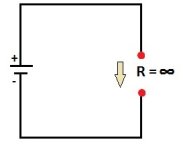
Rewind back to fall of 1992. This is my first semester at Ok State University pursuing my BS in Electrical Engineering Technology. The class was ECT1104. We were on the top floor of the Engineering North building. Our instructor was Richard Zmich. Richard was a very large man. I mean, possibly north of 400# large. Super nice guy and we all liked him as in instructor. He placed a diagram similar to this on the board with a 12 VDC source and asked "how much current is flowing?"

Screenshot 2025-10-27 154653.jpg

Several kids raised their hands and rattled off some goofy answers while a few of us remained without hands in the air to say "zero." After a few bad answers, Richard, said very loudly, "this is an OPEN circuit! Current can't jump .....(he jumped a couple feet across the floor with a huge bang and our desks shook)....and OPEN CIRCUIT!!!"

None of the kids in that class will EVER forget that story or the answer to that question. LOL I'm sure everyone on the second and first floors of that building was like just happened. It was a HUGE thud and everything shook. Good times, I tell ya, good times.

Now, we all know, with enough voltage...it quite possible will "jump and open circuit" but not under normal circumstances. ;)
 
No matter how perplexed that a "master electrician" has asked this question, it does allow me to tell a relevant story and I guarantee you that you will never forget the answer to the question again.

Rewind back to fall of 1992. This is my first semester at Ok State University pursuing my BS in Electrical Engineering Technology. The class was ECT1104. We were on the top floor of the Engineering North building. Our instructor was Richard Zmich. Richard was a very large man. I mean, possibly north of 400# large. Super nice guy and we all liked him as in instructor. He placed a diagram similar to this on the board with a 12 VDC source and asked "how much current is flowing?"

View attachment 2580273

Several kids raised their hands and rattled off some goofy answers while a few of us remained without hands in the air to say "zero." After a few bad answers, Richard, said very loudly, "this is an OPEN circuit! Current can't jump .....(he jumped a couple feet across the floor with a huge bang and our desks shook)....and OPEN CIRCUIT!!!"

None of the kids in that class will EVER forget that story or the answer to that question. LOL I'm sure everyone on the second and first floors of that building was like just happened. It was a HUGE thud and everything shook. Good times, I tell ya, good times.

Now, we all know, with enough voltage...it quite possible will "jump and open circuit" but not under normal circumstances. ;)

Actually, it's not that simple. Yes, the steady-state current will be zero, but the transient behavior getting there is different. For example, suppose the battery and the open location is separated by a distance of 1000 feet. When you connect up the battery to the wires, the battery has no way of knowing at that instant that there's an open circuit at the other end. To the battery, the pair of wires looks like a transmission line of some characteristic impedance Z. A step wave will go racing down the wires. About 1 microsecond later it gets to the open portion, where it is reflected back with the same amplitude but inverted in phase. This it cancels out the incident wave on the way back, resulting in the steady-state condition of I=0. This can be observed with a sufficiently fast oscilloscope.
 
Actually, it's not that simple. Yes, the steady-state current will be zero, but the transient behavior getting there is different. For example, suppose the battery and the open location is separated by a distance of 1000 feet. When you connect up the battery to the wires, the battery has no way of knowing at that instant that there's an open circuit at the other end. To the battery, the pair of wires looks like a transmission line of some characteristic impedance Z. A step wave will go racing down the wires. About 1 microsecond later it gets to the open portion, where it is reflected back with the same amplitude but inverted in phase. This it cancels out the incident wave on the way back, resulting in the steady-state condition of I=0. This can be observed with a sufficiently fast oscilloscope.
If you want to get way into the weeds, yes, but most would assume a question like that is asking for steady-state current. The question does not ask, "what is the transient behavior of the current pulse when connected to a battery 1000 feet away when the loop is open at the end." Not sure how many electricians have an actual engineering background and would even consider things like that. Zmich was teaching ECT1104, the very first electronics class at OSU so most of the kids couldn't even spell electricity then. His silly antics served their purpose. :cool:
 
If you want to get way into the weeds, yes, but most would assume a question like that is asking for steady-state current. The question does not ask, "what is the transient behavior of the current pulse when connected to a battery 1000 feet away when the loop is open at the end." Not sure how many electricians have an actual engineering background and would even consider things like that. Zmich was teaching ECT1104, the very first electronics class at OSU so most of the kids couldn't even spell electricity then. His silly antics served their purpose. :cool:
But jumping out into the weeds is what we do in here. :D
 
Top