does SCR phase angle firing promote arcing in machines?

Genepires

Member
Location
Washington state
Occupation
Electrician
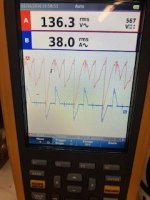
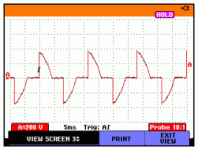
I work in a industrial facility with large 480v IR lamp ovens that are controlled with SCRs that use phase angle fired control for power to heaters like in this image. This 50% output
1767896016630.gif
we are getting arcing in various parts of the machine in connections that look tight. But maybe a ring terminal on wire that connects to a small bolt but the ring a little too big for bolt. On tight but maybe not the perfect mating of surfaces. or a wire whip in a screw tight connection.
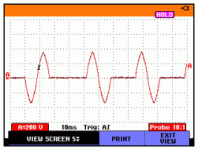
My question is, would this type of control with the abrupt change from 0 to potentially +- 280v be something that can promote arcing? Where a normal sine curve does not create arcing?

thanks
 
I think that the faster risetimes promoting arcing is a somewhat remote possibility. Can you measure the current waveforms with a suitable probe to see if any significant current peaking is occurring?

The fast risetimes would definitely create more high order harmonic content on the current that's drawn. That could be an issue for the facilty's power system, but not likely for the ovens themselves.
 
I took a oscope reading from one phase from one of the 8 scr banks. Red line is voltage and blue is current from same phase. It is interesting the wobbles near the peak current and the one spike mid way between positive and negative sections. I was thinking the spikes and dips may indicate arcing events but it could be an expected gating signature from scr. When I looked at other banks it looked similar. Kinda fun getting into the sorcery part of our trade.
 
I don’t know what is going on with my voltage lines. Maybe I got a bad location for the reference grounded leg on meter. For this fluke scope the voltage tip has an additional reference clip but I couldn’t reach a grounded terminal so I used a random screw on scr housing. Maybe that was a bad choice.
 
Scopes are very useful in real life but it can be tricky to understand what the data they present actually means. The ground lead reference point is very important if you want "cleaner" data. A big advantage of the fluke meters , ones that are battery operated, is their isolation from earth ground.
With common AC, w/ground line connected, scopes you need to be very careful where you connect the ground lead reference.
As was mentioned the phase firing is producing higher frequency harmonics. Scope leads are susceptible to induced artifacts and keeping the ground lead connection as short as possible helps.
 
Scopes are very useful in real life but it can be tricky to understand what the data they present actually means. The ground lead reference point is very important if you want "cleaner" data. A big advantage of the fluke meters , ones that are battery operated, is their isolation from earth ground.
With common AC, w/ground line connected, scopes you need to be very careful where you connect the ground lead reference.
As was mentioned the phase firing is producing higher frequency harmonics. Scope leads are susceptible to induced artifacts and keeping the ground lead connection as short as possible helps.
I agree that my ground was probably a poor choice. will try again to a actual grounded point today if I have the time. thanks!
 
Phase angle firing of SCRs for voltage control requires an RC snubber across each SCR to avoid the ringing effect of turning on the SCR abruptly. That could conceivable cause a higher than normal voltage in those instances I suppose, but I'm not clear on how that would translate to arcing on things like over sized ring terminals. The voltage ring transient would not be much higher than the line voltage.

But I have never seen an SCR controller that did not have snubbers, because without it, that can cause the SCRs to self commutate (fire when not told to) as well. Did someone fabricate the controller without this knowledge? If so, this will not be your only problem.
 
I’ll have to do some research on these snubbers. The scr is from avatar industries so if they are standard then I assume it has some. Will check though. Thanks!
I'd be interested in a schematic? Or pics of how this is arranged. I'm surprised no EEs are mentioning the fact that what I see is possibly poor gate drive dynamics. Think of the gate drive of the SCR as a light switch, but it 'can' behave more like a potentiometer. I have no idea of the typical duty cycles here, or even the heat sinking of the SCRs, but sort of points to either poor design, or poor tuning.

And I only say that from the first pic, which tells me little. I just see a nasty WFO rise. Now, you 'can' snub that with inductance, but looking at proper SCR drive would be the first line.

What I have seen is drive circuits not well matched to the SCRs. They get replaced, etc. This goes back to days working on aerospace GPUs, which are huge DC power supplies.

As for arcing..... I'd like to see a pic of that. Amps are amps, but when combined with high voltage, any poor quality connection would step in front quickly. As I've seen in heating equipment like this, they tend to use pretty "slim margin" components. IE, use a 15A rated connector at 14A, leaving no margin for ANY resistance without going nuclear. Heating equipment can suffer from heat cycle stress.
 
Top