
Dripping wet inside a commercial meter cabinet. Really wet.

Merry Christmas

brycenesbitt

Senior Member
Location
United States
Saw something odd today. I was taking a second look at a panel I'd designed for earlier.
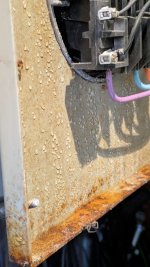
But this time there was water between many of the seams, and a puddle on the floor. I open the CT cabinet
and find:
PXL_20251205_214238432.jpg

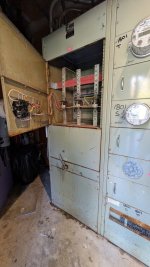
It's a 1000A panel with a 400A CT section.

Outside temperature was about 45F, pretty cold for the region. The install is at sea level.
The cabinet top, ceiling were dry, and all conduit entry well below point with water. Other sections in the same cabinet were unaffected.
Yet all the seams showed a lot of rust, as if this was not the first water rodeo:
PXL_20251205_212146873.jpg


I guess this can't be normal, is it common? Is there a code/listing legal way to prevent this?
 
looks like high humidity air entering the service entry section and condensing, due to temperature in the service room falling below the condensing temperature point.
Solution would be to close off the outside air entry point into the service entry section or provide heat to keep it above the condensing temperature point

Reminds me of a earth buried well pump building, dripping from the ceiling, but the pipes never froze and broke because it was buried deep enough to be below the seasonal frost line. Adding a heater helped but without any air exchange with outside or another dryer space it never dried out fully any time of year, unless you left the door open for days. but when closed up, the cold water lines would drip constantly with condensation. The eventual fix for the electrical gear was to remote it underground to a different nearby building.
 
Humid air entering through the conduits. Seal them all. If any are routed underground, the air in them is ground temp and likely saturated. When it hits the 45 degree enclosure, it condenses.
 
At first glance of the title, for a minute i thought i ended up at the wrong website 😂
A clean mind is a clean keyboard :)

OP here. This cabinet serves an office complex and is within the thermal envelope of the office structure. The conduits head to other buildings and outside for solar. Construction date in the 1970's.

This meter cabinet has three sections. Two of them have factory air vent louvers. This third section has no vents from the factory.
In addition to adding duct seal to the conduits in, we discussed both adding drylok paint to the concrete below to reduce moisture drive AND adding vents.

But adding vents risks the AHJ complaining about violating the listing of the original panel. We're in an area where pragmatic solutions are generally met with resistance.

The rust on the metal folds says this is not the first time the panel has become damp. Damp can't be good. The local AHJ also only allows duct seal on one side of the conduit, so moisture can escape. In some cases both conduit ends are potentially affected by the humidity, as it goes from occupied office space to another building that's occupied. There's no evidence the conduit is compromised -- it's all sch80 PVC 2" to 3".
 
Last edited:
You have to consider atmospheric pressure inside the building where the gear is. If there are exhaust fans making the building pressure slightly negative, it will draw in outside humid air through all conduits from outside to inside. Having slightly positive building pressure pushes air outward thru the conduits. As long as the inside air exiting remains dryer than outside air, no condensation will form in the conduits or gear enclosures as it is exiting. This problem can be excessive when there are fans pulling air out of the building and there lacks a air make up system to replace the air being drawn out.

restaurants with lots of hood exhaust, industrial units with dust collectors or spray booths or other similar occupancies with lack of the proper make up air supply to keep the building envelope slightly positive with dry air pressure. Prevailing wind pressures over the building can also be a factor in certain conditions.

Duct sealing inside conduits can also be a big help, reducing the the need for as much make up air. Temperature between inside and outside air also plays an effect. I have seen sealed control enclosures get flooded inside them when there was a large dust collector servicing the building and the air balance system was negative from improper balancing. Walk in freezers and coolers also experience these type problems. It is often never thought of, until condensation and frost start causing problems.
 
Top