Dryer receptacles Grounding Question

Status
Not open for further replies.
I have recently purchased a home and noticed that the dryer receptacle is extremely close to the hose-bib - and I wanted to move the dryer receptacle further away from the water source.

In doing so, my washer has a 4-prong plug, and I had a 4 prong (X,Y,N, and EGC) receptacle. The existing wiring to the 3 prong (X,Y,N) that I needed to remove.

My train of thought:

I have removed the 3 prong plug and relocated the wiring (X,Y, N) to my preferred location and have landed the existing wires on the appropriate terminals of the new receptacles. I have then ran a #10 Equipment grounding conductor in parallel with the feeds (as it was the only new termination left).

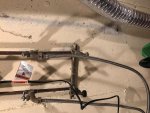
Question: I have ran the Equipment grounding conductor (new #10 wire) to an existing ground wire that is bonded to the water pipes (which is eventually grounded when it goes outside). Is it an issue that this Equipment grounding conductor does not go back to the panel where it is fed, or is it OK as long as it's connected to ground at a location?
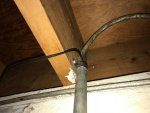

Pic.jpg
Pic2.jpg
 
doesnt sound to be to-code, but now safer ;)
 
Question: I have ran the Equipment grounding conductor (new #10 wire) to an existing ground wire that is bonded to the water pipes (which is eventually grounded when it goes outside). Is it an issue that this Equipment grounding conductor does not go back to the panel where it is fed, or is it OK as long as it's connected to ground at a location?

Yes, I believe that is legal if I am reading this correctly.

You connected your EGC to the GEC that goes to a water pipe that is an electrode.

NEC 250.130(C)(2)(C) Nongrounding Receptacle Replacement or Branch
Circuit Extensions. The equipment grounding conductor
of a grounding-type receptacle or a branch-circuit extension
shall be permitted to be connected to any of the following:

(2) Any accessible point on the grounding electrode conductor
 
I don't completely understand the issue with receptacle too close to hose bib.

Many water leaks spray in fan or cone shape. So the closer to the source the receptacle is, the less likely to get sprayed.

Unless directly beneath hose bib where a drip could be a problem? :?
 
I have recently purchased a home and noticed that the dryer receptacle is extremely close to the hose-bib - and I wanted to move the dryer receptacle further away from the water source.

In doing so, my washer has a 4-prong plug, and I had a 4 prong (X,Y,N, and EGC) receptacle. The existing wiring to the 3 prong (X,Y,N) that I needed to remove.

My train of thought:

I have removed the 3 prong plug and relocated the wiring (X,Y, N) to my preferred location and have landed the existing wires on the appropriate terminals of the new receptacles. I have then ran a #10 Equipment grounding conductor in parallel with the feeds (as it was the only new termination left).

Question: I have ran the Equipment grounding conductor (new #10 wire) to an existing ground wire that is bonded to the water pipes (which is eventually grounded when it goes outside). Is it an issue that this Equipment grounding conductor does not go back to the panel where it is fed, or is it OK as long as it's connected to ground at a location?


View attachment 18831
View attachment 18830

That clamp is not for grounding, just securing the pipe. You at least need to get the proper clamp.
 
I have recently purchased a home and noticed that the dryer receptacle is extremely close to the hose-bib - and I wanted to move the dryer receptacle further away from the water source.

In doing so, my washer has a 4-prong plug, and I had a 4 prong (X,Y,N, and EGC) receptacle. The existing wiring to the 3 prong (X,Y,N) that I needed to remove.

My train of thought:

I have removed the 3 prong plug and relocated the wiring (X,Y, N) to my preferred location and have landed the existing wires on the appropriate terminals of the new receptacles. I have then ran a #10 Equipment grounding conductor in parallel with the feeds (as it was the only new termination left).

Question: I have ran the Equipment grounding conductor (new #10 wire) to an existing ground wire that is bonded to the water pipes (which is eventually grounded when it goes outside). Is it an issue that this Equipment grounding conductor does not go back to the panel where it is fed, or is it OK as long as it's connected to ground at a location?

No, sorry.

If you have an older home with a 3 prong dryer or range receptacle that was installed when the Code was in effect that allowed the neutral and EGC to be combined on a branch circuit run with SE cable (as you have there) from the main panel, you may continue to use it provided you make no changes, use a 3 wire dryer cord and strap the neutral to G on the terminal board where the cord connects to the appliance.

(I believe beginning with the 1968 Code cycle) a 4 prong plug must be used fed with a cable having a separate insulated neutral with a ground. It can also originate from a main panel or a sub panel. However the 3 prong wiring is grandfathered as long as you comply with the above.

So since you want to move the location as well as replace the receptacle the only legal way now for you is to replace the run with 10/3 Romex back to the panel. Then you can put the new 4 prong receptacle any place you want and use a 4 wire cord on your dryer.

-Hal
 
Last edited:
No, sorry.

If you have an older home with a 3 prong dryer or range receptacle that was installed when the Code was in effect that allowed the neutral and EGC to be combined on a branch circuit run with SE cable (as you have there) from the main panel, you may continue to use it provided you make no changes, use a 3 wire dryer cord and strap the neutral to G on the terminal board where the cord connects to the appliance.

(I believe beginning with the 1968 Code cycle) a 4 prong plug must be used fed with a cable having a separate insulated neutral with a ground. It can also originate from a main panel or a sub panel. However the 3 prong wiring is grandfathered as long as you comply with the above.

So since you want to move the location as well as replace the receptacle the only legal way now for you is to replace the run with 10/3 Romex back to the panel. Then you can put the new 4 prong receptacle any place you want and use a 4 wire cord on your dryer.

-Hal
3 wire (using neutral conductor as the EGC to the frame of ranges and dryers) Was allowed for most installs until the 1996 code.
 
Is that even SE cable?

No, I am not sure what type of cable it is. I want to say "Romex" but it wasn't the typical yellow sheathing I'm used to seeing. When I cut through it, it was like cutting through a fabric with some strings woven through. I'm sure any insulation that was rubber-y (not sure if that's a word) has seen it's days.

The previous installation did have a small bare ground wire that was on the receptacle but it tied into the exact same thing that I tied into in the previous picture. So, if the best thing at this point is to run a new 10/3 romex (2 hots, 1 N, and the EGC) and land the new EGC back at the panel, that's what I'll do.

My only other thought is - why can't I just run my new EGC (the black wire in the picture) back to the ground in the panel and then that would essentially be the same as a new 10/3 Romex.

Also - for the gentlemen asking why I'm moving my receptacle in the first place. If you see the last picture on this post, you can see where the old 3 prong plug was located. In my opinion, awful place to have it. I have moved it further along the wall away from potential water spray.

Also - I'm very happy with the dialog on this post. Glad people care about this stuff as much as I do.

Thanks.
pIC 4.jpg
pIC 5.jpg
 
No, I am not sure what type of cable it is. I want to say "Romex" but it wasn't the typical yellow sheathing I'm used to seeing. When I cut through it, it was like cutting through a fabric with some strings woven through. I'm sure any insulation that was rubber-y (not sure if that's a word) has seen it's days.

The previous installation did have a small bare ground wire that was on the receptacle but it tied into the exact same thing that I tied into in the previous picture. So, if the best thing at this point is to run a new 10/3 romex (2 hots, 1 N, and the EGC) and land the new EGC back at the panel, that's what I'll do.

My only other thought is - why can't I just run my new EGC (the black wire in the picture) back to the ground in the panel and then that would essentially be the same as a new 10/3 Romex.

Also - for the gentlemen asking why I'm moving my receptacle in the first place. If you see the last picture on this post, you can see where the old 3 prong plug was located. In my opinion, awful place to have it. I have moved it further along the wall away from potential water spray.

Also - I'm very happy with the dialog on this post. Glad people care about this stuff as much as I do.

Thanks.
View attachment 18834
View attachment 18835
"Romex" is on particular manufacturers trademarked name for what NEC calls Non metallic sheathed cable (NM).

All NM cable has had a plastic sheath for 40-50 possibly even 60 years now. What you have is just an old version but still was NM cable for NEC purposes. Some other changes to the basic construction of NM cable has happened over the years as well, in particular temperature rating is now 90 degrees C instead of 60, a little different kind of plastic is used to get this.
 
The previous installation did have a small bare ground wire that was on the receptacle but it tied into the exact same thing that I tied into in the previous picture. So, if the best thing at this point is to run a new 10/3 romex (2 hots, 1 N, and the EGC) and land the new EGC back at the panel, that's what I'll do.

The last picture you posted is telling. All the way on the right (and partially out of frame) is what looks like a piece of the old cable that you cut off with a stripped end. I see a black, white and red making it an old version of Romex. However the ground wire is not visible, and by your own admission it is reduced size as was typical back then. If it were full size you would be good to go. And from what you say it sounds like the old receptacle was improperly wired if the ground was landed on the receptacle neutral instead of the box.

So it looks like you have an open unfinished basement and it should be easy enough to re-run with new Romex. If it were me it would be done in the time it took to write all of this. :happyyes:

-Hal
 
"Romex" is on particular manufacturers trademarked name for what NEC calls Non metallic sheathed cable (NM).

All NM cable has had a plastic sheath for 40-50 possibly even 60 years now. What you have is just an old version but still was NM cable for NEC purposes. Some other changes to the basic construction of NM cable has happened over the years as well, in particular temperature rating is now 90 degrees C instead of 60, a little different kind of plastic is used to get this.
NM with that type of jacket was still being sold in the late 60s when I was working at a local hardware store. That type also did not have a full sized EGC.
 
Well if it is not, I am retracting my answer.

I assumed SE cable, 2 H+1N, and OP wanted to add an EGC.

I can not really tell much from pics. The sideways orientation makes me dizzy.:)

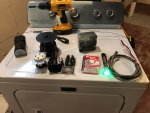
I assumed that also. But look at the scrap sitting on the right top corner of the dryer.

-Hal

attachment.php
 
Okay, I am not sure what that is but I see 2H+1N, if there is an EGC, reduced as mentioned, I am missing it.

If there was no EGC, then a separate EGC could be run.

I'm not seeing the EGC either unless the OP pulled it out and that's it lying at the back of the dryer behind the drill.

Since we got the type of cable squared away yeah, you could run a separate EGC back to the panel. But if you were going to do that why not do it right and re-run? Just as much work maybe less because you pull the old out and reuse the holes.

-Hal
 
I believe you could do either. Run a proper size ground #10 or # 12 minimum (the color should be green not black) to the equipment grounding electrode or run a new 10/3 romex back to the panel. I am assuming at minimum your electrical panel is properly grounded. i.e. A ground rod or a cold water pipe bond.


Sent from my iPad using Tapatalk
 
Status
Not open for further replies.
Top