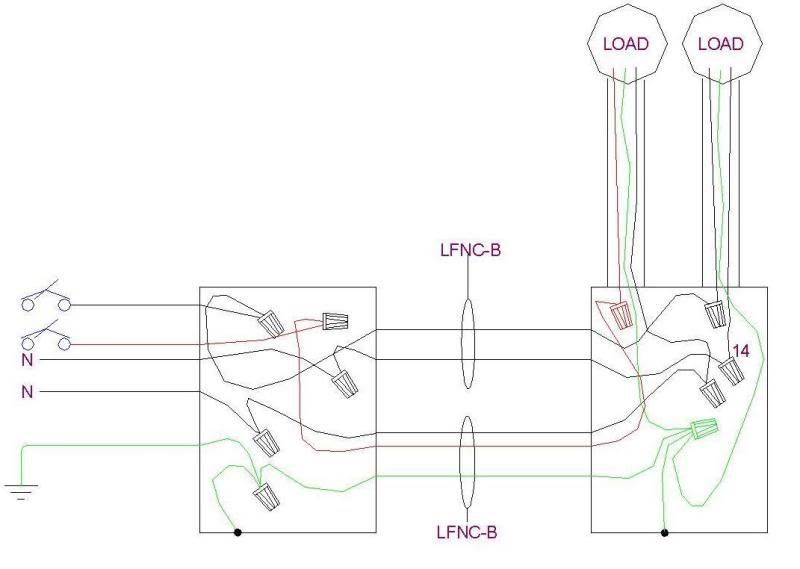
EGCs run in each raceway?

Merry Christmas
Status
Not open for further replies.

Twoskinsoneman

Senior Member
Location
West Virginia, USA NEC: 2020
Occupation
Facility Senior Electrician
Got a situation where two LFNC-B raceways are run from a load panel to a junction box. I believe the NEC says I have to have an EGC in each of these. (some body give the ref I don't have it yet)
What is the point? If the EGC is in one but not the other everything required can still be grounded...
 
. . . some body give the ref I don't have it yet. . .
250.122(F).

I can't give you the reason for certain. I think it is something along the following lines: If a ground fault takes place within one conduit, you want a full-size EGC readily available to carry the fault current back to the source, so that the overcurrent device can trip to quickly terminate the fault.
 
250.122(F).

I can't give you the reason for certain. I think it is something along the following lines: If a ground fault takes place within one conduit, you want a full-size EGC readily available to carry the fault current back to the source, so that the overcurrent device can trip to quickly terminate the fault.

This talks about parallel conductors but I'm refering to two separate raceways carrying different circuits run from one box to another.
 
250.122(F).

I can't give you the reason for certain. I think it is something along the following lines: If a ground fault takes place within one conduit, you want a full-size EGC readily available to carry the fault current back to the source, so that the overcurrent device can trip to quickly terminate the fault.

Thats what I was always taught, Charlie. I saw a illustration once of one parallel conduit being struck by a back hoe..the result being a accidental connection between the eq' ground and phase conductor on the "downstream" side. Were it nor for the parallel grounding, the load ground would have been energized. Not too far fetched from damaged wiring I've seen.
 
300.3(B) All conductors of the same circuit and where used, the grounded conductor and equipment grounding conductors, and bonding conductors shall be contained in the same raceway...
The ground needs to be in both conduits.
 
. . . I'm refering to two separate raceways carrying different circuits run from one box to another.
Sorry. I misunderstood the question.

How about 300.3(B)? You have a raceway, and the circuit(s) it contains must have an EGC, and that EGC must be within the same raceway as the circuit conductors. You have a second raceway, and the circuit(s) it contains must also have an EGC, and that EGC must be within the same raceway as the the second set of circuit conductors. The fact that the two raceways terminate in the same junction box does not change the requirement to have the circuit conductors and the EGC in the same raceway.

Does that work for you? Did I get the situation right this time?

If so, I think the reason is simply that if you eliminate one circuit, and remove its conductors, the circuit within the other raceway must still be complete and intact in its own right.
 
Yea, what Rick said. :roll:

I wonder if my priviledges as a Moderator include the ability to lock out a thread while I am typing a reply, to prevent anyone else from giving the same reply before I am ready to post mine. :-? :D
 
Sorry. I misunderstood the question.

How about 300.3(B)? You have a raceway, and the circuit(s) it contains must have an EGC

Trying to get technical to deffend my position. Where does 300.3 (B) say you have to have an EGC in the raceway in the first place? it says "where used, the grounded conductor". From that I don't see a REQUIREMENT to run an EGC with each circuit. Everything required to be grounded is grounded.

I understand your position and it is mine also. But I can't find support for it.
 
If your installation is one that does not require an EGC, or one for which the raceway itself can be credited as the EGC, then I know of no rule that would require you to run an EGC in either raceway, let alone a separate EGC in both raceways. If that constitutes agreeing with your position, then I agree.

However, in your specific example, the raceway could not qualify as an EGC. Is there something about the installation that allows it to exist without having any EGC run from the source to the load? I can't think of any example of such an installation myself.
 
Everything required to be grounded is grounded.
May I ask what this means? "Grounded," as in "connected to planet Earth," or as in "bonded to all nearby metal," or as in "connected to the N-G bond point at the main panel by way of a conductor intended to carry fault current back to the source in the event of a ground fault"?
 
If your installation is one that does not require an EGC, or one for which the raceway itself can be credited as the EGC, then I know of no rule that would require you to run an EGC in either raceway, let alone a separate EGC in both raceways. If that constitutes agreeing with your position, then I agree.

However, in your specific example, the raceway could not qualify as an EGC. Is there something about the installation that allows it to exist without having any EGC run from the source to the load? I can't think of any example of such an installation myself.

Why does the circuit it'self need an EGC? The equipment it is connected to is grounded by an EGC in another raceway?
 
You have me confused. :-? What is in each of the two LFNC raceways? Each has its own circuit, and the circuits feed different equipment, is that not right? Are you suggesting that the EGC protecting one item of equipment can also be used to protect another, if the two are bonded to each other? :-?

Back to basics.
Why does the circuit it'self need an EGC? The equipment it is connected to is grounded by an EGC in another raceway?
Start at the equipment. It has conductors that supply it power. Those conductors are in a raceway. Is there, or is there not, an EGC in that raceway? If not, then you have a violation of 300.3(B).
 
If all the conductors were in one raceway one grounding conductor could serve all circuits ,. but in this case there are two raceways to one junction box ,..so I think his question is can one EGC serve the circuits of both raceways ??
 
You have me confused. :-? What is in each of the two LFNC raceways? Each has its own circuit, and the circuits feed different equipment, is that not right? Are you suggesting that the EGC protecting one item of equipment can also be used to protect another, if the two are bonded to each other? :-?

Back to basics.
Start at the equipment. It has conductors that supply it power. Those conductors are in a raceway. Is there, or is there not, an EGC in that raceway? If not, then you have a violation of 300.3(B).

Here's a pic of the ciruit in question. How do I prove that the second raceway NEEDS an EGC

circuit.jpg
 
Here's a pic of the ciruit in question. How do I prove that the second raceway NEEDS an EGC
Nice picture. It explains everything.

The top conduit contains circuit conductors that supply the right hand load. That load needs an EGC, in order to protect its user from a ground fault. I agree with you that, since the right hand load has a connection within the junction box to the EGC that runs in the lower conduit, it will have the necessary protection. However, 300.3(B) still requires the EGC serving the right hand load to be within the top conduit, as it requires the EGC to be in the same conduit as the circuit conductors, wherever those circuit conductors are routed.

Are you asking why 300.3(B) has that requirement? My best guess is that someday they may eliminate the left hand load, and remove the lower conduit. If the upper conduit does not have its own EGC, then it will be left without protection.
 
give him a little quiz based on 2002 still applicable in you case ,..I think

http://ecmweb.com/nec/Code-Quiz-40423/

In general, under what condition in an alternating current feeder or branch circuit is an equipment grounding conductor permitted outside of a cable or raceway?

A) under no condition
B) as part of a high-impedance grounded neutral system
C) on ground-fault circuit interrupter protected circuits
D) any time

Answer: A.......


....It has been proven that separating the equipment grounding conductor from the circuit conductors greatly increases the impedance of the circuit. Separation of these conductors will increase the inductive reactance of an AC circuit, which increases grounding circuit conductor impedance values. The impedance of the equipment grounding conductor of a circuit should be kept as low as practicable. Excessive separation can render an adequately sized equipment grounding conductor ineffective in carrying enough current to operate the circuit overcurrent protective device in a reasonable amount of time to clear the fault.
 
Because the equipment on the right is connected by permanent wiring methods, Section 250.110 (2005) requires it to be grounded. One of the methods permitted for grounding this equipment is by providing a connection to an equipment grounding conductor routed with the circuit conductors per 250.134(B). The raceway from the panelboard to the junction box, for the load on the right side of the picture, does not include an equipment grounding conductor and is in violation of 250.134.
 
More ammo

http://74.125.47.132/search?q=cache...e+holt&hl=en&ct=clnk&cd=3&gl=us&client=safari

Sections

250.134 Grounding (Bonding)?Fixed Equipment.

Metal parts of fixed electrical equipment, raceways, and enclosures must be grounded (bonded) to an effective ground-fault current path in accordance with (A) or (B), except where they are grounded (bonded) to the grounded neutral conductor as permitted by 250.142.

(A) Equipment Grounding (Bonding) Types. Metal parts of fixed electrical equipment, raceways, and enclosures can be grounded (bonded) by any of the equipment grounding (bonding) types specified in 250.118.

(B) With Circuit Conductors. Where an equipment grounding (bonding) conductor of the wire type provides the effective ground-fault current path, it must be installed with the circuit conductors in the same raceway, cable tray, trench, cable, or cord. Figures 250?179 and 250?180

Exception 1: The equipment grounding (bonding) conductor can be run separately from the circuit conductors when necessary to comply with 250.130(C).

FPN No. 1: Where the equipment bonding jumper is installed outside a raceway, its length must not exceed 6 ft and it must be routed with the raceway [250.102(E)].
 
Status
Not open for further replies.
Top