tomahawk44
Member
- Location
- Chicago, IL
- Occupation
- Installer
I'm working (I'm not lead but I don't want to speak out of turn if my line of thought is totally off kilter) to help expand three different solar setups (all residential, 200A service 200a panels). They all have similar conditions in that they have existing solar setups. Each location either maxed out of solar panel roof space or they have no interest in adding more. The only thing we are doing is adding more battery capacity. Two of them are pretty straight forward because we we're just expanding like with like, more of the same brand batteries EG4 in one location and Enphase for another. We don't have to add additional inverters.
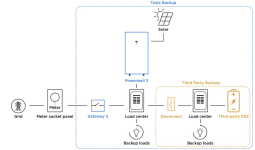
The third I'm less sure about has a solar setup with Powerwall 3s, 1 powerwall leader + 3 powerwall expansions. It's setup with the leader connected to main panel and the tesla backup switch between the meter and the main panel (which gives them a whole house backup). Because they are at max expansion capacity for their first leader, I'm pretty sure this means we need to add new leader and probably ac combine both of them to a gateway. However, the HO wants to use EG4 server batteries, which works out for us because we rather not have to deal with the liability of fiddling or modifing the existing setup if possible. The Tesla design spec is to cascade 3rd party solutions at the panel the Powerwalls are tied into (or put an independent system if the gateway/switch is after the main panel and the PW is on critical load panel). This means we're probably looking at something like
current system
meter----> backup switch-----> main panel--(60A breaker, 48A nameplate)---> powerwall leader----> powerwall expansion
Due to existing continuous loads (which total 40A ish nameplate), I believe the plan was to put an ac combiner panel after the main panel (either 100A or 60A), then have the load panel after the inverters and move existing loads from the main panel to the load panel.
so branching off
meter----> backup switch-----> main panel--(60A breaker, 48A nameplate)---> powerwall leader----> powerwall expansion
main panel ----> ac combiner ---(derate breaker and inverters if necessary)--> 3rd party inverters-----> batteries
inverters---> inverter combiner ----> load panel
Does this look right? I'm assuming the thought is that by nesting continuous loads to their own panel downstream of the inverters this avoids counting the ac combiner and existing continuous loads together.
If this is the thought, is this the only way to address the issue?
The third I'm less sure about has a solar setup with Powerwall 3s, 1 powerwall leader + 3 powerwall expansions. It's setup with the leader connected to main panel and the tesla backup switch between the meter and the main panel (which gives them a whole house backup). Because they are at max expansion capacity for their first leader, I'm pretty sure this means we need to add new leader and probably ac combine both of them to a gateway. However, the HO wants to use EG4 server batteries, which works out for us because we rather not have to deal with the liability of fiddling or modifing the existing setup if possible. The Tesla design spec is to cascade 3rd party solutions at the panel the Powerwalls are tied into (or put an independent system if the gateway/switch is after the main panel and the PW is on critical load panel). This means we're probably looking at something like
current system
meter----> backup switch-----> main panel--(60A breaker, 48A nameplate)---> powerwall leader----> powerwall expansion
Due to existing continuous loads (which total 40A ish nameplate), I believe the plan was to put an ac combiner panel after the main panel (either 100A or 60A), then have the load panel after the inverters and move existing loads from the main panel to the load panel.
so branching off
meter----> backup switch-----> main panel--(60A breaker, 48A nameplate)---> powerwall leader----> powerwall expansion
main panel ----> ac combiner ---(derate breaker and inverters if necessary)--> 3rd party inverters-----> batteries
inverters---> inverter combiner ----> load panel
Does this look right? I'm assuming the thought is that by nesting continuous loads to their own panel downstream of the inverters this avoids counting the ac combiner and existing continuous loads together.
If this is the thought, is this the only way to address the issue?
![GUID-D9E74F5A-9475-49E9-8947-E16E2BC7729C-online-en-US[1].png](https://forums.mikeholt.com/data/attachments/45/45120-7589cd259ed6742ca9357911bbab6fef.jpg "GUID-D9E74F5A-9475-49E9-8947-E16E2BC7729C-online-en-US[1].png")