I'm trying to understand why the inspector doesn't approve the feeder wire with how we have a 100A breaker in the main panel and also a 100A main breaker in the sub panel. To me it looks like with how we are trying to get it approved looks like it satisfies 705.12. I attached some sketches.

You are using an out of date browser. It may not display this or other websites correctly.
You should upgrade or use an alternative browser.
You should upgrade or use an alternative browser.
Grid Tied PV System Feeder Tap
- Thread starter mtthhrs
- Start date

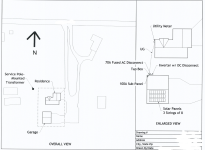
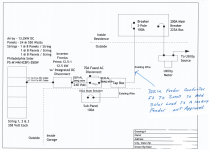
For this job it may not be worth pushing to get it approved since we don't have that far to trench to the main breaker panel and just running a separate wire. But I still want to understand if it should be accepted or not.
jaggedben
Senior Member
- Location
- Northern California
- Occupation
- Solar and Energy Storage Installer
Your tap is fine but at the main panel you still need to satisfy the 120% rule, or another rule, or use a Power Control System. The drawing doesn't show how you would be doing this.
jaggedben
Senior Member
- Location
- Northern California
- Occupation
- Solar and Energy Storage Installer
If 'too small to add solar load' is the inspector's words, that's incorrect reasoning, because the solar isn't a load.
That's correct he was calling it a load and I explained it to him that it isn't a load and it only produces power. But I didn't get anywhere. In the Main panel I would be satisfying the 120% rule I believe if the main bus is 225Amps x 1.2 = 270amps that allows me 70amps which is what my fused disconnect would be sized at. I would move the 100amp breaker going to the subpanel down to the bottom.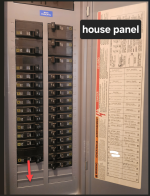
We did check and it is 2awg aluminum, which technically would only be rated as 90amps but even if we offered to switch the 100amp breakers to 90 amp that would not have satisfied him. Somehow he thinks that has to multiply the breaker amperage by another 125%. So his theory was 100amps x 125% then you would need 2/0 Aluminum. Which in my opinion makes no sense.
ggunn
PE (Electrical), NABCEP certified
- Location
- Austin, TX, USA
- Occupation
- Consulting Electrical Engineer - Photovoltaic Systems
This. Does the inspector believe that current can flow both ways in a conductor? As long as your inverter's max output current is less than 80A, and it is, and the feeder then the feeder is fine. You have 100A OCP on both ends; if the feeder wire is protected by the OCP, then I do not see a problemIf 'too small to add solar load' is the inspector's words, that's incorrect reasoning, because the solar isn't a load.
jaggedben
Senior Member
- Location
- Northern California
- Occupation
- Solar and Energy Storage Installer
Don't know how I missed the 225A bus earlier. I think your design is fine.
Yeah 2awg AL is rated 90A at 75C, which means to be proper you'd downsize the 100A breakers to 90A, and do a load calc to show the calculated load is less than that. (Or upgrade the feeder, say to 3awg copper). But it'd be really unusual if the load on that panel was all continuous, meaning it does not need a 125% factor. The solar does require the 125% factor, but that already comes out to only 70A so the 2awg al is still fine for that. These requirements do not need to be added together when you have overcurrent protection at all three ends, so whichever requirement is more is the one that rules.
Sounds like this inspector doesn't have a good grasp of the code or electrical theory. Maybe show them all of our posts except where I said that. Good luck.
Yeah 2awg AL is rated 90A at 75C, which means to be proper you'd downsize the 100A breakers to 90A, and do a load calc to show the calculated load is less than that. (Or upgrade the feeder, say to 3awg copper). But it'd be really unusual if the load on that panel was all continuous, meaning it does not need a 125% factor. The solar does require the 125% factor, but that already comes out to only 70A so the 2awg al is still fine for that. These requirements do not need to be added together when you have overcurrent protection at all three ends, so whichever requirement is more is the one that rules.
Sounds like this inspector doesn't have a good grasp of the code or electrical theory. Maybe show them all of our posts except where I said that.
Good luck.ggunn
PE (Electrical), NABCEP certified
- Location
- Austin, TX, USA
- Occupation
- Consulting Electrical Engineer - Photovoltaic Systems
Waited too long to save my edit.This. Does the inspector believe that current can flow both ways in a conductor? As long as your inverter's max output current is less than 80A, and it is, and the feeder then the feeder is fine. You have 100A OCP on both ends; if the feeder wire is protected by the OCP, then I do not see a problem
Does the inspector believe that current can flow both ways in a conductor? As long as your inverter's max output current is less than 80A, and it is, and the feeder is #2 Al, then the feeder is fine. You have 100A OCP on both ends; the feeder wire is protected by the OCP. It is the inverter output Imax that you need to multiply by1.25, not the breaker rating.
52.1 X 1.25 = 65A. Assuming a 104 degree F max temp and no more than 3 CCC's in the conduit the 90 degree ampacity of #2 Al is 91A and the 100A breaker protects it by the "round up" rule, Assuming continuous use the 75 degree ampacity exceeds 65A. I do not see the problem.
ggunn
PE (Electrical), NABCEP certified
- Location
- Austin, TX, USA
- Occupation
- Consulting Electrical Engineer - Photovoltaic Systems
Simultaneously, I mean. I once had an inspector fail a project of mine that was wired similarly to yours because he added the current from the PV system with the current to the loads and declared the feeder to be overloaded. He was a master electrician who did not understand basic electrical theory.Does the inspector believe that current can flow both ways in a conductor?