
Ground Rod Resistance

Dennis Alwon

Moderator
Staff member
Location
Chapel Hill, NC
Occupation
Retired Electrical Contractor
I have done a 3 point or fall of potential test on ground rods. The one I did was not connected to the service neutral. Just had rods in the earth without the conductor.

Are there tests that test the rods while connected to the service neutral. Imo, that defeats the purpose and it is not testing the rods. I heard one electrician say he uses the entire system to get his 25 ohms. Is that correct?

Are there any tests for ground rod resistance where you are connected to the service neutral? Here is what I did
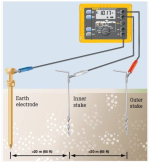
1769518831252.png
 
The 'fall of potential' test measures the resistance of the rod on its own. The rod must be disconnected from the service neutral and other electrodes to get a useful measurement of the rod on its own.

But there is an approach that can work for a connected rod. Remember that a resistance measurement is all about injecting current and measuring voltage (or applying voltage and measuring current).

Think about the circuit formed by the rod that you want to test, the interconnecting GEC, EGC, and neutral conductors, and all of the other electrodes connected to the system and pounded into the earth. You can use a clamp on transformer to couple voltage to the electrode under test, and a clamp on CT to measure the current flow, and measure the impedance of this 'electrode and soil' circuit. Pick the correct point to make your measurement and this impedance will be dominated by the single electrode you wish to test.

You can buy clamp on instruments that do exactly this sort of testing. See https://forums.mikeholt.com/threads/clamp-on-ground-resistance-testing.2574298/ for an extensive discussion. Note: I participated in that discussion and I understand the theory of the instruments...but I've not had occasion to use them.

-Jonathan
 
The 'fall of potential' test measures the resistance of the rod on its own. The rod must be disconnected from the service neutral and other electrodes to get a useful measurement of the rod on its own.

But there is an approach that can work for a connected rod. Remember that a resistance measurement is all about injecting current and measuring voltage (or applying voltage and measuring current).

Think about the circuit formed by the rod that you want to test, the interconnecting GEC, EGC, and neutral conductors, and all of the other electrodes connected to the system and pounded into the earth. You can use a clamp on transformer to couple voltage to the electrode under test, and a clamp on CT to measure the current flow, and measure the impedance of this 'electrode and soil' circuit. Pick the correct point to make your measurement and this impedance will be dominated by the single electrode you wish to test.

You can buy clamp on instruments that do exactly this sort of testing. See https://forums.mikeholt.com/threads/clamp-on-ground-resistance-testing.2574298/ for an extensive discussion. Note: I participated in that discussion and I understand the theory of the instruments...but I've not had occasion to use them.

-Jonathan
I have one of those clamp on testers, they are great for testing systems already connected to the utility, for existing grounding electrodes, or new adding ones, but don’t work for new installs where utility is not connected. I have cheated, and ran a #6 over to a nearby utility pole and tapped to the pole ground. Not as accurate, but does give me an idea of how good the grounding electrode is.
 
I have one of those clamp on testers, they are great for testing systems already connected to the utility, for existing grounding electrodes, or new adding ones, but don’t work for new installs where utility is not connected. I have cheated, and ran a #6 over to a nearby utility pole and tapped to the pole ground. Not as accurate, but does give me an idea of how good the grounding electrode is.

So with the clamp on system you are not getting lower readings than say from a fall of potential reading. Not sure I can understand the physics of how that works. I believe it works but is it accurate
 
So with the clamp on system you are not getting lower readings than say from a fall of potential reading. Not sure I can understand the physics of how that works. I believe it works but is it accurate
I'm sure that this is real but the entire subject seems to be hocus pocus. Don't try this at home but a few decades ago we would remove the GEC to the rod and put in on a 20 amp breaker. Turn it on and read the current on the GEC. Ohms law find the resistance. Proved nothing other than the circuit breaker wouldn't trip.
 
I'm sure that this is real but the entire subject seems to be hocus pocus. Don't try this at home but a few decades ago we would remove the GEC to the rod and put in on a 20 amp breaker. Turn it on and read the current on the GEC. Ohms law find the resistance. Proved nothing other than the circuit breaker wouldn't trip.
I had a gas station where I wired the building, but another contractor wired the pumps. They did not pull any grounds because it was all rigid, but used a pvc nipple between the wireway and the panel under the counter, and no bond. Employees were claiming they were getting shocked off the door knobs. Found the contractor had a 20 amp circuit unterminated and stripped laying against the wireway. Breaker didn’t trip even with all of that rigid buried to the pumps!
 
I'm sure that this is real but the entire subject seems to be hocus pocus. Don't try this at home but a few decades ago we would remove the GEC to the rod and put in on a 20 amp breaker. Turn it on and read the current on the GEC. Ohms law find the resistance. Proved nothing other than the circuit breaker wouldn't trip.

I agree and I know it wont trip a breaker simple because you would need to be down at 6 ohms to trip a 20 amp breaker. No way that is happening around here.
 
So with the clamp on system you are not getting lower readings than say from a fall of potential reading. Not sure I can understand the physics of how that works. I believe it works but is it accurate

So imagine the simplest possible multi-electrode system: two perfectly identical electrodes placed in identical soil conditions say 50 feet apart, connected by a jumper.

It is pretty straightforward to say that if you did a 'fall of potential' test on this pair of electrodes, you would get a result that is about 1/2 of the true value for one electrode. You would get some error because the two electrodes are slightly in each others 'sphere of influence', and share some of the soil conductivity, but at 50 feet apart this is a small factor.

Now you instead put a clamp tester on the jumper between the two electrodes. What this tester is measuring is the resistance of the entire circuit, from one electrode, through the soil, through the other electrode, into the soil, and back to the first electrode. This tester cannot make a meaningful measurement of any piece of this circuit, only the impedance of the entire circuit. The resistance of the copper jumper is tiny, so the bulk of the impedance is the measurement of the _two_ electrodes in series. As described the meter reading is pretty close to 2x the impedance of a single electrode.

Now go to another very simplified system: a single normal ground electrode connected by a jumper to a 'perfect' 0 resistance electrode. Remember you are not doing an FOP test where these two electrodes are parallel; you are making the measurement on the jumper and measuring the series circuit of electrode-jumper-'perfect electrode'-soil and back to the first electrode. In this case the resistance of the jumper is tiny, the resistance of the perfect electrode is assumed to be zero, and the reading is dominated by the electrode to soil resistance. This hypothetical setup will give you an accurate measurement of the impedance of a single electrode.

In practice, these clamp on testers give an approximate value that assumes that the utility neutral is your perfect electrode. This real electrode has a very low but not zero impedance, and this real electrode is not infinitely far from the electrode under test. Both of these factors introduce errors.the meter reading should be slightly larger than the true impedance of the electrode under test. On top of this you have instrumentation errors including coupling to the circuit with two transformers rather than getting wired directly into the circuit. But the system should give you reasonable information
 
Top