Instrument, measurement, results

Status
Not open for further replies.

gar

Senior Member
Location
Ann Arbor, Michigan
Occupation
EE
180507-0912

Problem:

Using various instruments and calculations, a 10 ohm resistor as a load, and rectangular wave function generator what are the results of measurements across the load?

1. Average DC volts.
2. Actual RMS volts.
3. Fluke 87 AC RMS volts.
4. Fluke 27 AC volts.
5. Simpson 260 on AC volts.
6. Simpson 260 on Output.

For the following waveforms where the frequency is high enough for satisfactory coupling and averaging of the signal for the time percentages.

1. +10 V for 10% and 0 V for 90%.
2. +9 V for 10%, and -1 V for 90%.
3. 0 V for 10%, and -10 V for 90%.

How do a Simpson 260 and a Fluke 27 measure AC and get their readings? Define the philosophy.

.
 
Do you get to reverse the leads on the Simpson test for # 3. That there needle thing just goes into the blank white space off to the left of zero. Can I put a 9 ohm diode* across the meter? :ashamed:

* You know the black thingy with the white stripe in another thread.


Seriously, good post, should help some folks understand equipment. -- and entice others who do not have one to get a 'scope of some type, even a cheap hantek or similar.
 
1801037 EDT

junkhound:

No just switch the switch to -DC.

What is a 9 ohm diode? Is there a thread with a 9 ohm diode? I have many thingys with glass and a black strip, or a gray and black, and then the black with white strip, but none that are 9 ohms, or not for long. Had some marked backwards.

The waveforms I selected were designed to achieve certain results and ones where one can almost do the RMS calculation in their head.

Using a Simpson 260 in AC, a 120 V 60 Hz sine wave source, and a diode in series with a resistive load I did not get the result I expected, which is a reading of 60. It was more like the Fluke 87. I need to study this further.

.
 
What is a 9 ohm diode? Is there a thread with a 9 ohm diode?

Tongue in cheek description.
Reference to the doorbell thread where a supposed EE describe a diode across a switch as a resistor. The OP took issue with you for calling into question his knowledge base on measurement techniques.

I'd forgotten the Simpson had a -DC switch position.
 
re: Using a Simpson 260 in AC, a 120 V 60 Hz sine wave source, and a diode in series with a resistive load I did not get the result I expected, which is a reading of 60

For a calculated value get 59.7 volts expected for calculation of 1.1 * avg(1/2 wave rectified 120 vac) n e.g. =59.7

However, believe the Simpson 260 USES only a single forward CuO diode and a resistor string to the 50uA meter, so is already measuring just 1/2 wave rectified and the meter scale calibrated as such - did you read (an unexpected) 120 Vac on your test with an actual 260 ?
 
you mean like measuring the voltage of AC PWM at 20kHz and 20% duty cycle?
maybe i not understanding your question.

but how sneaky of them, adding secret functions
 
180507-1640 EDT

FionaZuppa:

The purpose of this thread was to stimulate thought and possibly get readers to think about whether a particular reading on some instrument was giving them the information they expected. For example RMS current should give a measure of the heating effect in a resistance. Does the AC current measured on a Fluke 87 do so?

All the Fluke hidden functions were interesting.


junkhound:

Neglecting diode drop the DC voltage across my 240 ohm resistor from a 120 V source should be ( (120/0.707)*0.636)/2 = 53.97 DC V avg. The calibration multiplier on this value in AC mode should be 0.707/0.636 = 1.112 . Thus, reading becomes 53.97*1.113 = 60.0 . This is intutitive because current only flows 1/2 the time.

Assuming the Fluke 27 and Simpson 260 meters use a full wave bridge to rectify the AC input and then do a DC average, then 60.0 V on the AC scale should be expected. The AC scale vs the DC scale on the 260 does some linearization as well as the 1.11 scaling. In the 40s the rectifier was CuO. Sometime around 1960 it became 4 small diodes. Possibly 1N34s.

On 260 and 270 meters we have to work on the 250 V scale. The 260 is I believe a +/-2% full scale accuracy on DC and less on AC. The 270 is 1% instead of 2. The present day 27 has an AC accuracy listed as +/-0.5% plus a count of 3.

My results were:

DC meter mode calculated 54.0 V assuming no diode drop
87 ........ 53.3 V average
27 ........ 53.4
S270-1 . 53
S270-2 . 52

AC meter mode
87 ........ 65.2 V
27 ........ 65.0 expected close to 60
S270-2 . 64.0 expected close to 60
S260 .... 60 this meter is from 1946 or 47 and was jumping on DC

.
 
The 27 & probably all VOMs takes an average reading then the scale is calibrated to read RMS. Works fine for a normal sine wave.

Amprobe model ACD-2 threw me for a loop on day reading a compact fluorescent light bulb. The reading was over double what was expected. I replaced it with an incandescent & it read as expected. I reproduced the situation for this thread.

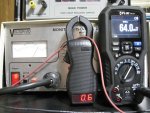
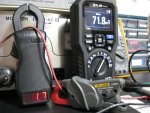
The AMPROBE is reading is direct. You move the decimal point on the DMM two digits to the left so it is actually reading .640A or .718A. The Fluke probe is set in the 20A position or 100mV/A.

First picture the measurement is being taken on a 100W incandescent. The meters agree.
Picture 2 is an old compact Fluorescent. Rated at 120V/620mA, that's what is printed on it with the 42W. The AMPROBE has lost it's mind or has it ?

I will post back tomorrow evening on why the AMPROBE is doing this. I have to wonder what the designers were thinking when they made this meter...
 

Attachments

  • IMG_2177.jpg
    IMG_2177.jpg
    144.7 KB · Views: 0
  • IMG_2181.jpg
    IMG_2181.jpg
    141.7 KB · Views: 0
180508-0723 EDT

describe your method for the +9,-1 V waveform


.

to keep the interest going...

2 methods here for show and tell, others left to the students <G> :
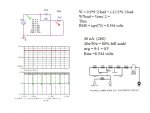
a. cheat, use PSpice
b. 9-1 = average; Watts is average of 9V and 1V power dissipation; thus Vrms = sqrt (watts*load) (note: 200k in PSpice schematic if from Simpson user manual for 50 uA movement)

rms.jpg
 
180508-1245 EDT

junkhound:

Your waveform is not what I suggested, but it is just fine for illustrating the calculation.

My RMS calculation agrees with yours for your waveform.

I do not agree on the average calculation, although the answers are the same. I get
9*0.9 - 1*0.1 = 8.1 - 0.1 = 8.0

Had the two peak values been 8 and -2 with the same duty cycle, then I get an average of
8*0.9 - 2*0.1 = 7.2 - 0.2 = 7.0 which is not 8 - 2

Or for 0 and -10 I get an average of
0*0.9 - 10*0.1 = 0 - 1 = -1 which is not -10

.
 
for illustration purposes, might be good to take pics of your meter gear AND the signal as seen on a scope.

and if its a signal gen, change the frequency on the different waveforms, and adjust % duty if its true square wave PWM. see what the meters do.
 
180508-1606 EDT

FionaZuppa:

junkhound provided a good plot of the signal he analyzed.

If the voltage levels are held constant, the duty cycle is constant, the bandwidth is sufficient to not distort the waveform, and frequency is high enough that good averaging occurs, then frequency does not matter.

If the peak-to-peak voltage is held constant, and the above criteria are met, then as average DC voltage is changed the RMS voltage will change. This is the problem with the Fluke and similar meters and calling them true RMS.

An electrodynamometer type meter is a true RMS meter within its limitations, and can provide a transfer measurement from DC to AC.

There are various persons on this forum that are insistent that an RMS meter should be used. But blindingly doing this may not provide the wanted information. You need to know your waveform, how your instrument works and its limitations, and what your measurement is going to do for you (provide useful information).

At this point I don't even know who those proponents are. That is not important.

Knowing how your meter works, and the meaning of its measurements are what is important.

.
 
180508-1606 EDT


If the peak-to-peak voltage is held constant, and the above criteria are met, then as average DC voltage is changed the RMS voltage will change. This is the problem with the Fluke and similar meters and calling them true RMS.
so are you talking about cases where +Vpk != -Vpk , yet pk-pk is constant?
 
180508-2107 EDT

FionaZuppa:

Yes.

In that paragraph, and the waveforms I presented in post #1 the peak-to-peak values were the same, and will remain the same when the waveform is coupled thru a capacitor that removes the DC component.

When you have a meter or amplifier that removes the DC component, then the output waveform remains the same independent of the that original DC component. A Transformer does the same.

.
 
After looking on line for the AMPROBE instruction manual I came to the conclusion that this particular instrument was measuring the peak current & then converting it into a RMS value. An averaging instrument would read the compact fluorescent lamp low, at least the Fluke T6 does at .2A.

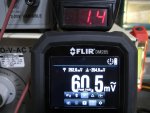
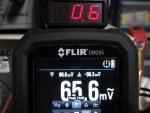
Here are a couple more pics of the pair, except this time I have turned on the PEAK HOLD function in the 285. Many upper tier Flukes have this same feature. They can capture transients greater than 250micro-seconds.

Remember the decimal point must be shifted two digits to the left on the Flir285.
Compact Fluorescent Bulb
In first picture the where the AMPROBE is displaying 1.4A the 285 is showing a peak to peak reading of 5.26A (2.62+2.64) . If you divide that by 2.8 a normal sine wave RMS value would be 1.88A. The RMS meter & known value are much lower, around .6A. Looking at the data provided on the 285 one can tell the sides of the sine wave are much steeper than normal.

Incandescent Bulb
In the second picture the AMPROBE is spot on at .6A considering full scale is 200A. The 285 is displaying .656A with a peak to peak value of 1.929A (.966+.963). Again dividing by 2.8 one gets .69A. The sides of this sine wave is pretty much normal. We know the top of the waves are a little flattened out all across the country from a previous thread. That may account for the slight difference between the calculated & measured.
 

Attachments

  • IMG_2186.jpg
    IMG_2186.jpg
    134.1 KB · Views: 0
  • IMG_2189.jpg
    IMG_2189.jpg
    134.5 KB · Views: 0
GAR, I will try to set aside some time this coming weekend to run the experiment with some of my instruments. My biggest problem will most likely be setting up the function generator.
 
180507-0912

Problem:

Using various instruments and calculations, a 10 ohm resistor as a load, and rectangular wave function generator what are the results of measurements across the load?

1. Average DC volts.
2. Actual RMS volts.
3. Fluke 87 AC RMS volts.
4. Fluke 27 AC volts.
5. Simpson 260 on AC volts.
6. Simpson 260 on Output.

For the following waveforms where the frequency is high enough for satisfactory coupling and averaging of the signal for the time percentages.

1. +10 V for 10% and 0 V for 90%.
2. +9 V for 10%, and -1 V for 90%.
3. 0 V for 10%, and -10 V for 90%.

How do a Simpson 260 and a Fluke 27 measure AC and get their readings? Define the philosophy.

.

In 2 above why is the +9 associated with the 10% & -1 with the 90% ?
The AC Peak to Peak Function is showing +1 & -9 on the Fluke 289 & Flir 285.

The 289 is measuring 3.03VAC / 5.04V AC+DC / A Crest Factor of 3 / 60HZ / 89.96% Duty Cycle / 4.03VDC
 

Attachments

  • IMG_2192.JPG
    IMG_2192.JPG
    73.6 KB · Views: 0
  • IMG_2193.JPG
    IMG_2193.JPG
    65.1 KB · Views: 0
180512-2619 EDT

SG-1:

Your post #19.

In 2 above why is the +9 associated with the 10% & -1 with the 90% ?
The AC Peak to Peak Function is showing +1 & -9 on the Fluke 289 & Flir 285.

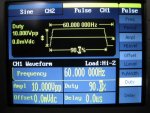
Because I chose to create a waveform rectangular in shape, with a low duty cycle (not symetrical in time), and with the same peak to peak value independent of DC offset.

The reason for this choice was that many meters in their AC mode remove the DC component of what is being measured. This may or may not be important to the measurement being made. Fluke 27 and 87 for example do strip DC, while Simpson 260 does not unless you switch the + probe to Output.

RMS calculation of a rectangular waveform is very easy. A +/-5 V sq-wave (10 V peak-to-peak) has an RMS value of 5. If offset to +10 and 0, then RMS is 7.07 V.

The Fluke 27 and 87 will produce incorrect true RMS readings for all waveforms that do not have a zero DC component.

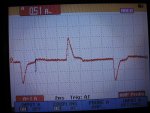
Using my scope to set time and voltage at 1 mS + direction and 9 mS - direction, and 10 V peak to peak the Fluke 87 reads 2.97 V. This is slightly low by about 0.03 V for zero bias. The reading does not change with a change of DC bias.

At +10 V and 0 V the reading should be 3.16 V, and Fluke read 2.97. At +9 and -1 it should be 3.00 and the Fluke 87 read 2,97, this is about correct, At 0 and -10 the reading should be 9.487, but it is still 2.97 .

.
 
Status
Not open for further replies.
Top