
Is this compliant?

Status
Not open for further replies.

Coppersmith

Senior Member
Location
Tampa, FL, USA
Occupation
Electrical Contractor
Is it compliant to run a UF cable through a sleeve all the way to an a/c disconnect? The UF cable is not fastened at either end. In this particular case the sleeve is three feet long.
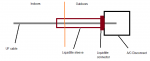
Sleeved UF cable.png
 
Yes it's perfectly legal. The chase or raceway would probably need a bushing or fitting on the ends.

Roger
 
I would say it’s the legal compliant way.
Places like NC have an amendment that allow NM-b up to 6’ outside with other stipulations
 
So, as devil's advocate, how does the proposed install comply with 312.5(C)? I assume that an A/C disconnect enclosure is a cabinet, so that Article 312 applies, rather than Article 314. Or is there some other section that exempts the proposed installation from the requirements of 312.5(C)?

Cheers, Wayne
 
So, as devil's advocate, how does the proposed install comply with 312.5(C)? I assume that an A/C disconnect enclosure is a cabinet, so that Article 312 applies, rather than Article 314. Or is there some other section that exempts the proposed installation from the requirements of 312.5(C)?

Cheers, Wayne
So read exceptions a through g and tell us what may be the problem.

Roger
 
I tried like hell to get this changed in 312.5 to no avail. Technically it probably isn't allowed
Unfortunately MH had a graphic showing his interpretation of this but removed it from the website a few years ago, I agree with his interpretation through the exceptions to the section


Roger
 
312.5(C) exception says it must enter the top of the cabinet before you even get to the other conditions you must comply with
So enter the back at the top or the top at the back.

Roger
 
So read exceptions a through g and tell us what may be the problem.
It's not exceptions a through g, it's one single exception with 7 different requirements to qualify, plus the requirement in the text that it be a "non-flexible raceway". That exception is pretty clear intended for interior installations; if an exterior installation complied with all the requirements, it would result in an inferior installation to what the OP proposes.

Cheers, Wayne
 
It's not exceptions a through g, it's one single exception with 7 different requirements to qualify, plus the requirement in the text that it be a "non-flexible raceway". That exception is pretty clear intended for interior installations; if an exterior installation complied with all the requirements, it would result in an inferior installation to what the OP proposes.

Cheers, Wayne
I agree.
 
Ok, I will agree as well. So the simple solution is to install a box at an accessible location even if on the inside of the wall and run single conductors from that point.

Roger
 
Well, 312.5(C) just says (2014): "Where cable is used, each cable shall be secured to the cabinet, cutout box, or meter socket enclosure." Is there any general requirement that the securing means be a product listed for the purpose? If not, would any of these comply:

(1) Use a zip tie with a screw hole to secure the cable to the enclosure via a small nut and bolt.
(2) Just pack ductseal around the cable in the end of the liquidtite connector, the duct seal is securing the cable.
(3) After threading the locknut on the liquidtite connector, thread on a coupling, then thread in a cable clamp to clamp the cable.

Cheers, Wayne
 
312.5 doesn't seem to allow conduit like EMT.

312.5 Cabinets, Cutout Boxes, and Meter Socket Enclosures.
Conductors entering enclosures within the scope of
this article
shall be protected from abrasion and shall comply
with 312.5(A) through (C).


None of A thru C seem applicable.
 
It's silent on conduit methods, so there's nothing to comply with. I mean, conduits automatically comply, because 312.5 doesn't impose any requirements on them.

Cheers, Wayne
 
Maybe I'm misreading but the section says "conductors entering enclosures" "shall comply with A thru C". That does not sound like silence. Conductors enter enclosures through conduits or cables.
 
Right, but A, B, and C don't impose any requirements on conduit methods:

(A) Is the opening closed? Yes, the conduit takes care of that
(B) Is it a wiring method using exposed individual conductors? Nope, so nothing to check.
(C) Is it a cable wiring method? Nope, so nothing to check.

That's it.

Cheers, Wayne
 
Status
Not open for further replies.
Top