
Is using Polaris multi port tab in a junction box code compliant

aks20000

Member
Location
San Francisco
Occupation
engineer
My two outdoor AC condensers , installed in 1990s by the builder in the side yard of the home and still functional, have a 100 amp feed coming from the garage sub panel where it is protected by 100 amp OCPD. The feed terminates in a junction box where it is spliced with two 60 amp branch feed going to two condensers. The condensers have individual disconnect with 60 amp fuse as required by these 5 ton condensers.

I am now planning to add a 3rd 25 amp branch feeder to the same junction box with its own 25 amp fused disconnect for the yet to be installed mini split. In order to make spliced joints clean in that junction box, I plan to use polaris insulated 4-port tab with correct amp rating for the three branch feeders and 100 amp main feed.

Will this be code compliant ? The overloading of 100 amp feed is not a concern , as both 5-ton AC condensers are going to be replaced soon with two 30 amp heat pumps and disconnects will have right size fuses.

If not, should I plan to replace the junction box with a sub panel having right size OCPDs / breakers for the three branch circuits ?
 
This sounds like a feeder tap. Can't tell you if its compliant as there are various rules and different approaches. See 241.21(B) subparts
(1) Taps not over 10' in length
(2) Taps not over 25' long
(5) Outside taps of unlimited length

There are wire size limitations in (1) and (2). If this junction box and all the smaller taps are outside, then (5) probably applies and is the easiest of the 3 rules. Hopefully all the tap conductors are in a raceway as that insures sufficient protection from damage.
 
The junction box and smaller taps are all outside. The older smaller taps ( two 60 amp branch circuits ) are all routed trough metal conduits behind the stucco ( canceled, done at the time of building the house ) and approx 10-15' in length. The new 25 amp tap , that I am planning to add, is being routed through 1/2" metal emt pipe running on the surface of stucco ( can't be concealed as the older taps ) and is 15' in length too. The new branch circuit is rated for 25 amp 230v and is using 10g wire - two hot wires and ground through metal conduit. The older branch circuits were rated for 60 amp and are using 6g wire. The 100 amp feed is using , I think, 4g wire as my electrician told. So, all the wires are as per the spec for current it will be carrying.

Since you mentioned wire size limitation, are you referring to any limitation making three taps inside the junction box which is probably 10"x10" ? The junction box is metal and very securely mounted on the stucco with half of its depth ( I guess 4-6" ) buried in the wall and half protruding out with a metal cover on it .

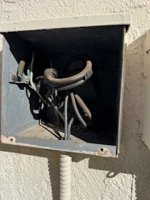
Enclosing a picture of this junction box with cover off to show how the existing main feed and branch circuits are spliced together. The flex whip
going out of the junction box is one 60 amp branch circuit that has the disconnect ( not shown in the picture ). The other 60 amp branch circuit is going towards left through a conduit and concealed behind stucco. The 100 amp main feed is coming to this junction box through a concealed conduit too all the way from the garage sub panel and protected by 100 amp breaker on the sub panel.

The new 25 amp branch circuit will be tapped in the junction box from the main feed ( splices replaced by Polaris multi-port tap ) and go out to a disconnect 15' away through a metal conduit on the surface of the wall.


IMG_3412.jpeg
 
Last edited:
The answer to the question in your subject line is yes, although as others have mentioned you need compliant taps and may have wiring method issues.

Personally I might replace that j-box with a small sub since you probably don’t save much money using 4-port polaris.
 
  • Like
Reactions: jap
Does serving only hvac units change that rule? For regular feeders, you can have larger than normal breakers on a wire since the HVAC units provide overload protection and the breaker is only providing short circuit protection. But Im not sure this is allowed with a feeder tap.

Could be another reason to put a small breaker panel there and perhaps do away with the separate disconnects if that local panel satisfies the HVAC disconnect sight and distance limitations.

The wire size rules I mentioned above apply to the 10 and 25 foot tap rules. The tap can only be so much smaller than the main feeder. Since you have conduits inside the wall, those taps are not inside and are length limited. You new one may be an outside tap.
 
Top