Issue with power quality on portable generator

Merry Christmas

clemver

Member
Location
PA
Occupation
Electrician
Had a customer reach out to me about a portable generator that I wired up for him earlier this year. It's a Duromax XP15000HXT.

He said that when he ran on generator power, his furnace control board fried.

Assuming that all voltage is good going to it, the more research I do the more I see that the power quality may be the issue and the generators THD might be the culprit. Never had an issue like that before. Would a UPS before the furnace take of this? Or something else that can go in-line between the panel and furnace to mitigate this? Really want to avoid telling him he now needs an inverter generator instead.
 
First question- why did the board die? Did a component let out the smoke or something else?

Second question- Is the voltage from the generator into the house wiring actually correct? It's easy enough to accidentally swap a couple of terminals and get the neutral onto a hot terminal.

Third question- Is the generator connected as a separately-derived system or not? Could be the connection scheme doesn't actually have a neutral/ground bonding jumper and the voltage to ground exceeded what the furnace board could handle.

Always start with the simple (and obvious) things before getting complex.
 
A small typical ups would not help because they are off-line, meaning that they don't do any power conditioning when power is present, it is a pass through. If you could find a double conversion UPS unit, it might help
 
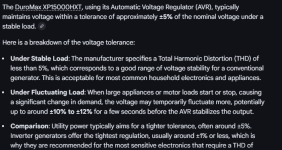
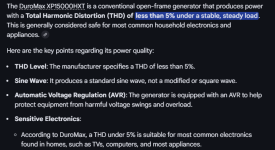
This is what the manufacturer claims

Screenshot 2025-12-08 223118.pngScreenshot 2025-12-08 222850.png

If this is accurate, I doubt the Generator caused it. Maybe took something out that was already on it's death bed, but I've seen even restoring utility power cause chaos. Something that was barely hanging on goes out of it's normal operating temp for the first time in a year or something, stuff moves a little bit, connections move just a bit, then something fails
 
It's a Duromax XP15000HXT.
Installed a DuroMax XP13000 earlier this year.

Tech support was going in circles trying to fix problems with the factory assembly.

Posted the defect with the floating neutral on this forum in June of this year.

Start button failed, since generator charging alternator was defective, and the battery had drained.

We used the pull rope to start the generator, and tested a 20A split system fine, but the central HVAC failed to start AC compressor, after several attempts from T-stat control. We could hear the generator skip a beat each time.

Did not diagnose further, since central HVAC started on POCO power. Perhaps, a relay opens before allowing 50A generator to attempt ~100 Amp locked rotor.

To prevent voltage extremes, the generator may be designed to open a relay when heavy loads lug the motor, or when frequency drops.

If your 60A generator failed to interrupt a compressor locked rotor, or similar electric heaters, it may have dropped frequency and raised voltage long enough to destroy something.
 
Last edited:
Not sure why my reply was deleted but anyway, post how the genny is connected to the system and if bonded or not. The main issue with those cheap generators is lack of electrical protections on the generator. If they are bogged, the frequency can drop nasty now, and the generator cares none. Voltage will also be through the floor.

Tell us more about the board that supposedly fried too.
 
First question- why did the board die? Did a component let out the smoke or something else?

Second question- Is the voltage from the generator into the house wiring actually correct? It's easy enough to accidentally swap a couple of terminals and get the neutral onto a hot terminal.

Third question- Is the generator connected as a separately-derived system or not? Could be the connection scheme doesn't actually have a neutral/ground bonding jumper and the voltage to ground exceeded what the furnace board could handle.

Always start with the simple (and obvious) things before getting complex.
Havent made it up there to check anything out yet. Just going by what he told me on the phone. Started researching which got me down this rabbit hole. So 1 and 2, not sure.

3: Confirmed with the generator manufacturer that it came with a bonded neutral. They gave me instructions on how to remove the jumper in the generator, which I did. Have neutral and ground bonded at the panel.
 
Not sure why my reply was deleted but anyway, post how the genny is connected to the system and if bonded or not. The main issue with those cheap generators is lack of electrical protections on the generator. If they are bogged, the frequency can drop nasty now, and the generator cares none. Voltage will also be through the floor.

Tell us more about the board that supposedly fried too.
Came with a bonded neutral. Removed the jumper per manufacturer instructions and have the ground and neutral bonded at the panel. Haven't made it up to his house to look at it yet, or talk to the HVAC tech. Should have more info once I get to all that.
 
Came with a bonded neutral. Removed the jumper per manufacturer instructions and have the ground and neutral bonded at the panel. Haven't made it up to his house to look at it yet, or talk to the HVAC tech. Should have more info once I get to all that.
I want to know more about the connection to home. 2 pole manual transfer? Just breaker lockout? 3 pole?

What I said in my deleted post is these generators are not stable and not ideal as a backup generator. If they get hit with too much load, they will bog and drop frequency as low as 40hz. However, the actual HVAC equipment type is more in question. I am doubting the generator caused it.
 
I have personal experience with cheap generators burning up electronics.

There are several reasons: First, THD will vary with loading. Many manufacturers will advertise +\- 5% THD, but those tests are done under no-load conditions. As the load increases, so does harmonic distortion.

Second, cheaper generators usually are 2 pole, and that contributes to voltage and frequency instability.

Third, many cheaper generators have such a large (comparatively) lag time between power demand and power delivery, that voltage spikes, voltage lags, low frequency, and high THD, are the rule rather than the exception.

I have installed plenty of MTS for DuroMax, Champion, PowerHorse, Firman, and every other Costco/Home Depot/BogBoxMart brand of cheap generator, but I do warn the customers about the potential problems with them, and at the end of the day, I’m not responsible for what they connect to the MTS.

I would advise an inverter unit if they want to stick with a portable.
 
I have personal experience with cheap generators burning up electronics.

There are several reasons: First, THD will vary with loading. Many manufacturers will advertise +\- 5% THD, but those tests are done under no-load conditions. As the load increases, so does harmonic distortion.

Second, cheaper generators usually are 2 pole, and that contributes to voltage and frequency instability.

Third, many cheaper generators have such a large (comparatively) lag time between power demand and power delivery, that voltage spikes, voltage lags, low frequency, and high THD, are the rule rather than the exception.

I have installed plenty of MTS for DuroMax, Champion, PowerHorse, Firman, and every other Costco/Home Depot/BogBoxMart brand of cheap generator, but I do warn the customers about the potential problems with them, and at the end of the day, I’m not responsible for what they connect to the MTS.

I would advise an inverter unit if they want to stick with a portable.

Pretty much on point with my deleted post. Though I don't have loaded THD data, the biggest issues are with horrible frequency and voltage regulation, and no guardrails at all. They are not intended to be "home generators", and ECs should give them the inlet and tell the owners "good luck".

I really don't think THD was at play in this failure, but will wait to hear more.

The main issue with these 3600rpm screamers is putting the engine WAY outside peak torque, which guarantees when they see load, frequency hold is gone. Any good generator is 4 pole at 1800rpm. Yep, they cost more! Inverters are solid, BUT I've setup BOTH, and I will firmly defend a real induction generator. When you set a diesel prime or standby, that's what that is, and they work great.
 
I had a whole police district in Philly run off of one of these for over a month because of a blown primary and nobody noticed until it went out on low oil. Detective with an office in the room next to the utility room told me he had been complaining for over a month about the noise. Rock solid. I never put a scope on one, because I never had a problem with one, but I've come across them a lot and they are rock solid.

But you can't wirelessly connect to them with your smart phone, and we all know internet connectivity is the most important thing in a generator

1765370801441.png
 
Top