
You are using an out of date browser. It may not display this or other websites correctly.
You should upgrade or use an alternative browser.
You should upgrade or use an alternative browser.
Line Side Breaker Self Welded
- Thread starter MrJLH
- Start date
- Status
- Not open for further replies.

kwired
Electron manager
- Location
- NE Nebraska
- Occupation
- EC
Are you trying to say one pole fails to open?
Are you trying to say one pole fails to open?
Sorry more info: 3phase HMCP 250A 480VAC.
The breaker did not trip. The pump was attempted to,be LOTO and the handle would not move on the enclosure. It was attempted to trip the breaker via the "push to trip" but the breaker did not trip.
Due to the breaker construction all three phases are linked so since the B phase was welded to its self it would of never tripped if a fault occured.

MechEdetour
Member
- Location
- NY, USA
- Occupation
- Design Engineer
So i just got a breaker that failed today, and the 'B' phase was fused to its self on the line side of the breaker.
The breaker was mounted in a Nema 7/9 enclosure that has some significant corrosion.
Has any one had this happen?
Just got? Are you saying you received a breaker with welded contacts?
kwired
Electron manager
- Location
- NE Nebraska
- Occupation
- EC
and the 'B' phase was fused to its self on the line side of the breaker.
Still not sure exactly what you mean with that phrase.
Locked handles typically won't stop the device from opening should it encounter a trip condition, trip mechanism would have to have problems for that to happen.

- Location
- San Francisco Bay Area, CA, USA
- Occupation
- Electrical Engineer
Also, how are you determining that the breaker failed to trip and how did you determine that B phase is welded? First you said it was B phase welded, then you said the breaker failed to trip and all of the contacts are linked. If all were linked (actually not true) and stuck closed, how could you have determined that B phase is welded? Something isn't adding up here.
I think the breaker did in fact trip and the other two poles opened, that's why you were able to notice the B pole being welded. An HMCP has no thermal trips, so it only trips on very high magnetic current during a short circuit. If it is a bad enough fault, meaning the current exceeded the rating of the breaker, that sometimes welds contacts. It's not supposed to, but "stuff" happens. Now you need to look for the short circuit down stream of that breaker, it's going to be a bad one.
Also, if you were using an HMCP as a feeder and there was no corresponding overload relay down stream to trip on long term thermal over current, you could have caused the breaker contacts to weld from a simple overload. An HMCP can ONLY be used as part of a listed motor starter assembly. Sometimes people remove the starter and use the breaker as a feeder, that's not allowed, for this very reason.
I think the breaker did in fact trip and the other two poles opened, that's why you were able to notice the B pole being welded. An HMCP has no thermal trips, so it only trips on very high magnetic current during a short circuit. If it is a bad enough fault, meaning the current exceeded the rating of the breaker, that sometimes welds contacts. It's not supposed to, but "stuff" happens. Now you need to look for the short circuit down stream of that breaker, it's going to be a bad one.
Also, if you were using an HMCP as a feeder and there was no corresponding overload relay down stream to trip on long term thermal over current, you could have caused the breaker contacts to weld from a simple overload. An HMCP can ONLY be used as part of a listed motor starter assembly. Sometimes people remove the starter and use the breaker as a feeder, that's not allowed, for this very reason.
sorry all for the confusion.
Originally the breaker was fed off a switch rack. We needed to LOTO the breaker for maintenance purposes on the load. The electrician went to operate the handle to apply his lock and the handle on the outside NEMA 7 enclosure which houses the breaker would not budge. He did some additional trouble shooting and pushed the "trip" button integral to the breaker and nothing happened.
We replaced the breaker, took it back to our shop and this is the inside what we found on the line side
Keep in mind this is a HMCP with a available fault current less than 17kA
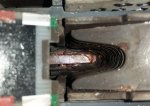
Originally the breaker was fed off a switch rack. We needed to LOTO the breaker for maintenance purposes on the load. The electrician went to operate the handle to apply his lock and the handle on the outside NEMA 7 enclosure which houses the breaker would not budge. He did some additional trouble shooting and pushed the "trip" button integral to the breaker and nothing happened.
We replaced the breaker, took it back to our shop and this is the inside what we found on the line side
Keep in mind this is a HMCP with a available fault current less than 17kA
meternerd
Senior Member
- Location
- Athol, ID
- Occupation
- retired water & electric utility electrician, meter/relay tech
The damage in your pic looks like arcing, not overload (no discoloration). Could have been a faulty set of contacts or frequent tripping under a fault condition. Is it a bolted bus connection or stabs? If it was a long term problem, you should see more damage than just the breaker contacts. Check all of the bus connections closely....wouldn't want to ruin another breaker. Hard to say if it was a manufacturing defect or internal damage.
The damage in your pic looks like arcing, not overload (no discoloration). Could have been a faulty set of contacts or frequent tripping under a fault condition. Is it a bolted bus connection or stabs? If it was a long term problem, you should see more damage than just the breaker contacts. Check all of the bus connections closely....wouldn't want to ruin another breaker. Hard to say if it was a manufacturing defect or internal damage.
Yeah funny thing about that is this is second time in 18 months this breaker was replaced.
In fact this breaker was replaced in mid-2016 1 month after a NETA test on the entire switchrack system. (Which checked out fine)
Last time the contact fell off the breaker line side.
- Location
- Placerville, CA, USA
- Occupation
- Retired PV System Designer
Is this breaker routinely used as a switch to turn a load on and off?Yeah funny thing about that is this is second time in 18 months this breaker was replaced.
In fact this breaker was replaced in mid-2016 1 month after a NETA test on the entire switchrack system. (Which checked out fine)
Last time the contact fell off the breaker line side.
- Location
- San Francisco Bay Area, CA, USA
- Occupation
- Electrical Engineer
So is it part of a listed motor starter assembly then?
Is this breaker routinely used as a switch to turn a load on and off?
As far as I know NO
The load is started by 1 of 6 start/stop stations in the field.
So is it part of a listed motor starter assembly then?
Unfortunately NO
The Starter /OL assembly is Spreckler and Schuh
with control circuity being various manufacturers in a Curlee enclosure

That would be my guess. I think the OP said it has a fault capacity of "just" 17kA. Not really all that high for the duty.An HMCP has no thermal trips, so it only trips on very high magnetic current during a short circuit. If it is a bad enough fault, meaning the current exceeded the rating of the breaker, that sometimes welds contacts. It's not supposed to, but "stuff" happens. Now you need to look for the short circuit down stream of that breaker, it's going to be a bad one.
- Location
- San Francisco Bay Area, CA, USA
- Occupation
- Electrical Engineer
The assembly is not to code then. It sounds as though you have more than one S+S starter down stream of this HMCP then? If so, that would be a likely explaination of the failure. You can't do that.Unfortunately NO
The Starter /OL assembly is Spreckler and Schuh
with control circuity being various manufacturers in a Curlee enclosure
Magnetic-Only circuit breakers like the HMCP can ONLY be used in listed and labeled combination starter assemblies where the breaker has been tested with a SPECIFIC overload relay.
The assembly is not to code then. It sounds as though you have more than one S+S starter down stream of this HMCP then? If so, that would be a likely explaination of the failure. You can't do that.
Magnetic-Only circuit breakers like the HMCP can ONLY be used in listed and labeled combination starter assemblies where the breaker has been tested with a SPECIFIC overload relay.
So you got me thinking.:blink:
My actual set up is a FWD/REV starter fed by the HMCP. I wonder if the relay has failed which prevents the REV from closing while in FWD?
I will check this out if I can tomorrow!!!
Thanks!
Can you elaborate on your statement about HMCP and OL testing? My facility is older than most on this forum and starters have been pieced together with various parts through the years so every new starter I look at is a surprise.
- Location
- San Francisco Bay Area, CA, USA
- Occupation
- Electrical Engineer
...
Can you elaborate on your statement about HMCP and OL testing? My facility is older than most on this forum and starters have been pieced together with various parts through the years so every new starter I look at is a surprise.
NEC Article 430.53.C. (emphasis added)
(3) Instantaneous Trip Circuit Breaker. An instantaneous
trip circuit breaker shall be used only if adjustable
and if part of a listed combination motor controller having
coordinated motor overload and short-circuit and ground fault
protection in each conductor, and the setting is adjusted
to no more than the value specified in Table 430.52.
Informational Note No.1: Instantaneous trip circuit breakers
are also known as motor-circuit protectors (MCPs).
To your first point though, in a reversing starter the contactors should be both mechanically and electrically interlocked to avoid just that sort of issue. If the interlocking is only electrical, a burned aux. contact can lead to destructive events.
NEC Article 430.53.C. (emphasis added)
To your first point though, in a reversing starter the contactors should be both mechanically and electrically interlocked to avoid just that sort of issue. If the interlocking is only electrical, a burned aux. contact can lead to destructive events.
SO I dont have ground fault protection on this system. Does that not apply?
- Location
- San Francisco Bay Area, CA, USA
- Occupation
- Electrical Engineer
SO I dont have ground fault protection on this system. Does that not apply?
"Short circuit and ground fault protection" in this sense is just how the NEC describes a circuit breaker. It just means that the device senses a line to line fault as well as a line to ground fault.
"Short circuit and ground fault protection" in this sense is just how the NEC describes a circuit breaker. It just means that the device senses a line to line fault as well as a line to ground fault.

I figured I show a trimmed out schematic of the setup. Please don't judge this on me. I'm still thinking this has something to do with the relays on the 480VAC side
- Status
- Not open for further replies.