Motor Lead Pigtail Splicing of a 4000V Motor

Status
Not open for further replies.

kkaragory

Member
I have a question regarding motor lead pigtail splicing of a 4000V motor.

What is/are appropriate ways of taping this connection?

I will further clarify my question as follows:
  • I would also like to know WHY you do it the way that you do, i.e. "That's the way we always do it," is NOT an acceptable answer to me.
  • I am interested in taping standards and NOT a heat-shrink kit.
  • I am more interested in the best connection and not the easiest to take apart.
  • I am interested in a 4000V connection and NOT a 480V or 13000V connection.
Thank you,
Kevin G. Karagory
 
cable termination

cable termination

The proper way to terminate your cable is by a blueprint drawn up from the specific cable manufacturer. The cable manufacturer will be the only one who can properly determine the safe termination of this cable. Especially if this cable is an old lead covered hv cable it is a tedious process to rebuild the cable and make a stress cone.
Many plastic cables you can buy kits for termination. If you do not understand the voltages at this level I strongly advise you do not attempt a termination without proper training.
Go to www.youtube.com and type in the search arcflash if you need to see why .the guys running around on fire will help to convince you.
If you need to find a qualified #1 cable splicer call a local union hall and they could direct you to a properly trained contractor in your area
 
Do they make separable elbow connectors for motors at this voltage? I'm thinking they do. Might want to check the Raychem catalog. Hard to say, exactly. Myself, I haven't connected a 4160 motor since the last time. I think that taping and wiping went out in the 70's at this voltage, didn't it?
 
Last edited:
If you want the best connection, why do you want a tape connection. A heat shrink or cold shrink kit is better then most field taped installations.
Don
 
Don, I have to partially disagree with you. A hand taped termination or splice properly done by an experienced splicer will outlast a kit. That being said the quality of workmanship is the determining factor weather or not it will last and since it is not done much anymore there are less and less people that can properly do it. In my splicing class we spent weeks and weeks hand taping slices and cutting them open to see if we left any flaws. The kits are a lot less prone to workmanship problems. Still, the cable prep is the key. Especially at higher voltages. 5KV is pretty forgiving. If a the cable is not prepared right it will fail in time. One particular high voltage contractor in my area cuts off a lot of kits and hand tapes the termination. They do it after partial discharge testing uncovers the flaws. They will guarantee their terminations and splices for the life of the cable if they are hand taped. With a kit they will only give you the warranty the kit manufacturer gives.
quogueelectric, cable manufacturers usually do not give you splicing and termination instructions. Kerite is the only one I have found that does and they are only hand taping instruction's. The suppliers of the particular termination or splice you are using are normaly what is used.
mdshunk, dead break and load break elbows are not used in motor terms. It is not practical. 3m, Elastimold and Raychem do however make some pretty cool term kits. Actual lead wiping of cable with the solder pots and all is a rare occurrence these days. They make lead to solid dielectric kits now so you can take off with EPR or XLP. The old lead cable will last forever as long as it is undisturbed.
 
Nick said:
...cable manufacturers usually do not give you splicing and termination instructions. Kerite is the only one I have found that does and they are only hand taping instruction's.
Thanks for that tidbit.
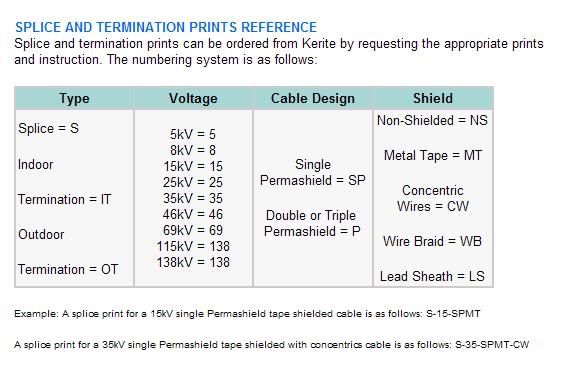
Here you go, if you want to order the tape type termination print(s):

tapesplice.jpg
 
lead wiping

lead wiping

Nick said:
Don, I have to partially disagree with you. A hand taped termination or splice properly done by an experienced splicer will outlast a kit. That being said the quality of workmanship is the determining factor weather or not it will last and since it is not done much anymore there are less and less people that can properly do it. In my splicing class we spent weeks and weeks hand taping slices and cutting them open to see if we left any flaws. The kits are a lot less prone to workmanship problems. Still, the cable prep is the key. Especially at higher voltages. 5KV is pretty forgiving. If a the cable is not prepared right it will fail in time. One particular high voltage contractor in my area cuts off a lot of kits and hand tapes the termination. They do it after partial discharge testing uncovers the flaws. They will guarantee their terminations and splices for the life of the cable if they are hand taped. With a kit they will only give you the warranty the kit manufacturer gives.
mdshunk, dead break and load break elbows are not used in motor terms. It is not practical. 3m, Elastimold and Raychem do however make some pretty cool term kits. Actual lead wiping of cable with the solder pots and all is a rare occurrence these days. They make lead to solid dielectric kits now so you can take off with EPR or XLP. The old lead cable will last forever as long quogueelectric, cable manufacturers usually do not give you splicing and termination instructions. Kerite is the only one I have found that does and they are only hand taping instruction's. The suppliers of the particular termination or splice you are using are normaly what is used.
as it is undisturbed.
Totally agree the skill of the splicer has everthing to do with the reliability of the termination. I am a certified #1 lead splicer and I have always had a print for the termination or splice that I was making giving exact dimentions of the tape buildup and length of stress cones and splices. I was always working for a contractor who obtained these for me though.
I have done about two dozen of these terminations usually to a high voltage chiller or primary distribution disconnect only one done without a print.
These cable manufacturer instructions are handed down from instructor to student inclasses and are as old as the hills. I have an old toolbag with all of my splicing tools init along with any documents I recieved in class. I havent done one in about 15 years but the splices are still out there although rare they still exist on some large facilitys usually owned by the state or federal govt.
The number of people that are trained to do the splices are few I probably only know about a dozen in my area and I know the power company has a few and a handfull of local contractors. I turned down the last one I was offered about 3 years ago a backhoe hit a live cable cable at shinnecock hills where they hold the US open occasionally. It had to be repaired immediately and I didnt feel confident enough to go it alone under tremendous pressure.
 
quogueelectric said:
Totally agree the skill of the splicer has everthing to do with the reliability of the termination. I am a certified #1 lead splicer and I have always had a print for the termination or splice that I was making giving exact dimentions of the tape buildup and length of stress cones and splices. I was always working for a contractor who obtained these for me though.
I have done about two dozen of these terminations usually to a high voltage chiller or primary distribution disconnect only one done without a print.
These cable manufacturer instructions are handed down from instructor to student inclasses and are as old as the hills. I have an old toolbag with all of my splicing tools init along with any documents I recieved in class. I havent done one in about 15 years but the splices are still out there although rare they still exist on some large facilitys usually owned by the state or federal govt.
The number of people that are trained to do the splices are few I probably only know about a dozen in my area and I know the power company has a few and a handfull of local contractors. I turned down the last one I was offered about 3 years ago a backhoe hit a live cable cable at shinnecock hills where they hold the US open occasionally. It had to be repaired immediately and I didnt feel confident enough to go it alone under tremendous pressure.

Excellent reply, Splices are an art, and serious business, a few year ago we had a local contractor take on a splice job for primary feeder to a local manufacturing plant, of course his first mistake was bidding low, his second mistake ordering the wrong cable and his fatal mistake making bad splices, this all ended up in a court case when the splices faild and cost the company $10K an hour down time for 16 hours plus the cost of having the work done right, I am not sure of what he ended up paying, but he moved from a mc mansion to a 3 room apartment, and was driving a rent a wreck, no more fancy 4W, he went from 4 trucks and a shop, to one beater truck, and worked out of storage unit. So if you don't feel confident eniough, pass on it.

"I have always had a print for the termination or splice that I was making giving exact dimentions of the tape buildup and length of stress cones and splices."

Same here, I never worked them without engineering prints, and I still have a lead pot.
 
Last edited:
I'm surprised anyone answered, considering how arrogant and condescending the post seemed.

------------------

I apologize for being so terse in my post. However, I am not new to this forum. I know how threads can "get away" and end up being about everything else but the question that was asked.

For instance, I do not want to start a discussion about whether taping or kits are better. So I stated as much. If someone is interested in that discussion, they should simply start it. I think it would be quite a meaningful and worthwhile discussion, however it does not answer the question as to how to properly tape.
 
If you want the best connection, why do you want a tape connection?

I have always had a print for the termination or splice that I was making giving exact dimensions of the tape buildup and length of stress cones and splices.

---------------

The choice is not up to me. However, I still want to ensure that we are making correct connections.

I have this bad feeling that we are not taking into account partial discharge/ionization of the air at 4000V when taping our connections.

This is an engineering forum so I want to know why instructions are what they are...

I have found through experience that there are far too many electricians and engineers that blindly follow instructions without really understanding all the factors involved in whatever construction they are attempting to accomplish. I think grounding/bonding is an excellent example of this blind faith in whatever the schematics say.

That is what I thought this site was all about... finding the truth and debunking the myths behind our craft; so as to make safer, more reliable electrical installations.
 
Before anyone flames me because this is the Electrical Contracting and Estimating/Management
forum, I honestly tried to original post in the Engineering_Forum
 
Kevin, I ask you to take a deep breath, and exercise some patience. If your thread goes off topic, all you have to do is click on the
report.gif
button on the off-topic post, and all moderators will be emailed to address it.

You've indicated you'd like the thread moved to the engineering forum, so I will do that for you.

Welcome to the forum, and relax. :)
 
I will try to answer your question

I will try to answer your question

kkaragory said:
Before anyone flames me because this is the Electrical Contracting and Estimating/Management
forum, I honestly tried to original post in the Engineering_Forum
The theory behind the high voltage splice is to use the xlp which stands for crosslinkpoly which is a great dielectric to not stress it all at one point therefore the semiconductor and the stress cone grounded braid. This distributes the high voltage stress evenly across the radius of the insulator this helps the insulator distribute the stress just like plywood under a refridgerator helps distribute a point load on a floor. if evenly distributed a heavy point load can be handled with minimal effort. The semiconductor layer acts as a buffer betwen insulator and conductive braid. I hope that this satisfies your curiosity however this forum is by no means a substitute for formal training. This would be hearsay at best in a court of law. You weed out for yourself who has hidden agenda.
 
you tube

you tube

kkaragory said:
If you want the best connection, why do you want a tape connection?

I have always had a print for the termination or splice that I was making giving exact dimensions of the tape buildup and length of stress cones and splices.

---------------

The choice is not up to me. However, I still want to ensure that we are making correct connections.

I have this bad feeling that we are not taking into account partial discharge/ionization of the air at 4000V when taping our connections.

This is an engineering forum so I want to know why instructions are what they are...

I have found through experience that there are far too many electricians and engineers that blindly follow instructions without really understanding all the factors involved in whatever construction they are attempting to accomplish. I think grounding/bonding is an excellent example of this blind faith in whatever the schematics say.

That is what I thought this site was all about... finding the truth and debunking the myths behind our craft; so as to make safer, more reliable electrical installations.
Please tell me you watched the clip on arc flash. If you are this disturbed and have a gut feeling you are over your head you probably are. However you seem to have stated that this is out of your control.and seem to be going with what is forced on you by your boss. email me and we can discuss this further
 
The theory behind the high voltage splice...

----------------------------

The procedure that you allude to seems to be more in line for 12 kV and above; have you made many 4 kV connections the way that you described?
 
Welcome to the forum, and relax. :)

------------------------------

All I want to know is what is the electrical construction practice regarding 4 kV motor connections, and why.

I knew that I wouldn't get a straight response from anyone without pushing; so I decided to push first. :mad:
 
I allready done both old and new " School" splices and i rather use the new school spice due it save alot of time and more safer due they have very good cold shrink wrap on the motor termails the last time i did old school splices it took me little over 2 hours to just get three termails spliced up per spec. [ large number of 33+ tape and varnish tape and rubber tapes each one take over min of 15 rolls min on 4160 volt motor]

to do the cold shrink it cut the time alomst half as long you prepare the cables in correct way


Merci , Marc
 
kkaragory said:
I have found through experience that there are far too many electricians and engineers that blindly follow instructions without really understanding all the factors involved in whatever construction they are attempting to accomplish.

AMEN! AMEN! AMEN! (seeing how it's Sunday)
 
I have found through experience that there are far too many electricians and engineers that blindly follow instructions without really understanding all the factors involved in whatever construction they are attempting to accomplish.
That is much better than the electrician that just makes the splice without following the instructions. If they are properly written, blindly following them with out knowing the "why", should result in a good termination. A bigger problem is an electrcian that knows part of the "why" and trys to take shortcuts.
Don
 
Status
Not open for further replies.
Top