Name of Disconnect Switch

Merry Christmas
Status
Not open for further replies.

zam

Member
Location
New York, NY
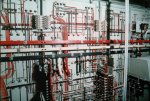
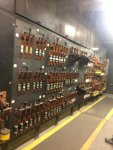
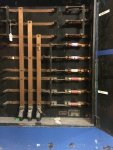
Good morning. Please take a look at the attached photos. Is their a specific name for these type of disconnect switches? Thank you.
 

Attachments

  • IMG_0160.jpg
    IMG_0160.jpg
    135.2 KB · Views: 5
  • IMG_0163.jpg
    IMG_0163.jpg
    144.1 KB · Views: 5
I agree knife switches. Worked on many of those back in the 1980's in depression built buildings in Rockefeller Center.
 
The modern version, with all energized parts enclosed in a strong steel box, is called a "safety switch", but we never back-named the old ones "danger switches". Still a "knife switch".
 
Same set up still in use in this building here
So what is proper procedure to do anything involving that switchboard?

Turn off the main supply, suit up to check for voltage, possibly on every exposed conductive surface to ensure it is off, then proceed with the task you intended to do?

What allows that to remain in place? If not OSHA, then you would at least think no insurance company will be interested in insuring something like that and would push owner to want to replace with something considered safer.
 
The more interesting part of these switchboards is the back. Typically a wide open array of various sizes of copper bus.
 
So what is proper procedure to do anything involving that switchboard?

Turn off the main supply, suit up to check for voltage, possibly on every exposed conductive surface to ensure it is off, then proceed with the task you intended to do?

What allows that to remain in place? If not OSHA, then you would at least think no insurance company will be interested in insuring something like that and would push owner to want to replace with something considered safer.

It was code in the era it was installed,
The building is insured, no OSHA complaints
Procedural wise I have never work on it

I do no they have plans to upgrade the equipment and there is an electrical engineer working on the project
 
The more interesting part of these switchboards is the back. Typically a wide open array of various sizes of copper bus.

We called those rear spaces “suicide rooms”.

OSHA can’t force someone to buy new gear, but the employer must have a safe procedure in place to do anything involved with that equipment. If using NFPA70E to establish the procedure, the equipment would have to be in a controlled access area, inside of which anyone entering would need appropriate PPE.
 
When I started in the trade 15 years ago, I heard the term "dead front" many times but I didn't really understand the term until my apprenticeship school instructor passed around his electrical school book from 30 years prior. There was a section describing "live fronts" like the one pictured above. All of a sudden it all made sense.
 
When I started in the trade 15 years ago, I heard the term "dead front" many times but I didn't really understand the term until my apprenticeship school instructor passed around his electrical school book from 30 years prior. There was a section describing "live fronts" like the one pictured above. All of a sudden it all made sense.

Seems like it should be the other way around: The old ones are "dead fronts" cuz they make you dead, and the new ones are "live" because you stay alive ;)
 
Replaced a few
374c6e7ff70aadedf04254aa28903797.jpg


Sent from my SM-G965U using Tapatalk
 
We had some 1600A knife switches. The only way I could open one was grab the handle, put my feet against the panel and throw myself backwards. For some reason I always ended up flat on my back.

UK’s health and safety executive threatened to shut our plants down unless we got rid of all the open switchgear.

This is the back of the last one I took out.

TRK-2-switch_zps90a2a75e.jpg
 
Status
Not open for further replies.
Top