NEC 110.14 D Torquing conductors on residential projects

Larrysharron

New User
Location
Clermont Florida
Occupation
Chief Building Inspector
I’m an electrical inspector in Lake County Florida. On new projects residential and commercial including service change outs, PV systems and etc., I have been enforcing torquing the conductors in accordance with the panel manufacturers specifications for years. I encounter loose conductors on approximately 90% of the jobs that I inspect. We recently hired a new building official who was at one time an electrician. Today he informed me that his previous building official and himself in his 12 plus years as a building official have never enforced torquing conductors on residential projects. I didn’t know that conductors knew the difference if they were installed on a residential project or a commercial project. He wants to discuss this issue when I get back in the office. What do you Gentleman think about this issue?
 
Last edited:
I think you are good to check. I have found neutrals and grounds that haven't been "tightened" down. Though, a tug test might be all that's needed for most wire sizes in residential.
 
What do you Gentleman think about this issue?
It's in the NEC for a reason, because often the connections are not tight enough. Now with just about every installer tightening them with a cordless tool there is no guarantee that they're anywhere near the specified torque level. At least back in the day when we tightened everything by hand you could feel when it was tight. Not scientific by any means but still better than the mystery torque level provided by a power tool. We've been using torque tools for decades even when no one else was using them.
 
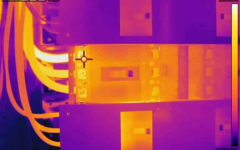
I had my facility sub-panels IR scanned a couple months ago. One of the flagged circuits showed a 23.5 degree (F) difference; it was definitely a hot spot. The wire had not been properly torqued to the circuit breaker. What is there to discuss about the issue? That it's spelled out plainly in the NEC? That the fast-and-loose guys who can't/won't/don't check their terminations are setting up a warmer situation?

1769719952609.png
* image pulled from interwebs
 
It’s enforced out here, but like you discovered not always (if u can call that enforcement). Single family panel upgrade not so much. But an acquaintance asked for my assist during inspection of a 40 unit panel swap because he knew what was coming. He just needed someone to man the meter mains while his crew stayed busy elsewhere. Inspector made him painstakingly go through every lug & breaker in each panel. We had to continue another day to complete due to inspectors schedule. Surprised me because I thought it would be a sampling.
 
I don't tighten any electrical connection with a power tool. I may run the screw or bolt in until it touches and then tighten it by hand so I can feel it. Never used a torque screwdriver.
 
If you are testing the torque a few days after the initial installation, I am not surprised that you are seeing 90% and that is to be expected. NFPA 70B says that if you test a previously torqued connection at 90% of the specification and it does not turn, it is good.
 
i think if the worst thing you find on a residential jobsite is a supposedly "loosely tightened screw", you have too much time on your hands.

just for reference, how many years worth of licensed electrical installation (not inspection), do you have?
 
Top