solarken
NABCEP PVIP
- Location
- Hudson, OH, USA
- Occupation
- Solar Design and Installation Professional
I understand NM-B Cable is not permitted in wet or damp locations. The JB1.2 juncion box from EZ Solar is a fully flashed, surface-mounted box with a Nema-3R rating, and I install them under a solar module so they do not get direct splashing rain, only runoff down the shingled roof, within which the flashing is interleaved just like the shingles. In addition, sealant is used for secondary protection around the roof penetration area of the enclosure.
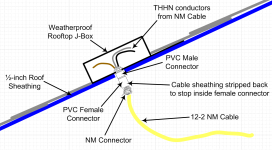
I am thinking of using the approach in the attached graphic for Microinverter AC wiring transition from Enphase Q-cable to NM-B for the run through the attic toward the combiner. All the NM-B I have has what appears to be THHN or THWN phase conductors within it, with PVC and nylon insulation, although it is not marked. The sheathing would be trimmed back to just beyond the NM connector, in the female PVC connector, andso would be well within the attic space, and not protruding into the Jbox. The Jbox in my opinion is just as dry as the attic, since it uses all the same principles to keep the space dry as is used to keep an attic dry. In fact, when you look at the ridge vent, and the box vents in the roof at this house, it sure looks like those are much more likely to allow a little water in than this Jbox that is flashed and caulked and sitting beneath a solar module.
I have read a few other posts that touch on the subject but not exactly with the application I am talking about here. Any thoughts about this approach? Any code references that I can use if I get any concern from the AHJ?
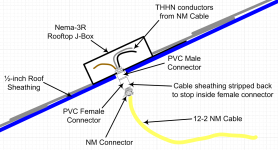
I am thinking of using the approach in the attached graphic for Microinverter AC wiring transition from Enphase Q-cable to NM-B for the run through the attic toward the combiner. All the NM-B I have has what appears to be THHN or THWN phase conductors within it, with PVC and nylon insulation, although it is not marked. The sheathing would be trimmed back to just beyond the NM connector, in the female PVC connector, andso would be well within the attic space, and not protruding into the Jbox. The Jbox in my opinion is just as dry as the attic, since it uses all the same principles to keep the space dry as is used to keep an attic dry. In fact, when you look at the ridge vent, and the box vents in the roof at this house, it sure looks like those are much more likely to allow a little water in than this Jbox that is flashed and caulked and sitting beneath a solar module.
I have read a few other posts that touch on the subject but not exactly with the application I am talking about here. Any thoughts about this approach? Any code references that I can use if I get any concern from the AHJ?