alyoshak24
Member
- Location
- Chicago
- Occupation
- Electrician
Hello wizards,
I have a couple of questions but first some context. Our crew is working on a project on a older facility (1960s or 50s) with an overhead xmfr feeding multiple buildings (maybe 3-5). Some buildings have multiple services and others only a single service. Utility stated that this is a metered primary that meters the aggregate load from all the buildings it feeds and that is why there are no individual meters on the buildings (dont know why that is). Most buildings are small office buildings, cafeteria, dorms and "welding shops" / "automotive shops" / "carpentry shops" etc for teaching. the xmfr info is as follows:
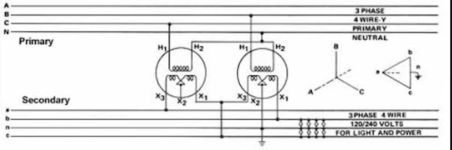
PRIMARY SERVICE: 25/14.4kV, 3PH, 4 WIRE.
BUILDINGS SECONDARY SERVICE: 120/208V & 120/240V, 1PH & 3PH, 3 & 4 WIRE
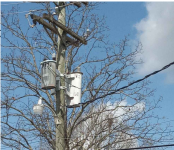
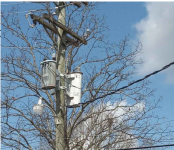
We are tasked to replace the main breaker panels for a building that has two service drops, a 225A 3P 120/208 42 space MBP and a 200A 120/240V 24 space MBP. These Main Disco Panels are right next to each other inside the building. Now we noticed that the overhead service drop for the single phase is tapped from the 3phase service wires L1, L2 but NOT the neutral. The neutral "looks" like it also tapped but upon closer inspection, its just hanging.
When we opened the service panels/discos inside the building we noticed that in the single phase 200A disco L1 L2 N were landed properly BUT there was a bonding jumper from the neutral lug on the single phase 200A panel to the 3Phase 225A panel.
This is the first time we EVER encountered something like this. Our initial reaction was to get utility to reconnect a neutral that was never connected in the first place and NOT jump the neutral from the 3Phase panel to the single phase panel. However, we are unsure if it was deliberately left that way due to the transformer config uration.
Can you great electricians share your wisdom and help clarify because the single phase panel readings were 120 L1-N and L2-N and 240 L1-L2, and the three phase panel readings were 120 L1 - N, L2 - N, L3 - N, AND 208 L1-L2, L2-L3, L1-L3. so if the readings came out correct for the corresponding services while the neutral was improperly jumped between the panels, then WHy didnt they just tap from the neutral service wire that attached to the 3PH service drop ?
Respectfully,
the original bobby wayne
I have a couple of questions but first some context. Our crew is working on a project on a older facility (1960s or 50s) with an overhead xmfr feeding multiple buildings (maybe 3-5). Some buildings have multiple services and others only a single service. Utility stated that this is a metered primary that meters the aggregate load from all the buildings it feeds and that is why there are no individual meters on the buildings (dont know why that is). Most buildings are small office buildings, cafeteria, dorms and "welding shops" / "automotive shops" / "carpentry shops" etc for teaching. the xmfr info is as follows:
PRIMARY SERVICE: 25/14.4kV, 3PH, 4 WIRE.
BUILDINGS SECONDARY SERVICE: 120/208V & 120/240V, 1PH & 3PH, 3 & 4 WIRE
We are tasked to replace the main breaker panels for a building that has two service drops, a 225A 3P 120/208 42 space MBP and a 200A 120/240V 24 space MBP. These Main Disco Panels are right next to each other inside the building. Now we noticed that the overhead service drop for the single phase is tapped from the 3phase service wires L1, L2 but NOT the neutral. The neutral "looks" like it also tapped but upon closer inspection, its just hanging.
When we opened the service panels/discos inside the building we noticed that in the single phase 200A disco L1 L2 N were landed properly BUT there was a bonding jumper from the neutral lug on the single phase 200A panel to the 3Phase 225A panel.
This is the first time we EVER encountered something like this. Our initial reaction was to get utility to reconnect a neutral that was never connected in the first place and NOT jump the neutral from the 3Phase panel to the single phase panel. However, we are unsure if it was deliberately left that way due to the transformer config uration.
Can you great electricians share your wisdom and help clarify because the single phase panel readings were 120 L1-N and L2-N and 240 L1-L2, and the three phase panel readings were 120 L1 - N, L2 - N, L3 - N, AND 208 L1-L2, L2-L3, L1-L3. so if the readings came out correct for the corresponding services while the neutral was improperly jumped between the panels, then WHy didnt they just tap from the neutral service wire that attached to the 3PH service drop ?
Respectfully,
the original bobby wayne