Overhead bus drop wire to cnc - no ground?

Status
Not open for further replies.
An industrial factory in town has a 3-wire/3-phase bus duct 480V. We are dropping a couple 10/4 lines down to cnc's. The factory engineer said because the bus does not have a neutral bar and is not grounded, we should use 10/3 drop and then use a ground rod for the grounding connection at each cnc. Is it possible that the bus casing is not grounded? I definitely want to run a GEC from the buss, but if the bus box is not grounded that seems to be a big safety issue. Any suggestions??
 
Good morning,
I have the very same setup here at our facility, 3 phase 480v buss. Our buss is grounded through the housing and we alway run a GEC from the J-plug to the equipment as well as a ground rod. One of the best has replied to you already. Have this engineer explain to you in detail his theory and reasons. Then ask yourself why did they hire me to do this. You can learn something from everyone the best part is you get to pick what you learn.

LHarrington
 
2wheelinusa said:
but is he accurate about the bus not being an effective ground?

I don't think so and if it is a poor grounding means adding a ground rod will do nothing to change that.

368.2 Definition.

Busway. A grounded metal enclosure containing factory-mounted, bare or insulated conductors, which are usually copper or aluminum bars, rods, or tubes.
 
I'm curious why the buss wouldn't be a good ground? He was adamant about the buss not being grounded. In fact, I was mounting a ground lug on the buss box when he approached me saying a ground connection from the box will do no good. Is there an easy way to check if it has a good ground besides checking the transformer and main? Getting to that area will be difficult. It is a big facility.
 
Sorry iwire, just noticed your 368.2 definition. I guess I will just assume the buss is grounded correctly and run a GEC and a ground rod at the cnc. If the engineer has a problem I will have to deal with plant manager. I assume mounting a ground lug in the buss disconnect for the ground wire and the 1/4" bolts attaching the box to the buss will be an acceptable method??
 
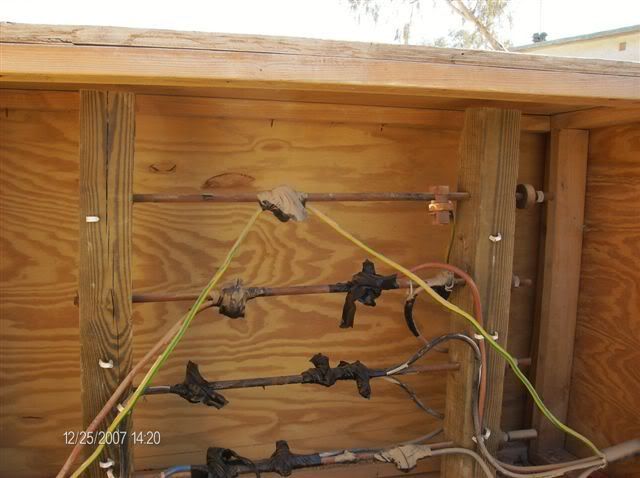
does the busway he designed look anything like this ?
(show him the pic and tell him this was the last ungrounded busway you worked on just for kicks.


groundrodMDP.jpg
 
What's wrong with that. Actually, this particular engineer is so smart he would probably measure between the posts and say they need to be farther apart for 480V, but 240 will be fine.
 
2wheelinusa said:
I'm curious why the buss wouldn't be a good ground? He was adamant about the buss not being grounded.

If the bus enclosure itself is not grounded that is in fact violation and a serious safety issue that should be addressed ASAP.

Is it possible that the bus is supplied from a ungrounded delta system?

That really would not change the requirement but might be what the EE heard and misunderstands.

2wheelinusa said:
I assume mounting a ground lug in the buss disconnect for the ground wire and the 1/4" bolts attaching the box to the buss will be an acceptable method??

It's always been acceptable as far as I know.
 
2wheelinusa said:
Thanks Bob. I can see how I could win the GEC argument, but is he accurate about the bus not being an effective ground?

He may or may not be correct, it depends on how the bus duct was designed.

Prior to the mid 80's almost no metal enclosed busway was considered to be an effective ground path, especially on systems 800A and larger. In the mid 80's manufacturers began to include a dedicated piece of metal in the enclosure to serve as a Listed ground path. but even today this extra "ground bus" is optional on busducts 600A and smaller (i.e. Square D offers their AP30210 - no dedicated ground and AP302G10 - w/Integral Ground Bus)

edited spelling errors.
 
Last edited:
jim dungar said:
Prior to the mid 80's almost no metal enclosed busway was considered to be an effective ground path, especisally on systems 800A and larger.

Regardless of that the EC must use it as the grounding means and the 'EE's suggestion to use a ground rod instead is downright stupid.
 
Years ago I had a friend who worked for a plastic injection mold company that used cords and plugs for their machines. Unfortunately, some of the machines were not properly grounded due to poor maintenance. As a result, one of the machine frames became energized. My friend touched the energized frame of the machine and the properly grounded frame of an adjacent machine. He died.
If the bus frame is not grounded then get it grounded, then make sure each machine has a GOOD EGC. The ground rod may help during a lightning storm but it won't provide a return path for power to the machine.
 
iwire said:
Regardless of that the EC must use it as the grounding means and the 'EE's suggestion to use a ground rod instead is downright stupid.

If the intent is to use an isolated ground rod, then it is not just stupid it is dangerous and irresponsible.

But, what if the intent is to supplement the busway enclosure with a ground rod that is part of the building's grounding grid/system?
 
I suspect that this engineer has a fundamental misunderstanding about the nature of equipment grounding. He is certainly not alone in associating the first five letters of the word "grounding" with planet Earth, thinking (incorrectly) that a ground rod will help electrons find their way back to "ground." He needs to get undeceived about this association before he gets someone killed.
 
jim dungar said:
But, what if the intent is to supplement the busway enclosure with a ground rod that is part of the building's grounding grid/system?

No problem but that is not what is being suggested.

We are dropping a couple 10/4 lines down to cnc's. The factory engineer said because the bus does not have a neutral bar and is not grounded, we should use 10/3 drop and then use a ground rod for the grounding connection at each cnc

10/4 cord has four conductors, 10/3 cord has three conductors unlike NM it is not plus ground.

So assuming a 3 phase machine that 10/3 cord can not supply the machine and provide a grounding means.
 
Status
Not open for further replies.
Top