Per Unit Values from a short circuit example

Merry Christmas

Grouch

Senior Member
Location
New York, NY
Gents,
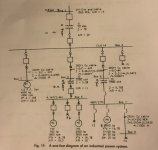
I attached a one-line diagram that I'm looking at. It's from GE's white paper on short circuit calculations.

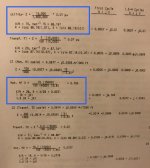
The 2nd attachment shows how they derive the per unit X and R values at each piece of equipment (transformers, motors, the cables, and the utility). The base power value throughout is 15000 kVA.

My questions are how they derived the X and R values where I highlighted in blue in the 2nd attachment.

For the utility (top blue rectangle): the equation to solve for the per unit impedance (Z)... shouldn't it be actual power / base power? The equation that they are using seems to be base power / actual power. The utility power is 1500 MVA. Base power as I mentioned above is 15000 KVA.

For Motor M1 (the bottom blue rectangle): what equation are they using to solve for the motor impedance X? The equation includes an X"d of 15% (sub-transient reactance) and a horsepower of 4000. I'm not familiar with the equation though. What equation is this?

Thanks!
 

Attachments

  • One-Line Diagram.jpg
    One-Line Diagram.jpg
    1.2 MB · Views: 41
  • R and X derivations.jpg
    R and X derivations.jpg
    1.4 MB · Views: 41
The utility X/R is a given or an assumption. The motor X calculation is putting the X value in per unit. X/R is given in the one-line. I think they are using the hp to approximate the kVA by the 0.8 in the divisor.
 
For the motor, they are getting current from horse power and then using the subtransient reactance% of 15/100.

For motors, to covert it to per unit, it is :

MPU = (HP / Sbase) * PF

They probably substituted that in.


X = X"d * (1 / Mpu )

X = X"d * ( Sbase / (HP * PF) )
 
I think they chose the base as 15,000 but I couldn't tell you why. You can try to calculate it with your own base and see if you get the same results.
 
X = X"d * (1 / Mpu )

X = X"d * ( Sbase / (HP * PF) )
Thanks for the equation. Sorry for my delayed response.

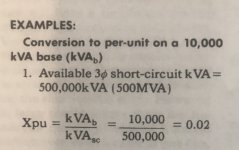
Regarding my question on the utility calculation, here is a similar example, see the attached image.

They are calculating per unit power as (base power / actual power). Isn't this backwards though? Shouldn't it be actual power / base power? Any time you calculate a per unit value, you divide by the base value. To me, Xpu = 500,000 / 10,000.
 

Attachments

  • IMG_1662.jpg
    IMG_1662.jpg
    500.6 KB · Views: 17
Maybe this will make sense, maybe not but when you calculate your actual power/base power you get PU power, not impedance. You stated "they are calculating per unit power as (base power / actual power)" when they are actually calculating PU reactance or impedance.

If you think of the original utility in this example and it is a powerful utility with a capability of supplying 1500 MVA... compare it to a weak utility capable of supplying only 15MVA. The IMPEDANCE of the more powerful utility would be less to enable the larger power flow. Hope it helps.
 
Maybe this will make sense, maybe not but when you calculate your actual power/base power you get PU power, not impedance. You stated "they are calculating per unit power as (base power / actual power)" when they are actually calculating PU reactance or impedance.
Thanks! I follow. I had it all backwards. It makes sense now... I was thinking of power instead of impedance. So I had the wrong value in my mind together with the wrong equation.
 
I'm revisiting this thread. I follow Post #6, that the equation is Zpu = actual impedance / base impedance.

What I don't follow, in my OP... How did they get 15,000 for the actual impedance and 1,500,000 for the base impedance? where do these numbers come from?
 
Thanks! I follow. I had it all backwards. It makes sense now... I was thinking of power instead of impedance. So I had the wrong value in my mind together with the wrong equation.
Not sure what I understood back in March. The equation in my OP, in the top blue box, says Z = 15,000 / 1,500,000. This is to calculate per unit impedance. But the values used in the numerator and denominator have nothing to do with impedance... these are power values... base power / actual power.

What is this equation that they are using, and why they are using these values.
 
Last edited:
Not sure what I understood back in March. The equation in my OP, in the top blue box, says Z = 15,000 / 1,500,000. This is to calculate per unit impedance. But the values used in the numerator and denominator have nothing to do with impedance... these are power values... base power / actual power.

What is this equation that they are using, and why they are using these values.
It is 6:30, on a Saturday morning, the coffee is still brewing, so forgive my typos.

The confusion often comes in because the initial PU value of voltage is set to 1 so it never really shows up when we convert utility short circuit MVA into utility short circuit impedance. If we don't show all of the steps and values (in particular the system voltage/base voltage) it looks like we are calling VA the same as impedance. It is cumbersome to write:
PU Zsc = (MVA base/MVA system)/((Vsystem/Vbase)2)
 
Last edited:
Thank you! Yeah, this would've helped had they wrote the whole equation in there. Sometimes the shortcuts kill me.

Where did you get this equation? Before I posted here I searched a lot on Google, and could not find this. I'm copying and pasting the equation into Google and STILL not finding it anywhere lol.
 
Is this another way to write the equation? I just replaced the left side of the equation.

(Zactual / Zbase) = (MVA base/MVA system)/((Vsystem/Vbase)2)
 
Basic equations work.
P = I X E, E = P/I, I = P/E
E = I X R, I = E/R, R = E/I

P = E X E/R = E2/R or P/E2 = 1/R or R = (1/(P/E2).

For PU the reciprocal of BASE/SYSTEM can be found by using SYSTEM/BASE.
 
Jim is providing excellent advise... maybe another way to view is since they chose the base MVA of transformer as SYSTEM base, you need to change utility using:

Per unit Znew = Per unit Z given x (base kv given / base kv new)^2 x (base kva new / base kva given) which is a common relationship used to adjust device characteristics when the system base is different than the base the values are given on.

In this case the transformer base = system base so just use the 0.07 = 7% but adjust utility... if this is more confusing just ignore me.
 
I guess it's obvious but alternative is to choose the utility rating as base and then change transformer T1 (and everything else). My only caveat is once you choose a base MVA, you're sort of stuck so choose wisely.
 
Thanks guys. Yep this all helped. I think back in March I understood the answer in Post #6, but then afterwards I never followed up by delving into the math.

Appreciate the help.
 
Top