Possible to fit 225a 3ph feeder in 2" EMT with aluminum??

Status
Not open for further replies.

LarryFine

Master Electrician Electric Contractor Richmond VA
Location
Henrico County, VA
Occupation
Electrical Contractor
Title says it all:
Is it possible to fit a 225a 3ph feeder in 2" EMT with aluminum? From what I can see, the answer is no unless I can use the 90C column.
 
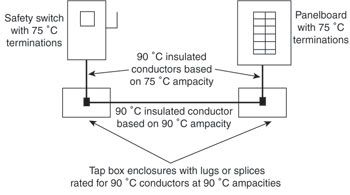
I did not look at wire sizes, but the only one way I see to use the 90C rating instead of the normal 75C is this set up.

09e_PauleyFIG9.jpg
 
I put 4 250 AL compact in 2" EMT before (no wire EGC). IIRC, the chart shows its ok, but doing the math it comes in a hair over. I would not recommend this unless you've only got like 1 90. I had 2 90's and a 45 I think, and it was a bear. So of course 250 MCM is 205 amps, but you can next size up to 225 depending on specifics.
 
I put 4 250 AL compact in 2" EMT before (no wire EGC). IIRC, the chart shows its ok, but doing the math it comes in a hair over. I would not recommend this unless you've only got like 1 90. I had 2 90's and a 45 I think, and it was a bear. So of course 250 MCM is 205 amps, but you can next size up to 225 depending on specifics.

Note 7 table 9 reconciles the math. Reduced noodle would also.

Chart does say 4 #250 Al compact is good.
 
Title says it all:
Is it possible to fit a 225a 3ph feeder in 2" EMT with aluminum? From what I can see, the answer is no unless I can use the 90C column.
Are you pulling a neutral?

Are you using the raceway as the EGC?

If only pulling the three ungrounded conductors I think it might be possible.

3 - compact 300's XHHW will fit in 2 inch EMT but is about all the allowable fill.

You could fit compact 250's and #2 neutral in 2 EMT also, but are limited to 205 amps of calculated load.
 
It's a 240v high-leg delta, so three hots plus neutral, conduit is EGC. I've told the customer we need the load information from the HVAC people. We may be able to downsize the high leg and/or the neutral, otherwise we need to go with copper. It's difficult to provide a specific installation with too many unknown variables.

Is the neutral size based solely on the calculated neutral load, as well as its presence, meaning we could get away with no neutral at all past the fused-switch disconnect? If the panel feeds only 1ph and 3ph 240v HVAC loads, the neutral can be omitted. The customer's interest is in "keeping the full capacity (225a) in reserve".

There is also a 200a 1ph 120/240v entrance available for the 120/240v loads. The existing service is made up of CT metering to a trough supplying the 200a 1ph panel as well as a 400a 3ph panel. Both panels are being replaced with new ones, relocated farther in the building, with the 400a being downsized to 200a or 225a.

 
It's a 240v high-leg delta, so three hots plus neutral, conduit is EGC. I've told the customer we need the load information from the HVAC people. We may be able to downsize the high leg and/or the neutral, otherwise we need to go with copper. It's difficult to provide a specific installation with too many unknown variables.

Is the neutral size based solely on the calculated neutral load, as well as its presence, meaning we could get away with no neutral at all past the fused-switch disconnect? If the panel feeds only 1ph and 3ph 240v HVAC loads, the neutral can be omitted. The customer's interest is in "keeping the full capacity (225a) in reserve".

There is also a 200a 1ph 120/240v entrance available for the 120/240v loads. The existing service is made up of CT metering to a trough supplying the 200a 1ph panel as well as a 400a 3ph panel. Both panels are being replaced with new ones, relocated farther in the building, with the 400a being downsized to 200a or 225a.

Noodle does not need to go past first disconnecting means. If not needed past that for panel, not required.
 
It's a 240v high-leg delta, so three hots plus neutral, conduit is EGC. I've told the customer we need the load information from the HVAC people. We may be able to downsize the high leg and/or the neutral, otherwise we need to go with copper. It's difficult to provide a specific installation with too many unknown variables.

Is the neutral size based solely on the calculated neutral load, as well as its presence, meaning we could get away with no neutral at all past the fused-switch disconnect? If the panel feeds only 1ph and 3ph 240v HVAC loads, the neutral can be omitted. The customer's interest is in "keeping the full capacity (225a) in reserve".

There is also a 200a 1ph 120/240v entrance available for the 120/240v loads. The existing service is made up of CT metering to a trough supplying the 200a 1ph panel as well as a 400a 3ph panel. Both panels are being replaced with new ones, relocated farther in the building, with the 400a being downsized to 200a or 225a.
Grounded conductor must be brought to service equipment, but beyond that you are not required to have one if you have no load that utilizes that conductor.

If you do have limited neutral load you only need to size per highest unbalance load - but must at least be as large as minimum required EGC, so for a 225 amp circuit even if you only had calculated 25 amps of maximum neutral you still would need 4AWG copper or 2AWG aluminum.

see 215.2(A)(2)

Note there is no minimum grounded conductor size for branch circuits, other then you need to be able to handle the neutral load. I run into this a lot with aeration fans on grain storage. Might have a 80 or 90 amp breaker for the motor circuit, but the stupid equipment manufacturer puts in a 120 volt contactor:rant: So we have a neutral load of just a few VA - I always run 14 AWG neutral in branch circuit portions of those applications.
 
Last edited:
Good info. Am I correct that there is no minimum size for the high leg beyond load calculation?
If using circuit breakers you typically stuck with same overcurrent setting per pole, but yes with fuses you can reduce the size of high leg if the load just isn't there.
 
So we have a neutral load of just a few VA - I always run 14 AWG neutral in branch circuit portions of those applications.
So why does the NEC require the neutral in a feeder to be at least as large as the minimum required EGC, but doesn't impose this requirement on branch circuits?

Cheers, Wayne
 
If using circuit breakers you typically stuck with same overcurrent setting per pole, but yes with fuses you can reduce the size of high leg if the load just isn't there.

I have seen the reduced sized high leg only a few times on stuff that I demoed. Def had to think about for a few minutes the first time around; so used to seeing same size ungrounded conductors.
 
So why does the NEC require the neutral in a feeder to be at least as large as the minimum required EGC, but doesn't impose this requirement on branch circuits?

Cheers, Wayne
I have no idea, but there is no similar rule in 210 for branch circuits.
 
I have seen the reduced sized high leg only a few times on stuff that I demoed. Def had to think about for a few minutes the first time around; so used to seeing same size ungrounded conductors.
Back when they still used Delta breakers, I think that was common. 100/200 amp conductors for the 120 volt lines landing on a 100/200 amp main breaker, maybe only a 6 or 8 AWG landing on the delta breaker for the only three phase load in the building - usually the air conditioning.
 
Status
Not open for further replies.
Top