service entrance routed inside building

Status
Not open for further replies.

cvirgil467

Senior Member
Location
NewYork
Our service equipment is located on the second floor. The service entrance condcutors will be routed below the building and then turn up a shaft. Do the conduits need to be encased in 2" of concrete when routed through this shaft? The shaft will also contain other conduits for feeders and branch circuit wiring. Forget opinions for now, i just want pure code analysis.

I could not locate anything in the 2005 code that says i need to concrete encase the conduits other than if the service conductors were passing through to feed another building.

Thanks.
C
 
The shaft shall be encased by not less than 2 in. of concrete or brick within the building. Please refer to Exhibit 230.15 on page 137 of 2005 NEC handbook.
 
While the NEC gives no maximum distance that SE conductors can run inside a building, many local codes do. In Washington State its 15 ft of raceway, other states have 2, 3,5 or no feet. However, if concrete encased then the conductors are not considered inside the building.
 
What is the purpose of the shaft mentioned in the OP?

Most likely the shaft is part of the interior of the building, and would not be considered as outside of the building. In that case, the conduit the service conductors are in would need concrete encasement, 230.6 and 230.70(A)(1).
P.S. the NEC does not say the service conductors cannot pass through this building, those conductors are limited by the location of the service disconnecting means.

Where in NY is this located?
 
Last edited:
Although all of the responses are correct I see what you mean by "pure code analysis". Yes the AHJ must make the call if the service can be located on the second floor but as for the service conductors entering the building, this could be confusing if you look at 230.32. It says you use 230.6 or a raceway wiring method in 230.43
 
I don't see anything hard or confusing about this.

The NEC requires the service disconnect to be 'nearest the point of entrance of the service conductors.

It sounds to me that your service conductors are entering the building at the ground level and you intend them to travel for some distance inside the building.

It will be up to the AHJ to determine how far they will allow you to go.

IMO it sounds to far and your options will be either move the service disconnect or encase the service conductors.

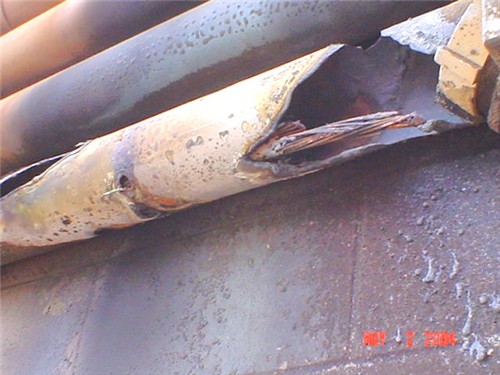
Here is an example of service conductors that faulted inside a 4" RMC.

NB3.jpg


What would happen if this occurs inside the shaft you want to run in?

Regardless of what the inspector will allow my suggestion is keep it short or encase it.
 
Bob,

I love that photo. Any idea what caused a fault in the middle of the conduit? Also I agree that this is a pretty cut and dry code requirement. I don't see how any AHJ would let service entrance conductors travel through a building to the second floor with out the required encasement. As you can see from the photo there is a good chance of severe damage to the building if a problem arose within the conduit run.
 
Around here you can get about 40' no encasement - depending on the general opinion of the indivbidual inpector.... But RMC is mandatory above grade or not encased.
 
e57 said:
Around here you can get about 40' no encasement - depending on the general opinion of the indivbidual inpector....

That is just plain scary to a guy that is used to about a 5' limit.
 
Hell.....we are lucky if we get 3'

I agree with Pierre'......hard to consider it outside of the building when it is actually within the building...not under the building either....

So i appears clear to me and I would not approve it....why not just have it come up to a main disconnect on the lower level and then in conduit to the remote distribution panel ( sub ) on the second floor if you wish.
 
Bob,

I agree with every thing you are saying and have been a strong supporter of concrete encasement but I was wondering why the reference to 230.43 exist.

Jim
 
Status
Not open for further replies.
Top