service feeders

Status
Not open for further replies.
I have an issue with a code being referenced by a city inspector in the City of Santa Monica. He is requesting that my general contractor encase the overhead feeder coming into the building to feed the meter panel in 2" of concrete. The code they reference is 230.6 (2). The meter panel is in the rear of the building in a garage shop area, is being fed with a 4" rigid inside of the building on the exterior wall up thru the roof to a weatherhead. I read the code they referenced and my interpretation is that 230.3 talks about feeders to one building cannot pass thru another and then 230.6 is referencing what is considered outside of a building. Just wondering what your take on this is ?? Any other codes that may reference this issue would help out greatly. I have personally never heard of this, and I belive that the inspector is wrong.

Thanks
 
I believe the conductors you are referring to are service conductors and not a feeder since there is no overcurrent protection where they receive their supply. Concrete encasing the conduit/conductors protects the premises from potential fire due to lack of overcurrent protection on the service conductors. I have run into this and although the code states pretty clearly the requirement some AHJ's allow service conductors to enter into the building when the distance is relatively short, such as stubbing up from the floor and terminating within the service panel, meter etc.
 
I've encountered this once also. An inspector in Wisconsin made us encase two runs of PVC that came up through the floor then into a wireway which ran over the top of the service disconnect. His logic was similar, only he quoted 230.70(A)(1) and the reference to the pipes not being "outside of the building" by the definition of 230.6. We gave a limited protest and ultimately encased the pipes.

The reference to 230.3 doesn't apply (I don't think) in this case.
 
Check out article 240.21. It addresses overcurrent protection of conductors and where it is required to be located. Basically, Overcurrent is required where a conductor receives it's supply. This article lists the exceptions, specifically 240.21 (c) (4) i believe in your case. Concrete encasing the conductors is considered "outside the building" and meets the exception.
 
The 4" rigid is the service entry conduit ,it is above 6 ft and is safe from any dmg. I understand that 230.6 deals with WHAT is concidered outside of the building , but where does it say that the service entry conductors cannot be run inside of the building, and by incasing the conduit it would then be outside of the building. I I know you cannot run service entrance conductors thru a building to get it to another one.
 
The section the inspector needs is 230.70(A)(1)
The disconnecting means is located nearest the point of entry of the conductors.

The key word is "nearest'. If the Code read "exactly at the point of entrance it would be a different ballgame.

Judgement call by your local AHJ. Make sure the real AHJ(the inspectors boss) is in concurrence

If the riser comes into the building through the roof and straight down to the service equipment, then I would think that ok.
Caveat: It would be exposed the whole way down and not pass through any office space on an upper floor or mezzanine.
 
George, first I have to ask are we talking about feeders or service conductors. There really is no such thing as a 'service feeder'.

I will assume it is service conductors.

230.70(A)(1) requires that the service disconect to be nearest the point of entrance of the service conductors.

In some areas the AHJ will allow 3,5, maybe 10' of service conductor inside the building, in other areas the AHJ will not allow an inch of service conductor in the building.

The way the NEC rule is worded it is definitely the AHJs call.

However according to 230.6 service conductors encased in concrete are considered outside the building even when they are inside the building.

So....IMO the inspector is well within their power to either have you encase the service conductors or install the service disconnect outside the building.

The reason why can be seen here.

NB3.jpg


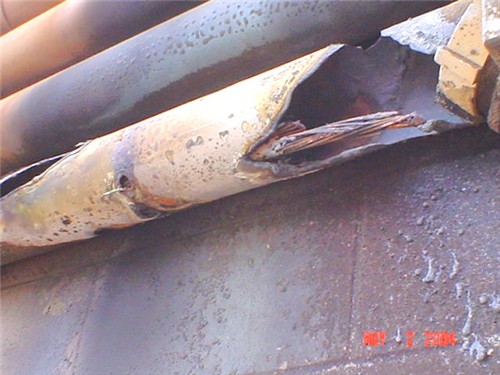
Here is a 4" RMC that had a service conductor fault inside it.

It was up about 15' out of harms way.
 
Article 240.21 states that all conductors shall have overcurrent protection at the point in which they receive their supply. I assume that the conductors connected to the utility transformer do not have overcurrent protection at the point of which they receive their supply since that is typically the case. Under other circumstances this would not meet code except that the code allows for this installation under Exception 240.21 (C) (4) In order to comply with the exception you must keep the conductors outside the building or concrete encase them (2") since the code considers this to be "outside the building" See 230.6 Conductors Considered Outside the Building for acceptable methods
 
In some areas the AHJ will allow 3,5, maybe 10' of service conductor inside the building, in other areas the AHJ will not allow an inch of service conductor in the building.

True! BUT whatever the allowable length is, it must be the SAME for everyone in that municipality!

The inspector cannot decide this one is 5', this one is 10', and hey you win today, 2" of concrete encasing your conduit!

My take on the OP is he has service entrance conduit, fed from teh POCO, running exposed on the interior of an outside wall to an interior located meter. What is the allowed "unprotected" length of conduit and wire as referenced in 230.70(A)(1).

IF the entire conduit run was on the exterior of the outside wall, then there is no issue.
 
whe4 said:
Under other circumstances this would not meet code except that the code allows for this installation under Exception 240.21 (C) (4)

IMO that exception is not needed for service conductors.

The OCP rules for service conductors are contained in Article 230. {240.3} {320.90}

240.21 (C) (4) applies to customer owned transformers and feeders.

It matters not as the rules are essentially the same. 8)
 
tshea said:
In some areas the AHJ will allow 3,5, maybe 10' of service conductor inside the building, in other areas the AHJ will not allow an inch of service conductor in the building.

True! BUT whatever the allowable length is, it must be the SAME for everyone in that municipality!

The inspector cannot decide this one is 5', this one is 10', and hey you win today, 2" of concrete encasing your conduit!

I disagree. In my area 5' is generally allowed but you will not find it written anywhere, they do have the option of saying none.

Here is the handbook cometary which I feel sums this up nicely.

Some local jurisdictions have ordinances that allow service-entrance conductors to run within the building up to a specified length to terminate at the disconnecting means. The authority having jurisdiction may permit service conductors to bypass fuel storage tanks or gas meters and the like, permitting the service disconnecting means to be located in a readily accessible location. However, if the authority judges the distance as being excessive, the disconnecting means may be required to be located on the outside of the building or near the building at a readily accessible location that is not necessarily nearest the point of entrance of the conductors. See also 230.6 and Exhibit 230.15 for conductors considered to be outside a building.

Basically it is an area of the NEC that is left as a judgment call.
 
thanks

thanks

Well as always you guys have been great help, I think this gives me the answers I need. I took the whole thing for granted and now understand how dangerous it can be. Since I 'm not gonna be the one actually doing the encasing (however difficult that may be) I'll suggest that they may want to re run the Service entrance conduit outside of the building and stub into the back of the Meter Panel, Anyways Ill check it with the inspector, if he will allow this. Thanks again.
 
I disagree. In my area 5' is generally allowed but you will not find it written anywhere, they do have the option of saying none.
So if you got an inspector who was po'd at the worls he could say your 2' was too much and to reduce it to 0', but let the next job he looks at go at 5'?

Here in Wisconsin it is maximum 8'. That is a State rule. The playing field is level for all.
 
tshea I hear you loud and clear, my view on this issue is opposite of my typical view and I can tell you why.

As we do not have any amendment to the NEC the actual NEC rule does not really allow any length of service conductors in the building.

That being the case each time they let us go 5' they are really just not enforcing the rule and as Charlie the utility guy has pointed out this could lead to a bad situation for the EC if something happens.

In practice I have found it generally goes smoothly here as long as you keep it as short as possible.
 
Status
Not open for further replies.
Top