Service Wireways

I have a wireway (gutter) with load side of utility wire coming into the wireway from meter. I am also passing the load side of my main disconnects through the same wireway. I was turned down by inspector. Where is the code that refers to not being able to do this
 
230.7

I think there is a argument to be made that a wireway is not a raceway. But, it is not really a good idea to have load side connections sharing the same gutter or raceway as your service entrance conductors. At least not without some kind of separator.
 
230.7

I think there is a argument to be made that a wireway is not a raceway. But, it is not really a good idea to have load side connections sharing the same gutter or raceway as your service entrance conductors. At least not without some kind of separator.
Thanks for replying. The inspector does not know the code that this refers to. All he said was you can mix them in service rated disconnects, ATS, etc... but not in gutters (wireways)
 
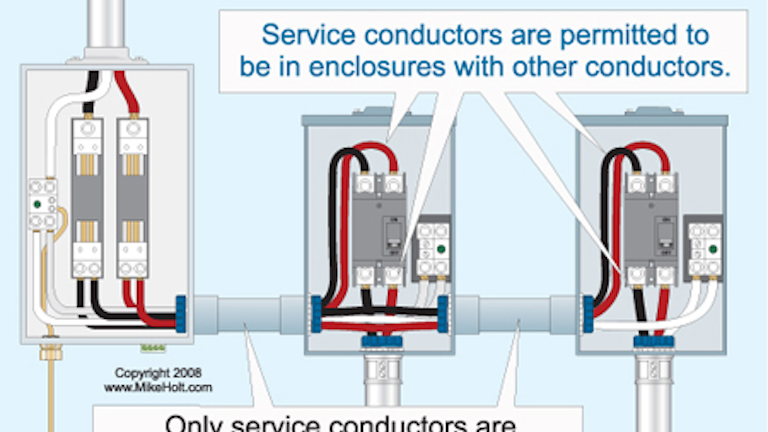
Here's a few examples from Mike Holt:
ecmweb_2768_230_0701web.png

1646773227923-png.2559763
 
In that last picture, change it so that the meter boxes are tight to the horizontal enclosure above, with no offset nipples in between. Now you can call the enclosure an Article 366 Auxilliary Gutter, and there is no violation.

Simpler I guess would be to run a nipple through the wireway.

Cheers, Wayne
 
I don't agree that a wireway is a raceway. Look at 376.2. It says that a wireway is attached to a raceway to complete system.
From 2020 NEC 376.2 (in 2023 the definition moved to Article 100):

"Metal Wireways. Sheet metal troughs with hinged or removable covers for housing and protecting electrical wires and cable and in which conductors are laid in place after the raceway has been installed as a complete system."

I read "the raceway" in the above as referring to the metal wireway. So the definition tells you a metal wireway is a raceway.

Cheers, Wayne
 
From 2020 NEC 376.2 (in 2023 the definition moved to Article 100):

"Metal Wireways. Sheet metal troughs with hinged or removable covers for housing and protecting electrical wires and cable and in which conductors are laid in place after the raceway has been installed as a complete system."

I read "the raceway" in the above as referring to the metal wireway. So the definition tells you a metal wireway is a raceway.

Cheers, Wayne
Yes per the definition from Article 376 it's a raceway. My guess is that the UL listing says the same thing.
 
but not in gutters (wireways)
Actually you can mix them in an auxiliary gutter (Article 366), but not in wireways (Article 376). Most everything that is called a gutter in the field is actually a wireway. In general if the item in question is connected to other enclosures via nipples, it is a wireway.
 
Actually you can mix them in an auxiliary gutter (Article 366), but not in wireways (Article 376). Most everything that is called a gutter in the field is actually a wireway. In general if the item in question is connected to other enclosures via nipples, it is a wireway.
Like Don I've always viewed the two as separate entities even though they can be practically identical in the field. I'm wondering why there is even a need for a distinction between the two.

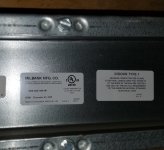
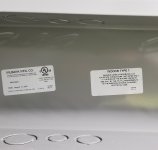
I found these labels odd. I'm guessing that the listing applies directly to the product use and not the actual way it's manufactured.
Wireway Label 001.jpg
Wireway Label 002.jpg
 
Yes a lot of the products are listed as both, but the article that covers them is determined by how they are used. An auxiliary gutter physically expands the wiring space of the equipment they are connected to. The best example that I can think if is a "top hat" for a MCC. However I know that you can get auxiliary gutters for some service equipment>

I think one of the reasons for the two articles is that when an auxiliary gutter is used with a service equipment enclosure, it becomes part of the service equipment enclosure. You are permitted to have conductors other than service conductors in the service equipment enclosure.
 
In general if the item in question is connected to other enclosures via nipples, it is a wireway.
the article that covers them is determined by how they are used.
So as a practical matter, how would you take a wireway or auxiliary gutter like the ones infinity pictured, and install them as shown in the lower picture in post #5, but without the nipples, so that the enclosure is now an auxiliary gutter rather than a wireway?

Let's say this is indoors so that maintaining 3R is not an issue. So I guess that means the meters would be gone, the gutter would be above/below the panelboard enclosures.

Cheers, Wayne
 
So as a practical matter, how would you take a wireway or auxiliary gutter like the ones infinity pictured, and install them as shown in the lower picture in post #5, but without the nipples, so that the enclosure is now an auxiliary gutter rather than a wireway?
I know of no way attach an auxiliary gutter to those meter cans. and I can see no use for one in that application as most if not all utilities prohibit conductors other that service conductors in a meter can.

I am not sure there is any way to use an auxiliary gutter unless it has been either supplied or specified by the manufacture of the equipment that it is being attached to. It must increase the wring space for the enclosure that it is attached to.

An auxiliary gutter adds to the amount of space in a piece of equipment. A wireway runs between pieces of equipment or is connected to equipment via raceways.

Other than MCC top hats, I don't think I have ever seen an auxiliary gutter installation.
 
Picture a panel enclosure with one side cut away, and a trough with its open side (and without its cover) the same size as the opening, is attached to the enclosure so its volume adds to the enclosure's volume.
 
Picture a panel enclosure with one side cut away, and a trough with its open side (and without its cover) the same size as the opening, is attached to the enclosure so its volume adds to the enclosure's volume.
Right, so if I wanted to, in a dry location, is there anything prohibiting me from taking a load center, cutting out most of the bottom of the provided cabinet, cutting a matching size rectangular hole in the top of some off-the-shelf auxiliary gutter, and bolting them together, presumably with some edge protection for the cut metal edges?

In a dry location, I'm not seeing any listing requirement for a metal cabinet or the metal auxiliary gutter.

Cheers, Wayne
 
Right, so if I wanted to, in a dry location, is there anything prohibiting me from taking a load center, cutting out most of the bottom of the provided cabinet, cutting a matching size rectangular hole in the top of some off-the-shelf auxiliary gutter, and bolting them together, presumably with some edge protection for the cut metal edges?

In a dry location, I'm not seeing any listing requirement for a metal cabinet or the metal auxiliary gutter.
I was being illustrative; I'm not sure about listing requirements.
 
Top