
Short circuit on an ungrounded delta delta system. Where does it go?

Dale001289

Senior Member
Location
Georgia
Let’s say you have a delta delta ungrounded system, 13.8kV to 480V with ground detectors installed at the 489V switchgear. A ground fault occurs and is alarmed via the ground detectors… but for some reason doesn’t get cleared by plant operations, and the fault goes phase to phase, ie short circuit.
Will the GEC take the short circuit current into the earth and into to the grounding electrode system?
 
Let’s say you have a delta delta ungrounded system, 13.8kV to 480V with ground detectors installed at the 489V switchgear. A ground fault occurs and is alarmed via the ground detectors… but for some reason doesn’t get cleared by plant operations, and the fault goes phase to phase, ie short circuit.
Will the GEC take the short circuit current into the earth and into to the grounding electrode system?

nope,

Current only follows closed circuit paths from one end of the 'source' to the other. The GEC might carry incidental 'charging current' caused by capacitive paths, but otherwise won't see much current in a ungrounded system.

In an ungrounded system, a phase to phase fault is simply a huge transient load, going from the source, through one fault into metal that shouldn't be carrying current, then through the other fault, and back to the source.

-Jonathan
 
Will the GEC take the short circuit current into the earth and into to the grounding electrode system?
GEC never 'take current into the earth' unless it is from a lightning strike.

As @winnie said, fault current needs to return to its source. Because current flows on all potential paths while it is possible some will flow through some dirt, but it will be minimal on less than 1000V systems.
 
GEC never 'take current into the earth' unless it is from a lightning strike.

As @winnie said, fault current needs to return to its source. Because current flows on all potential paths while it is possible some will flow through some dirt, but it will be minimal on less than 1000V systems.
What would be the end result of ‘fault current back to source’?
Would this current ultimately trip the CB in the primary side of the transformer? Or would it stay on the secondary side within the secondary air terminal chamber without a trip?
 
What would be the end result of ‘fault current back to source’?
Would this current ultimately trip the CB in the primary side of the transformer? Or would it stay on the secondary side within the secondary air terminal chamber without a trip?

Think of the double fault in an ungrounded system as a huge load applied to the transformer. Something will (hopefully) trip, but what depends on the specifics of the system design.

The primary of the transformer doesn't see a fault at all. It just sees a large current. If this current exceeds the trip rating of the primary OCPD, then it will eventually open.

But a known failure mode in _grounded_ 480V systems is L-L arcing where the arc impedance limits the fault current. The primary doesn't see excess current, the secondary doesn't see excess current, and the fault location simply keeps burning. I presume this can also happen in ungrounded 480V systems.
 
“and the fault location simply keeps burning”…this sounds like a very risky scenario
Thanks for the feedback !
it would take specific conditions (small arcing) to allow the fault to persist and not trip the secondary side OCP. That is true for all circuits. BUT more often than not a decent fault will create enough current to trip breaker or blow a fuse pretty damn quick. Even a fuse on a primary side protected only Xfrmer.
 
What would be the end result of ‘fault current back to source’?
Would this current ultimately trip the CB in the primary side of the transformer? Or would it stay on the secondary side within the secondary air terminal chamber without a trip?
Overcurrent protective devices respond to current magnitude not current paths. You need other protection features, such as ground fault, in order to trip other types of faults.
As @winnie said the primary cannot directly sense a fault on the secondary as anything other than excess loading. This is why the NEC requires the majority of indoor transformer installations to have both primary and secondary protection.
 
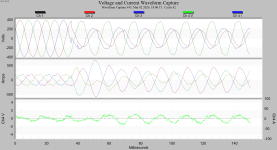
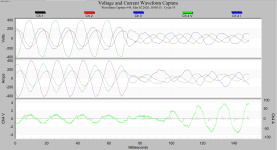
Here is one I was tasked with looking at.

This was a fault on the utility side, through the utility transformer to a 480V ungrounded wye. Then through a grounding / isolation transformer (480V delta - 277/480V wye). This monitor was on the 277V side.

I think it was a phase to phase. The utility marked it as 3 phase overcurrent (basically line to line to line). As the voltages synced and went from 380V (peak) to ~100V (peak) the current came up and eventually as the utility feeder opened (and eventually retested) the neutral had ~50A (peak) at like 3V. This was interesting to me, but I can't put my finger on what it is. Whether it is the utility burning through the fault, voltage comes down, syncs, and the imbalance creates neutral current? It is hard to tell. The max was 4V -100A (peak).

1772634794086.png
1772634828084.png
 
Hmm. The utility primary circuit is probably grounded, and the 480/277V wye secondary that you are monitoring is also grounded. So you could have capacitive coupling closing a circuit through the soil.

Double check your interpretation of the traces; it looks to me like the CH4 _green_ trace is just voltage, peaking at about 4V, and the CH4 dark trace is current, showing little wiggles near zero, not getting anywhere close to a sustained 100A. Is CH4 monitoring neutral current and neutral - ground voltage, or EGC current, or something else?
 
Hmm. The utility primary circuit is probably grounded, and the 480/277V wye secondary that you are monitoring is also grounded. So you could have capacitive coupling closing a circuit through the soil.

Double check your interpretation of the traces; it looks to me like the CH4 _green_ trace is just voltage, peaking at about 4V, and the CH4 dark trace is current, showing little wiggles near zero, not getting anywhere close to a sustained 100A. Is CH4 monitoring neutral current and neutral - ground voltage, or EGC current, or something else?

Utilty is ungrounded.

You are right. the grey looked like the zero line. I wasn't reading it right. I also didn't mention it in my notes because I don't normally comment on the neutral channel.

Makes me wonder what it is. Maybe just coupling.
 
Top