

I consider myself a code wonk: I like that things are spelled out in black & white and not subject to arbitrary determinations. That said, the purpose of the code is to ensure safe and professional installations. It should not be a replacement for common sense. Case in point...
I installed some 1/2" EMT inside a steel-framed partition wall. The junction box feeding the conduit is mounted on the top track. Each of the three conduit descend then turn 90 degrees and pass through holes I punched in the steel studs. The holes are just large enough to fit the EMT, so there is no possibility of free vertical movement of the conduit.
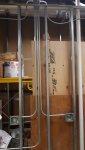
The inspector refused to pass the inspection, stating that the conduit needed to be secured within 3' of the top junction box. I acknowledge that this is the "letter of the code." But, IMO, it exceeds the "spirit of the code" and it seems ridiculous to me for the inspector to insist upon it. That conduit is protected inside a wall and it will be impossible for it to move physically, either vertically or horizontally, without ripping the wall open and disassembling the conduit from the connectors. Even if, by some miracle, the set screws in the connectors all un-torqued themselves and fell out inside the wall, that conduit simply cannot move.
It's no big deal for me to add a Caddy bracket between the studs and clamp the conduit to it. But will that make the installation any safer or better in any way? No.
I installed some 1/2" EMT inside a steel-framed partition wall. The junction box feeding the conduit is mounted on the top track. Each of the three conduit descend then turn 90 degrees and pass through holes I punched in the steel studs. The holes are just large enough to fit the EMT, so there is no possibility of free vertical movement of the conduit.
The inspector refused to pass the inspection, stating that the conduit needed to be secured within 3' of the top junction box. I acknowledge that this is the "letter of the code." But, IMO, it exceeds the "spirit of the code" and it seems ridiculous to me for the inspector to insist upon it. That conduit is protected inside a wall and it will be impossible for it to move physically, either vertically or horizontally, without ripping the wall open and disassembling the conduit from the connectors. Even if, by some miracle, the set screws in the connectors all un-torqued themselves and fell out inside the wall, that conduit simply cannot move.
It's no big deal for me to add a Caddy bracket between the studs and clamp the conduit to it. But will that make the installation any safer or better in any way? No.


