Strange Transformer Wiring Method

jrhopkins

Member
Location
Portland, OR
Occupation
Electrician
I work for a large manufacturing company. This company has it's own xfmr wiring schematic that they waterfalled to the AHJ and the electrical contractors on site. The inspector with the AHJ has told me in conversation that the city is not a fan of this new wiring method so the question I have is, is this new wiring method safe? The "new" wiring method is as follows. All grounds land under a common ground bar (nothing out of the ordinary), but instead of routing the secondary neutral to the "XO" the neutral for the secondary is instead landed at the common ground bar. The equipment bonding jumper is the only conductor that lands on the "XO", but the equipment bonding jumper is to be the same phase color and conductor size as the neutral for the secondary. This is a 480/277V primary, 400/230V secondary xfmr. It has me concerned about there now essentially being (2) "XO" termination points as landing the neutral for the secondary on the common ground bar essentially turns the ground bar into an auxiliary "XO" doesn't it? Since it is a code violation to land a neutral on the ground bar at the panel, why would it not be a code issue to land the neutral at the ground bar instead of the "XO" in the xfmr? I know that the neutral is created from the ground at the transformer, but something about this just doesn't sit right with me. The companies engineers have assured the AHJ and us contractors this wiring method is electrically sound, so I guess I'm just trying to make sure these engineers aren't putting myself, or my company in a compromising position with this wiring method.
 
I d
I work for a large manufacturing company. This company has it's own xfmr wiring schematic that they waterfalled to the AHJ and the electrical contractors on site. The inspector with the AHJ has told me in conversation that the city is not a fan of this new wiring method so the question I have is, is this new wiring method safe? The "new" wiring method is as follows. All grounds land under a common ground bar (nothing out of the ordinary), but instead of routing the secondary neutral to the "XO" the neutral for the secondary is instead landed at the common ground bar. The equipment bonding jumper is the only conductor that lands on the "XO", but the equipment bonding jumper is to be the same phase color and conductor size as the neutral for the secondary. This is a 480/277V primary, 400/230V secondary xfmr. It has me concerned about there now essentially being (2) "XO" termination points as landing the neutral for the secondary on the common ground bar essentially turns the ground bar into an auxiliary "XO" doesn't it? Since it is a code violation to land a neutral on the ground bar at the panel, why would it not be a code issue to land the neutral at the ground bar instead of the "XO" in the xfmr? I know that the neutral is created from the ground at the transformer, but something about this just doesn't sit right with me. The companies engineers have assured the AHJ and us contractors this wiring method is electrically sound, so I guess I'm just trying to make sure these engineers aren't putting myself, or my company in a compromising position with this wiring method.
I dont pretend to know a lot about Xfmr hookups but would it make you feel better to swap the 2 wires?
I wouldnt feel to good about landing XO on the ground bar either.
 
It would be basically the same as a neutral bar in a service, but the jumper from that bar to XO is full sized? Or sized as a bond jumper?
The companies new wiring spec requires the equipment bonding jumper to be the same size and color as the secondary neutral. In my configuration it means for my 75KVA transformer the equipment bonding jumper from the common ground bar to the XO is sized as #350 and phased gray to match the neutral for the 400/230V secondary.
 
I d

I dont pretend to know a lot about Xfmr hookups but would it make you feel better to swap the 2 wires?
I wouldnt feel to good about landing XO on the ground bar either.
Unfortunately I don't get to decide the wiring configuration and I am required to wire the transformer to the companies wiring spec.
 
I work for a large manufacturing company. This company has it's own xfmr wiring schematic that they waterfalled to the AHJ and the electrical contractors on site. The inspector with the AHJ has told me in conversation that the city is not a fan of this new wiring method so the question I have is, is this new wiring method safe? The "new" wiring method is as follows. All grounds land under a common ground bar (nothing out of the ordinary), but instead of routing the secondary neutral to the "XO" the neutral for the secondary is instead landed at the common ground bar. The equipment bonding jumper is the only conductor that lands on the "XO", but the equipment bonding jumper is to be the same phase color and conductor size as the neutral for the secondary. This is a 480/277V primary, 400/230V secondary xfmr. It has me concerned about there now essentially being (2) "XO" termination points as landing the neutral for the secondary on the common ground bar essentially turns the ground bar into an auxiliary "XO" doesn't it? Since it is a code violation to land a neutral on the ground bar at the panel, why would it not be a code issue to land the neutral at the ground bar instead of the "XO" in the xfmr? I know that the neutral is created from the ground at the transformer, but something about this just doesn't sit right with me. The companies engineers have assured the AHJ and us contractors this wiring method is electrically sound, so I guess I'm just trying to make sure these engineers aren't putting myself, or my company in a compromising position with this wiring method.
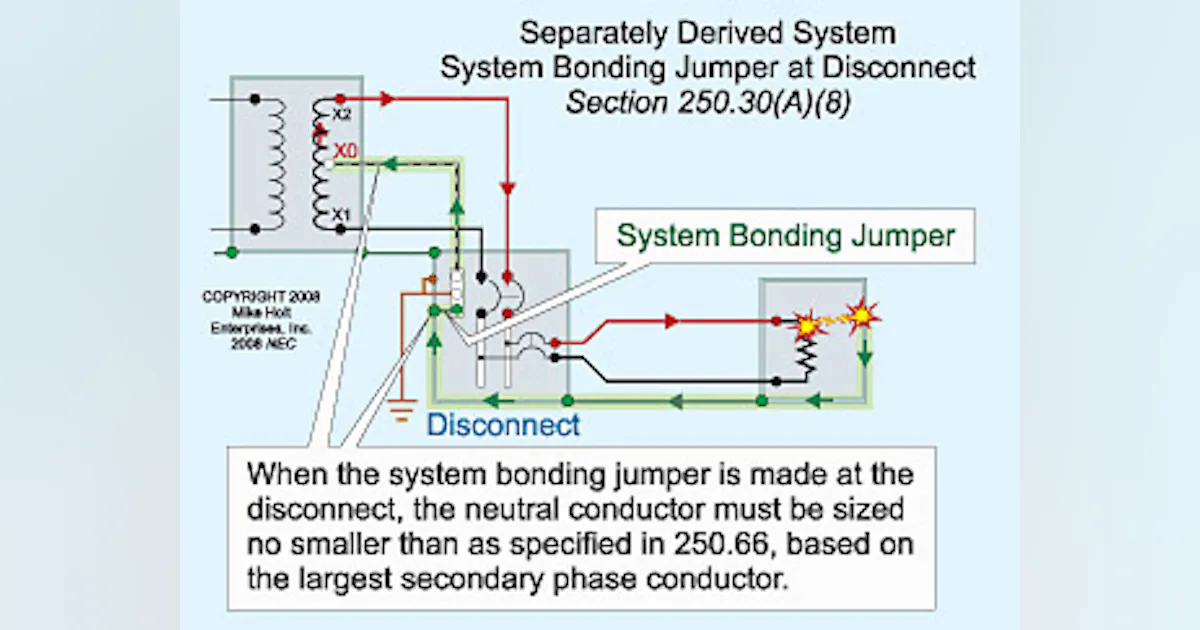
The bond does not have to be in the transformer, it can be in the first disconnecting means, and if that is in the panel, the grounds can go on the neutral bar, it’s just common practice that it gets bonded in the transformer.
 
It sounds like the company diagram meets the NEC. If the conductor from the X0 terminal to the ground bar is not green it sounds like it is a neutral conductor not an equipment bonding jumper. The NEC allows the X0 to ground jumper to be located in the transformer or in the downstream panel/disconnect/breaker.
 
I'm probably the only guy on this site that bonds the neutral in the first disconnect for a transformer. It's the way I was taught.
ecmweb_3267_803ecmcbfig1.png
 
I'm probably the only guy on this site that bonds the neutral in the first disconnect for a transformer. It's the way I was taught.
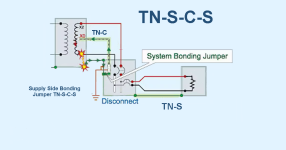
I have done them like that for sure, I'd call that the traditional NEC SDS method or in IEC terms I'd call it TN-S-C-S.

If I understand correct in the traditional method (TN-S-C-S); The first segment of secondary has a neutral and 'supply side bonding jumper', not to be contused with Multi grounded neutral (MGN) or Terra 'Neutral' -combined (TN-C), like a utility service where we would bond the combined neutral/equipment ground (protective conductor) at the transformer and the first disconnect, making the raceway a parallel neutral path.
In the traditional method there is no parallel neutral path,
Also in the traditional method a fault at transformer case needs to travel from the case via a separate protective conductor the NEC calls 'supply side bonding jumper' (the first 'S' in TN-S-C-S) to the first disconnect where it hits the neutral (the 'C' in TN-S-C-S) and travels back to X0 via the neutral.
A fault downstream of the main, like the original graphic, clears via equipment grounding conductor (the last 'S' in TN-S-C-S).
xo-fault.png

What the OP is describing as the 'strange method' I suspect is just a pure TN-S or possibly TN-S-S, is the Neutral immediately connects to a GEC at the transformer, I call that jumper from X0 a neutral, and the gound bar in the transformer I'd call a 'neutral' bar,
In TN-S the 'supply side bonding jumper' would not be called upon for a line to case fault inside the transformer enclosure, but still needs to carry more fault current than a ECG and sized differently than a EGC.
In TN-S the neutral is never part of the fault clearing path as in the first disconnect grounds and neutrals are separate ('S').
 
Last edited:
I'm probably the only guy on this site that bonds the neutral in the first disconnect for a transformer. It's the way I was taught.
ecmweb_3267_803ecmcbfig1.png
I’ve done it
Maybe once or twice when coming behind the original installer as a repair. It’s quicker to do at the disconnect or panel when you don’t want to have the customer down for a long period taking apart the transformer. Usually it’s for computers, because they don’t understand what “Isolated ground” actually means.
 
Top