

tap of panel bus

Merry Christmas

Sierrasparky

Senior Member
Location
USA
Occupation
Electrician ,contractor
I have a customer who's prior electrician made a tap (using a plug on terminal block ) at a 200amp Meter main load center. The terminal block is only rated for 150amps. ( can't believe it is rated that high) there is no main breaker in the panel fed from the tap. I argue that it does not comply with the tap rules. I know the terminal block is a issue. How say you?
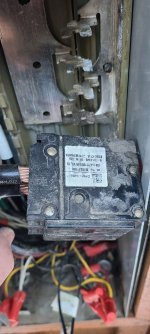
 
prior electrician made a tap (using a plug on terminal block ) at a 200amp Meter main
2/0cu tap needs max 175A OCP standard size, per T240.6(A), except for:
* Dwelling feeders per 310.12(B)
* Inductive loads per Article 430, or engineering supervision for other inductors
 
The terminal block is only rated for 150amps. ( can't believe it is rated that high) there is no main breaker in the panel fed from the tap
If the tap rules apply then the tap conductors must terminate in an OCPD. The question is does the 150 amp rating of the bus plug device mean that the tap rules apply. Given that the 150 amp rating makes this the "weakest link" in the tap ampacity I would say that the tap rules do apply.
 
I would think it is a tap and if it terminates in a breaker not exceeding 150 amp in compliance with the tap rules it should be ok. I did this once when changing a service from 100-200. I left the existing 100 amp panel as a sub. Fed it the same way with the tap terminating on the 100 amp main took the bonding screw out of the sub and added a ground bar. New 200 A panel next to the existing.
 
I would think it is a tap and if it terminates in a breaker not exceeding 150 amp in compliance with the tap rules it should be ok.
I agree. The problem here is that the panel has no main breaker or OCPD after the tap.
 
Since this is a meter main I assume it's the service equipment, and with no main breaker it seems to me this connection is an extension of service conductors. Thus the 'tap rules' (240.21(B)) do not apply. Not sure there's any issue with what we've been shown but there could be a 110.3(B) issue and there could be issues depending where and how those conductors end.
 
Since this is a meter main I assume it's the service equipment, and with no main breaker it seems to me this connection is an extension of service conductors. Thus the 'tap rules' (240.21(B)) do not apply. Not sure there's any issue with what we've been shown but there could be a 110.3(B) issue and there could be issues depending where and how those conductors end.
This is kind of a strange scenario but how would the tap rules not apply when you have a 150 amp tap block protected by 200 amps? Wouldn't the tap block be part of the tap conductors?
 
I don't see the terminal block itself as being an issue.
Actually it's a decent way to make a tap for whatever it is rated for.

To me, it's a violation of the tap rule simply because the load end of the tap does not land on an overcurrent device to protect the tap conductors.

Jap>
 
Since this is a meter main I assume it's the service equipment, and with no main breaker it seems to me this connection is an extension of service conductors. Thus the 'tap rules' (240.21(B)) do not apply. Not sure there's any issue with what we've been shown but there could be a 110.3(B) issue and there could be issues depending where and how those conductors end.
The way I read it this was a 200 amp meter/main meaning it had a 200a OCPD.
The panel that was tapped from the meter/main is the one that had no OCPD at the end of the tap.

Jap>
 
2/0cu tap needs max 175A OCP standard size, per T240.6(A), except for:
* Dwelling feeders per 310.12(B)
* Inductive loads per Article 430, or engineering supervision for other inductors
Read the whole article. The feeder conductors do not need to be larger than the service conductors.
 
I don't see the terminal block itself as being an issue.
Actually it's a decent way to make a tap for whatever it is rated for.

To me, it's a violation of the tap rule simply because the load end of the tap does not land on an overcurrent device to protect the tap conductors.

Jap>
The way I read it this was a 200 amp meter/main meaning it had a 200a OCPD.
The panel that was tapped from the meter/main is the one that had no OCPD at the end of the tap.

Jap>
I see it that way only if the terminal block was rated for 200 as the main is 200. I think most are in agreement here. I think what I am going to do in the short term is use a 125 amp breaker and wire to feed the sub panel. There is no provision for a main at the sub so tap rules will not work. Hopefully in the spring the customer will allow a service change to correct all the other issues. At least it will be compliant on this issue.
 
Read the whole article. The feeder conductors do not need to be larger than the service conductors.
That's what I was thinking. The OP never mentioned the service conductor size if its #2/0 then the conductors to the sub panel are not tap conductors.
 
That's what I was thinking. The OP never mentioned the service conductor size if its #2/0 then the conductors to the sub panel are not tap conductors.
I being the OP. I don't look at the 150amp terminal block as a weak link I view it as a violation of it's listing and possibly other codes that may apply.
 
I being the OP. I don't look at the 150amp terminal block as a weak link I view it as a violation of it's listing and possibly other codes that may apply.
What good is the terminal block if it cannot be used for a tap in a 200 amp or greater panel? With a 150 amp rating it would need to be used for a tap or not used at all when the panel was over 150 amps.
 
The way I read it this was a 200 amp meter/main meaning it had a 200a OCPD.
The panel that was tapped from the meter/main is the one that had no OCPD at the end of the tap.

Okay sorry, for the record I misread the post as saying the meter/main was the panel with no main breaker.

... I think what I am going to do in the short term is use a 125 amp breaker and wire to feed the sub panel. There is no provision for a main at the sub so tap rules will not work. ...

You could put a 150A OCPD in between the terminal block and the panel it's feeding, if you really needed to. But you're doing what I would do.

What good is the terminal block if it cannot be used for a tap in a 200 amp or greater panel? With a 150 amp rating it would need to be used for a tap or not used at all when the panel was over 150 amps.

Sometimes they are manufactured only to provide an alternative option to a main breaker in the panel being fed. But I agree they are a great way to tap when listed to go in a panel.
 
Top