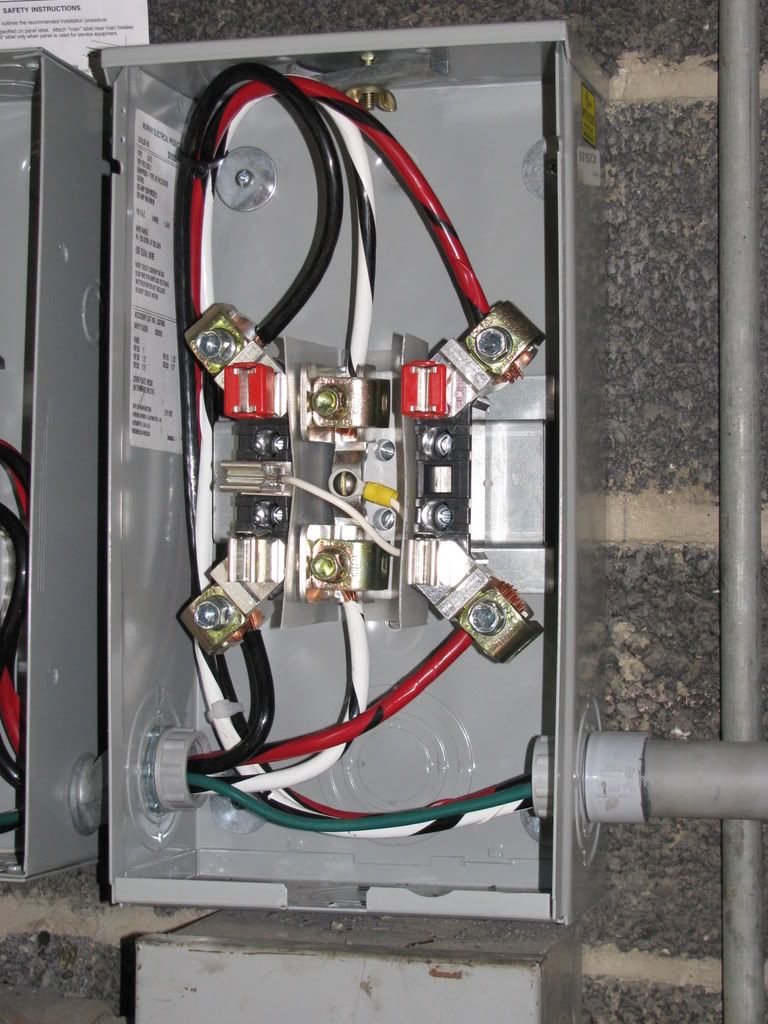
Top Feed Only

Merry Christmas
Status
Not open for further replies.
Based on the following two pictures, does "Top Feed Only" mean that the cable/raceway has to enter the top of the enclosure, or the conductors are required to be terminated to the top terminals?
(This meterpan and panel are installed on the loadside of the service disconnecting means)

57Cherokee-Yonkers430810.jpg


57Cherokee-Yonkers43082.jpg
 
I can explain by relating to a Circle AW catalog for meter sockets. Its lists sockets for underground and overhead use. The overhead sockets are not as wide, as this one is, meaning to me its designed for a top feed to the can. However meters are designed to be wired with the feed on the top lugs.
Here is the information from the UL White Book:
METER SOCKETS (PJYZ)
Meter SocketsPJYZGENERAL
This category covers meter sockets, which are complete enclosures accommodating plug-in type watt-hour and similar meters. They provide terminating means for conductors of wiring systems recognized by ANSI/NFPA 70, "National Electrical Code."
The tightening torque required for terminal screws is specified by a marking.
Terminal wire connectors may be omitted and, if omitted a marking specifies which connectors are intended to be used. Instructions for the field installation of connectors are provided with the connectors.
Meter sockets are suitable for supply wiring to enter the enclosure from either the top or the bottom, unless the meter socket is marked "Overhead Feed Only" or "Underground Feed Only," or the equivalent. The marking "Top Feed" is considered equivalent to "Overhead Feed," and "Bottom Feed" is considered equivalent to "Underground Feed."
The ratings of these meter sockets are limited to 600 V ac maximum and to 400 A maximum through any one meter.
Meter sockets rated over 30 A are marked with their short-circuit current rating in rms symmetrical amps. For short-circuit current ratings exceeding 10 kA, the marking includes the type and rating of overcurrent protection to be used with the meter socket.
Meter sockets are marked with a continuous amp rating and may in addition have a maximum use (intermittent) amp rating of not more than 125% of the continuous amp rating.

Do you have the latest version of the UL white book? Its interactive and is coordinated with the NEC - for the CD version.

 
I do have the current copy, all highlighted and tabbed on the top of the pages. ;)

I had been at this job the day before and asked for the isolated neutral kit to be installed. When reviewing the pictures today, I saw the label. I wanted to make sure that I was not out of line when I speak to the contractor about the label/installation.


Thanks Tom
 
Top is line and bottom is load it is that simple. This will be a quick fix from what I can see go ahead and knock it down this particular install is very dangerous to electricians who sometimes take it for granted that top is line and bottom is load. WE all just want to go home to our wives and kids at the end of the workday. This install could KILL someone. Over 50 dollars of wire and maybe 100 of labor. BTW no migb on service equipment.
 
Last edited:
Pierre C Belarge said:
Read what Tom wrote. I wanted to make sure and now I am, that the "top feed" is referring to the opening to the enclosure.


This meter is properly installed in regards to the supply is terminated to the proper terminals.

Now I am confused. If the meter can says top feed only, I thought Tom was saying the wiring had to come thru the top opening which is not the case in this install. I read Pierre as saying it is legal. :-?
 
from tom's post, i gather that on this o/h type can you must bring the supply in from the top through a hub.
 
That's not a legal install according to what was posted by Tom. Why the side/back knockouts if you can only enter from the top. Is this a trap?
 
Dennis Alwon said:
Now I am confused. If the meter can says top feed only, I thought Tom was saying the wiring had to come thru the top opening which is not the case in this install. I read Pierre as saying it is legal. :-?
Pierre just said the wire is under the correct lug, not that the path it took to get there was correct.
 
Pierre C Belarge said:
Read what Tom wrote. I wanted to make sure and now I am, that the "top feed" is referring to the opening to the enclosure.


This meter is properly installed in regards to the supply is terminated to the proper terminals.
So the line is coming in on the right in pvc and is terminated in the top lugs?
 
Opps I missed something in the picture, it was late last night.
I didn't see the line side wired to the bottom.
Thats not the standard practice. Not covered by the NEC as the NEC does not require a meter. maybe this is in the UL white book, otherwise its a ANSI standard.
 
tom baker said:
Opps I missed something in the picture, it was late last night.
I didn't see the line side wired to the bottom.
Thats not the standard practice. Not covered by the NEC as the NEC does not require a meter. maybe this is in the UL white book, otherwise its a ANSI standard.
I was thinking the feed came from the conduit on the right but I could be wrong. Pierre needs to use the wide angle lens so we can see the rest.:smile:
 
I vote illegal.

I say "top" refers to the enclosure. There is likely not enough bending radius there.
 
Top Feed Only simply means that the conductors that are landed in the top lugs must come from the top of the enclosure, not the sides or bottom.

The side & bottom KOs are for the 'load' side of the meter.
 
Not enough gutter space between the side of the can and the lugs? (Which, I suppose would help create the bending radius issue, too).

And a pet peeve of mine in the top photo, not trimming the tail of the ty-rap flush. Those tails are murder, I've got a nice scar on my wrist from one:mad:
 
The metersocket is clearly listed "top feed only" I beleive this particular installation is a violation of the metersocket listing and 110.3 (b).It is not clear which conductors are the line/load,nor do I know if the NEC stipulates this wiring method(line on the top-load on the bottom)however common industry wide wiring methods always have the line on top with the load on the bottom of equipment.
 
Status
Not open for further replies.
Top