Trenwa Cable Derating

arezapour2004

Member
Location
Houston, TX
Occupation
Associate Electrical Engineer
We are evaluating the ampacity basis for installing 15 kV, MV-105, single-conductor 750 kcmil copper cables in a Trenwa precast concrete trench system and would appreciate your guidance on the appropriate NEC-compliant methodology.
Specifically, we seek clarification on the following:
Applicable NEC references:
  • Which NEC 2023 provisions govern ampacity determination for medium-voltage conductors (>2000 V) installed in a concrete trench system such as Trenwa?
  • Is this installation eligible to be treated as “free air,” similar to Table 315.60 C (3) free-air assumptions, or must it be evaluated using engineering methods per current NEC requirements?
Effect of trench configuration:
  • How does the presence of a solid cover, ventilated cover, or no cover (open trench) impact the ampacity basis and classification (free air vs. enclosed installation)?
Derating methodology:
  • Is it acceptable to start with a 105 °C free-air ampacity of approximately 990 A for 750 kcmil Cu and apply adjustment factors such as:
  • 0.70 per NEC 392.80(B)(1) for cable-tray grouping, and
  • 0.95 for 40 °C ambient temperature,
Engineering calculation requirement:
  • Does NEC-2023 require a formal engineering thermal analysis (e.g., Neher-McGrath / ICEA) for MV cables installed in covered or partially covered Trenwa trench systems, and if so, should this be the governing design approach?
Your guidance will help us establish a defensible, code-compliant ampacity basis for this installation.
 
It would be nice if there was a rock solid NEC reference to tell you what to do in this very unique situation, but there is not.

Free Air (as applied to conductors) is an open or ventilated environment that allows for heat dissipation and air flow around an installed conductor. A trench nor entering equipment in my opinion is a free air environment.
Article 315 (2026 NEC) applies to Medium Voltage Conductors, Cable, Cable Joints, and Cable Terminations.
There is no Engineering calculation that I feel comfortable with to give you an ampacity for this non-free-air environment other than the standard Table 315.60(C)(7) - (10) depending on the configuration in conduit.

315.60(B) Ampacities of Conductors - Engineering Supervision.
 
Thanks Ron. Really appreciate it. As you mentioned using Trenwa precast concrete is not directly specified in NEC and software such as ETAP does not cover it either. If cables installed in maintained spacing (similar to cable bus) in Trenwa by itself (not in conduit) and we use ventilated cover, do you think table 315.60(c)(3) which specifies free air, to be used? or better run calculation using 315.60(B)? Also can we use 105 Deg C cable rating for MV-105 (i.e.: 990A for 15KV 750kcmil single CU per 315.60(c)(3)) or we should use 90 Deg C (870A) in our design since cable termination may not be rated for 105 deg C or use 105 deg C and after derating the cable as long as ultimate ampacity after derating is larger than 90 deg C rating then we are fine.
 
As Ron alread said, no NEC reference to this kind of raceway.Except the art.300 where there are some references about required depth: (A) Minimum Cover Requirements.
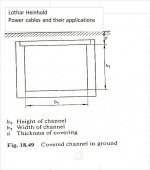
However, if it is earth covered and considered it as covered channel in ground there are some publications of how to calculate ampacity. See, for instance, the Lothar Heinhold book:
Power cables and their applications
channel in ground.jpg
 
Cablebus is typically ventilated, so to enclose it on 3 sides with a trench, makes it a different design.

I do not use the free air tables ever because I can't comply with 110.14(C)(1). I cannot find listed switchgear, switchboards or panelboards that are listed and marked otherwise with terminations as an assembly, for other arrangements such as free air.

I use 90degC ampacities because of the terminations.
 
Top