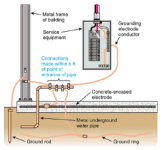
Understanding Bonding Jumpers

Seven-Delta-FortyOne

Goin’ Down In Flames........
Location
Humboldt
Occupation
EC and GC
400A service for example.

GEC from meter can to first ground rod is GEC, sized from 250.66, which is 1/0

From first ground rod to second, gas pipe bonding, water line bonding, are System Bonding Jumpers, sized from 250.102, which is #3

Is this correct?
 
GEC from meter can to first ground rod is GEC, sized from 250.66, which is 1/0
Since the electrode is a rod #6 is the largest required but if continuing on to other electrodes then it would need to be sized according.

How did you come up with #3? Sounds like Table 250.122..
 
From first ground rod to second, gas pipe bonding, water line bonding, are System Bonding Jumpers
No, they are Bonding Jumpers, but not System Bonding Jumpers, and they are sized the same as a GEC.

A System Bonding Jumper is defined in Article 100 and only exists for a Separately Derived System, not a Service.

Cheers, Wayne
 
Minor point compared to robs post:

Bonding Conductor or Jumper. A reliable conductor to ensure the required electrical conductivity between metal parts required to be electrically connected.


Bonding Jumper, System. The connection between the grounded circuit conductor and the supply-side bonding jumper, or the equipment grounding conductor, or both, at a separately derived system

(opps was typing as whitney posted..same point)
 
Since the electrode is a rod #6 is the largest required but if continuing on to other electrodes then it would need to be sized according.

How did you come up with #3? Sounds like Table 250.122..

Yes I got mixed up. I meant 250.102, which looks like it would be 1/0.

But based on what @Joe.B and @infinity posted above, it looks like #6 is all that is required, regardless of the service size, if you are using rod type electrodes?

So what is 250.102 used for?
 
If I’m understanding it correctly, 250.102 is about the N-G bonds, and grounded conductor sizing.

Also, does 250.66 mean that if you have a 2000A service, a #6, or #4 if you have a CEE, would be all that is required?

I’ve had plans that called out much larger GECs, one that even had a 3/0. Is that just engineers decision, and not based on NEC?
 
Also, does 250.66 mean that if you have a 2000A service, a #6, or #4 if you have a CEE, would be all that is required?
Yes if the #6 is going to a rod electrode.
If I’m understanding it correctly, 250.102 is about the N-G bonds, and grounded conductor sizing
Yes 250.102 is used for system bonding jumpers, for example X0 to case in a transformer. Also for bonding jumpers from one electrode to another and SSBJ's which would be for something like the bonding jumper from a metal raceway that contains service conductors.
 
So what is 250.102 used for?
Grounded Conductor, Main Bonding Jumper, System Bonding Jumper, and Supply-Side Bonding Jumper...
Also, does 250.66 mean that if you have a 2000A service, a #6, or #4 if you have a CEE, would be all that is required?

I’ve had plans that called out much larger GECs, one that even had a 3/0. Is that just engineers decision, and not based on NEC?

Yes. Assuming that the GEC is not serving any other function that is.

Because Architects/Engineers/Drafters don't study the NEC, and they certainly don't spend any time here...
 
Your OP seemingly indicates your GEC continues beyond the rod in which case the GEC to the rod would have to be sized according to the requirements of the other electrodes and not just a #6
 
Your OP seemingly indicates your GEC continues beyond the rod in which case the GEC to the rod would have to be sized according to the requirements of the other electrodes and not just a #6

Well, I run a GEC from the meter can to ye first rod, personally I usually just run it continuous to the second, then I need to bond the gas line.

The wire to the gas line terminates on the ground bar, gas piping is not allowed to be used as an electrode, it is merely bonded, so it is a bonding jumper. What is used to size that bonding jumper? Wouldn’t it be the same size as the GEC?
 
1775233048419.png
Start with water piping and or building steel then the jumpers are sized per 250.66 for the specific item they are hitting
 
gas piping is not allowed to be used as an electrode
So it's not part of the Grounding Electrode System, therefore it's not a Grounding Electrode Conductor sized per Table 250.66.

It's also not a Grounded Conductor, Main Bonding Jumper, System Bonding Jumper, or Supply-Side Bonding Jumper, so it's not sized per Table 250.102.

That leaves Table 250.122 Minimum Size Equipment Grounding Conductors for Grounding Raceway and Equipment. Here's where the can starts to open, is that required to be sized per that table?

250.4(A)(4) is the only section I have found to point to and say that the gas line needs to be bonded. One could argue (and they do) whether the gas line is "likely to become energized", and one could also argue (and they do) that the only likely source that could energize the gas line is equipment that is connected to both power and gas, such as a range or dryer, and those are already provided with an equipment grounding conductor as part of the circuit.
 
So every service change I do the inspectors want the gas line bonded.

So for my 400A service, my understanding is #6 to the 2 ground rods, 1/0 to the water line per 250.102, and #3 to the gas line, from 250.104 referencing table 250.122. 🥵

And since there is sections of metal raceway from the meter disconnect switch to the 4 meter stack, the bond bushings need to be bonded with 1/0 as well.

Article 250 can make my head spring sometimes.
 
If you're having a hard time wrapping your head around it, imagine how your "know-it-all" inspector (who really doesn't by the way) must feel. It's so much easier just to run one wire and catch everything. Most inspectors will approve that every time without a second thought.
 
Top