
You are using an out of date browser. It may not display this or other websites correctly.
You should upgrade or use an alternative browser.
You should upgrade or use an alternative browser.
VFD - Wye winding grounding
- Thread starter Charz
- Start date
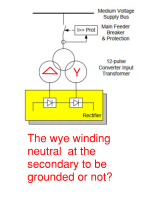
Just wondering what is a 12 converter pulse transformer? I know basic three phase VFD'S are 6 pulse and have PM'ed dozens of 18 pulse drives from 40 to 125 HP. My thinking is it would be safer if the unused neutral is grounded. Old school and was taught in most cases to ground one winding of transformer secondaries 120 volts and higher.Back in the early 1980's came across 240 volt three phase Lovejoy VFD'S that each 3 to 5 HP drives were wired thru a 480 to 240 volt three phase isolation transformers. Lovejoy made great three piece couplings but the worst drives. They had a long wire wound resistor that often burnt out.
zbang
Senior Member
- Location
- Roughly 5346 miles from Earls Court
Is that the same drawing twice? It's too tall to see side-by-side on my screen. (Also curious about 12-pulse.)
By considering the wye secondary as an SDS, I think the wye neutral point should be grounded, otherwise that part of the system is operating un-grounded and the volts to ground could float all over and possible damage the drive.
By considering the wye secondary as an SDS, I think the wye neutral point should be grounded, otherwise that part of the system is operating un-grounded and the volts to ground could float all over and possible damage the drive.
winnie
Senior Member
- Location
- Springfield, MA, USA
- Occupation
- Electric motor research
I can't give a well referenced answer to the OP, but my strong guess is that you would want to ground the neutral of the wye for the same reason that you would want to ground the neutral of the wye secondary of a typical drive isolation transformer. 1) You want to stabilize the voltage to ground of the secondary and the voltage to ground of the DC bus to help protect the motor insulation system and 2) you want to provide a path for switching noise currents that are capacitively coupled to ground through the motor frame. The reason that this is a guess rather than a solid answer is that I'm not sure what happens to the delta secondary voltage to ground.
To answer post #2:
In a bridge rectifier (of any number of phases) you only have one pair of diodes conducting at a time. The most positive phase gets coupled to the + DC bus, and the most negative phase gets coupled to the - DC bus.
In a normal 3 phase rectifier, each phase is most positive (or most negative) for 120° of the AC cycle. Each specific pair of diodes conducts for 60°, so you have 6 conduction 'pulses' per AC cycle.
The 12 pulse transformer gives you more secondary phases, so the conducting periods for a specific diode pair gets reduced and the number of pulses per cycle gets increased. With multiple separate secondaries you might also get overlapping conducting periods, but again that is outside of my work.
The net result is lower DC bus ripple and lower harmonics reflected to the transformer primary.
To answer post #2:
In a bridge rectifier (of any number of phases) you only have one pair of diodes conducting at a time. The most positive phase gets coupled to the + DC bus, and the most negative phase gets coupled to the - DC bus.
In a normal 3 phase rectifier, each phase is most positive (or most negative) for 120° of the AC cycle. Each specific pair of diodes conducts for 60°, so you have 6 conduction 'pulses' per AC cycle.
The 12 pulse transformer gives you more secondary phases, so the conducting periods for a specific diode pair gets reduced and the number of pulses per cycle gets increased. With multiple separate secondaries you might also get overlapping conducting periods, but again that is outside of my work.
The net result is lower DC bus ripple and lower harmonics reflected to the transformer primary.

synchro
Senior Member
- Location
- Chicago, IL
- Occupation
- EE
I can't give a well referenced answer to the OP, but my strong guess is that you would want to ground the neutral of the wye for the same reason that you would want to ground the neutral of the wye secondary of a typical drive isolation transformer. 1) You want to stabilize the voltage to ground of the secondary and the voltage to ground of the DC bus to help protect the motor insulation system and 2) you want to provide a path for switching noise currents that are capacitively coupled to ground through the motor frame. The reason that this is a guess rather than a solid answer is that I'm not sure what happens to the delta secondary voltage to ground.
The rectifier outputs from the wye and the delta windings are connected in series to supply the DC buses. So that will put some constraints on the voltage to ground on the delta windings if the wye is grounded. At least the delta is not "flioating".
On pg. 17 of the following document from Eaton about 12-pulse rectifier drives, both solidly grounded and resistance grounded wyes are mentioned. There is a caution not to ground the delta winding.
synchro
Senior Member
- Location
- Chicago, IL
- Occupation
- EE
I think the commentary about grounding in the document I gave link to above may be limited to configurations where the rectifier bridges from the wye and delta windings are connected in parallel. If the rectifiers are actually in series as the one-line provided seems to indicate, then grounding the wye secondary would result in unsymmetrical + and - DC voltages to ground. I think a resistive ground at the connection point of the two rectifier bridges would be more appropriate in order to obtain more symmetrical DC to ground voltages, and also limit the fault current so that the semiconductor devices have a chance of surviving. The manufacturers of the equipment should be consulted to get their recommendation.
If the rectifiers are operating at medium voltage, then a series connection of the rectifier bridges becomes a more likely configuration.
If the rectifiers are operating at medium voltage, then a series connection of the rectifier bridges becomes a more likely configuration.
zbang
Senior Member
- Location
- Roughly 5346 miles from Earls Court
Let's try that old refrain- What does the manufacturer say?