What are the consequences of this bad earthing system.

Status
Not open for further replies.

Kaaud

Member


As you can see:

1-There is no system earthing.
2-Neutral is directly connected to Protective earthing.

I think that in case of earth fault , there will be no loop for the earth current which subject personnel to great danger.

The commissioning team of this new plant suggested this design to 3 power centres (Fed by MV/LV transformers) and connected earth fault relay on the cable between Neutral and earth. What will happen also in case of inbalance?? Will this relay trip the main C.B??
 
Is this a service or SDS(separately derived system)? Where exactly is the red conductor installed? Is it within the switchgear?
 
Is this a service or SDS(separately derived system)? Where exactly is the red conductor installed? Is it within the switchgear?

The red conductor is connected at the main switch gear. From the neutral bus bar to the panel's protective earth terminal plate. (Which is connected to p.e network)

boboelectric; What do u mean by "At main discoonect" ?? Before or after the C.B. ??

Thx in advance for answering my question.
 
The red conductor is connected at the main switch gear. From the neutral bus bar to the panel's protective earth terminal plate. (Which is connected to p.e network)

Kaaud... we typically call that a grounded system. Nothing out of the ordinary afaict.
 
Kaaud... we typically call that a grounded system. Nothing out of the ordinary afaict.

What are u calling it?? IT system ? Because I cant see the system earthing ,or any kind of earthing at source.

Judging by your experience (post count) I am sure u r not confusing this with a TN system. (BTW , I edited a valid system using paint brush. What I drew is not ordinary)
 
What are u calling it?? IT system ? Because I cant see the system earthing ,or any kind of earthing at source.
IT system???

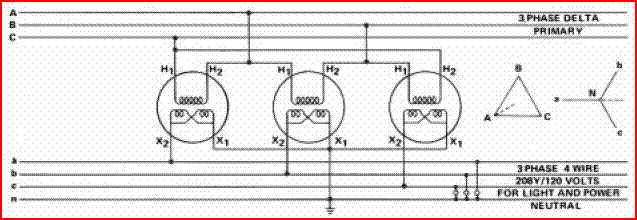
It's a typical grounded wye secondary (secondary voltage may be other than depicted in image)...

Delta-WyeBank.gif


It may help if you answer Don's question whether it is a service secondary or an SDS (separately derived system) secondary.

Generally, if a service secondary, the source neutral point will be bonded to the distribution MPN by the poco. Then the grounded conductor to the premises grounding electrode system at the service disconnect. In this case there would be no low impedance connection between the grounding's except for the grounded service neutral conductor.

For an SDS it is bonded to local grounding electrode system either at the source (secondary neutral terminal) or the neutral terminal/bus at the secondarydisconnect, but not both... so as not to create a parallel path for neutral current.

Judging by your experience (post count) I am sure u r not confusing this with a TN system. (BTW , I edited a valid system using paint brush. What I drew is not ordinary)
TN system???

Wye secondaries typically bond neutral to ground (including earth ground)... again either at the secondary neutral terminal or the neutral terminal/bus at the secondary disconnect, but not both.
 
IT system???

It's a typical grounded wye secondary (secondary voltage may be other than depicted in image)...

Delta-WyeBank.gif

You are showing me a pic where the neutral is earthed via separate earth rod. In my pic this rod is removed , and instead of that , the neutral is connected to protective earth network (safety earth). In other words ;u r showing me a pic that I have already edited before I post.


It may help if you answer Don's question whether it is a service secondary or an SDS (separately derived system) secondary.

Its a service secondary. 6600/400V Delta/Star. Its not an isolation transformer is this was meant by your question.

Generally, if a service secondary, the source neutral point will be bonded to the distribution MPN by the poco. Then the grounded conductor to the premises grounding electrode system at the service disconnect. In this case there would be no low impedance connection between the grounding's except for the grounded service neutral conductor.

Sorry Im not familiar with these terms. Whats MPN and Poco? I couldnt found them on google.


TN system???

Wye secondaries typically bond neutral to ground (including earth ground)... again either at the secondary neutral terminal or the neutral terminal/bus at the secondary disconnect, but not both.

You are correct. But here , the neutral is connected to safety earth. The earth rod near the transformer is removed.
Thanks for taking the time to answer my question.
 
What are u calling it?? IT system ? Because I cant see the system earthing ,or any kind of earthing at source.

Judging by your experience (post count) I am sure u r not confusing this with a TN system. (BTW , I edited a valid system using paint brush. What I drew is not ordinary)
What you drew is code compliant for a SDS. If this was a service there would normally be an grounding connection at both the transformer and the service panel, but in general for a SDS the grounding connection is made at either the transformer or the first OCPD, but not permitted at both. There is an exception that permits a SDS to be bonded at both if there is no parallel paths for neutral current between the transformer and the first OCPD.
 
What you drew is code compliant for a SDS. If this was a service there would normally be an grounding connection at both the transformer and the service panel, but in general for a SDS the grounding connection is made at either the transformer or the first OCPD, but not permitted at both. There is an exception that permits a SDS to be bonded at both if there is no parallel paths for neutral current between the transformer and the first OCPD.

What i drew is simply a wrong/bad design. The earth rod u see is the load's earthing.

In this book they are using "PE" short for Protective Earthing???

Maybe i am wrong ,and they name all earthing cables power earthing. Anyway this is the pic before I edit it. And this btw was the system before they actually change it.

 
You are showing me a pic where the neutral is earthed via separate earth rod. In my pic this rod is removed , and instead of that , the neutral is connected to protective earth network (safety earth). In other words ;u r showing me a pic that I have already edited before I post.
OK... I think I know what you are getting at... I'd been discussing blue only and you were looking for red :rolleyes:
NEC 2008

250.24 Grounding Service-Supplied Alternating-Current Systems.


(A) System Grounding Connections. A premises wiring system supplied by a grounded ac service shall have a grounding electrode conductor connected to the grounded service conductor at each service, in accordance with 250.24(A)(l) through (A5).
(1) General. The grounding electrode conductor connection shall be made at any accessible point from the load end of the service drop or service lateral to and including the terminal or bus to which the grounded service conductor is connected at the service disconnecting means.
FPN: See definitions of Service Drop and Service Lateral in Article 100.​
(2) Outdoor Transformer. Where the transformer supplying the service is located outside the building, at least one additional grounding connection shall be made from the grounded service conductor to a grounding electrode, either at the transformer or elsewhere outside the building.

(3) through (5) omitted for brevity

The NEC does not explicitly distinguish between earth and fault grounding.

BTW, is your electrical background European?

Its a service secondary. 6600/400V Delta/Star. Its not an isolation transformer is this was meant by your question.
Yes, sort of ;) ...but of no concern now since you stated it is a service secondary.

Sorry Im not familiar with these terms. Whats MPN and Poco? I couldnt found them on google.
Sorry, meant MGN = Multi-grounded Neutral of distribution lines

POCO = power company
 
Common brahs. There is no loop for earth fault current here. We are talking about people's life. This is a nightmare for me because I am responsible for operation of this plant.
 
I think there is some mis-communication between everyone. Here is what I think everyone is talking about. I'll use the picture description terms for clarity.

I think Kaaud is describing the "Electrical Equipment" as an actual load such as a motor. I think he is saying that there needs to be an equipment ground run to the machine from the main panel, instead of the "Local Earth" ground as shown in the picture.

I think everyone who has replied thinks that the "Electrical Equipment" in the picture is the main panel, or service disconnect.

I think the red line in the original drawing is supposed to be the equipment ground and is connected to neutral, supposedly at the main disconnect.

Am I right, or way off?:D
 
Kauud,

Most of the members of this board are most familiar with standards of practise as used in North America. To move forward on this discussion, we will first need to find some common ground in terminology.

SDS: a 'separately derived system' is a source (generator, transformer secondary, etc) which doesn't have some sort of built in 'galvanic' connection to your reference system. An ordinary delta-wye transformer is an example of an SDS; the system created on the secondary side does not have an electrical connection to the primary side. Unless intentionally being used to create an ungrounded system, SDSs require bonding and grounding.

MGN: 'multi grounded neutral': this is a utility conductor that is the neutral of the utility distribution system; it is regularly and frequently connected to earth electrodes. The MGN is used as the grounding point for the secondary of utility distribution transformers, and is thus electrically tied to the neutral conductor supplying a building.

In North America, distinction is made between a 'service' and an 'SDS', even when they are conceptually the same. The reason is that different electrical safety codes are applied to the utility distribution system and the building electrical system. These electrical safety codes are developed by different standards organizations, and are not always consistent with each other.

You have been using 'IEC' grounding terminology. Could you please confirm that this article: http://en.wikipedia.org/wiki/Earthing_system is reasonably correct in its description of the terminology?

If the wikipedia article is correct, then most 'services' in North America are type 'TN-C' with an additional earth electrode at the customer.

I do not see a significant life safety issue with the lack of 'system earthing' in your figure 1. It seems to be a 'TN-C' system with an earth electrode moved from the source to the customer, but otherwise equivalent.

The key question to ask: are all enclosures _bonded_ (electrically connected) to the system neutral by some metallic path. It is this bonding which allows fault current to flow in the event that an energized conductor contacts the metallic frame of the equipment, and it is the fault current which causes protective devices to open. The connection to a soil electrode is necessary to provide protection from high voltage events, such as leakage from the transformer primary. The single soil electrode shown would probably provide sufficient protection, although it may not be sufficient to meet code requirements.

The TT system shown in post 11 has a very significant life safety problem, and would not be permitted in North America. In the event of a fault to the equipment chassis, the only flow of fault current would be via the soil electrode path. This is not considered a sufficient path for operating protective devices. (I believe that such TT systems _are_ used in some parts of the world, however they use some form of residual current detection that will detect the low fault current through the soil path.)

If, as 76nemo surmises, you are talking about individual pieces of equipment, rather than entire buildings, then the system as described still has proper 'bonding' and thus has a fault current path. However a consequence is that each equipment enclosure would be subject to the voltage of its respective neutral. Different pieces of equipment in close proximity could be at different voltages, thus presenting a touch hazard.

-Jon

 
If the wikipedia article is correct, then most 'services' in North America are type 'TN-C' with an additional earth electrode at the customer.

Whoops. If the wikipedia article is correct, and I read it carefully, then most 'services' in North America are type 'TN-C-S'. The utility provides a PEN to the consumer; at the 'service entrance' this PEN is electrically connected to a grounding electrode and to separate N and PE conductors. All internal wiring has separate N and PE conductors.

-Jon
 
Status
Not open for further replies.
Top