
WHY, 3W Delta 480V instead of 4W Delta 480V?

11bgrunt

Pragmatist
Location
TEXAS
Occupation
Electric Utility Reliability Coordinator
If a customer asks for 3 phase, 240 volts, the POCO provides a delta secondary delivering 120,120,208-240,240,240.

Years ago, If the customer asks for 3 phase, 480 volts for motor loads, the POCO offered 480V delta with a grounded corner delivering L-L 480,480,480.
No single phase to neutral is provided. Today that service would be 480-277V Wye.

Why didn’t the POCO offer the same bank as the three phase 240 Volt, but use 480 Volt transformers?

That would deliver 240,240,416-480,480,480. The neutral comes in to play on the center tap of one transformer and 240 volt single phase L-N is provided.
I had never seen that secondary voltage in my life and never talked to someone that had seen it.
AI thinks it provides 240 single phase and 480 volt three phase.

The POCO metering system sent a high voltage alarm for one meter. When checked, that service was the 4W Delta connection. The POCO doesn't know why and the 480 has operated the 480 motor just fine for many years.
I don’t like one-offs but cannot answer why it has never been done or why it is a bad idea.
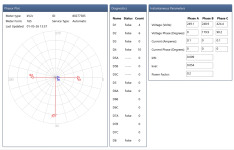

1767801628881.png
 
I'd guess the reason it was set up this way is those are the transformers available at the time. (Are there three transformers forming a closed delta or only two for the open delta?)
If the transformers did not have a center tap, then of course they couldnt do a 480V high leg delta. I dont know if 480v transformers commonly had a center tap or not. Today, I could see them not wanting to do a 480 delta of any type becuase they would need "special" transformers for it. A 277/480 bank would be built from 277V units.
 
Most electrical insulation ratings are 300V or 600V. Using 480Y/277 4 wire allows 300V L-G insulation which is smaller and less expensive than the 600V L-G insulation required for the 416V found on the center tapped delta.
 
The POCO builds all of these overhead banks with single phase 480-240V transformers, regardless of Open or Closed bank. All will have three secondary bushings, and all will have the center tap option.
 
Could also be because "we've always done it that way" :rolleyes: .
That may be the answer.
I have looked through many transformer books from many manufactures, including REA, and none have a schematic for 4W Delta to supply 480V.
 
I think I recall discussions of 480V high-leg on this forum, but it would be exceedingly rare. There'd be no real advantage over 480V corner grounded or wye, since such sites are 3-phase to begin with and inevitably going to use a step down transformer to power 120V loads. By comparison, most 240V high legs in my experience are open deltas consisting of two transformers and intended to supply a relatively small 3-phase load. So the point is that you can take what would be an ordinary split-phase 120/240V service and also provide some 3 phase power to by adding a second single phase transformer. There's no similar point in the high-leg setup, that I can see, when starting with 480V three phase.
 
Keep in mind that the open delta began as a modification to existing 1ph installations. Why would anyone want a high-leg service?
 
Open or closed bank does not change anything about building the 4W delta 480V.
The POCO is asked to deliver 480V three phase for the customer to serve a three-phase load. This 4W delta can be provided with three transformers or two transformers. The POCO can choose 3 transformers if they have three primary wires.
The metering is done with the same seven terminal socket used on the Y secondary.
Today most utilities I work in use 480-277 to provide 480V.
I have always thought delta was the best way to serve motor loads, especially loads using VFDs that produce harmonics.
The question is why is 3W grounded corner good and 4W is not?

Past threads
https://forums.mikeholt.com/threads/480v-high-leg-motor-issue.2588365/
 
Keep in mind that the open delta began as a modification to existing 1ph installations. Why would anyone want a high-leg service?
It’s cheaper for the utility, they only have to string one more wire for an open delta. It’s also cheaper for them to use smaller transformers. It’s not really the customer that wants it.
 
Keep in mind that the open delta began as a modification to existing 1ph installations. Why would anyone want a high-leg service?
Usually the alternative for a small customer with 3 phase power and light is a 208/120 Wye. Well if you are buying used industrial machine tools, they are usually 240/480 three phase. All kinds of stuff that way.

My Buddy owns a retail commercial building with 208/120 that has a coffee shop, laundromat, and nails/tanning. Even there most of the stuff is easier to find with 240/480 volt ratings than as 208
 
Usually the alternative for a small customer with 3 phase power and light is a 208/120 Wye. Well if you are buying used industrial machine tools, they are usually 240/480 three phase. All kinds of stuff that way.

My Buddy owns a retail commercial building with 208/120 that has a coffee shop, laundromat, and nails/tanning. Even there most of the stuff is easier to find with 240/480 volt ratings than as 208
I hooked up a German made tanning booth that would tan you in about 15 minutes, they said it had to be 230, so I had to use buck boost transformers. Since it was the first in the nation, they sent an engineer with it. I asked the engineer if it needed a neutral, he said no, but while I was wiring it in, I found the Germans used the ground as a neutral for the controls. Glad I checked, and made sure the unboosted leg was feeding the controls! I think they said the thing cost $60,000, and this was back in the 90’s.
 
I hooked up a German made tanning booth that would tan you in about 15 minutes, they said it had to be 230, so I had to use buck boost transformers. Since it was the first in the nation, they sent an engineer with it. I asked the engineer if it needed a neutral, he said no, but while I was wiring it in, I found the Germans used the ground as a neutral for the controls. Glad I checked, and made sure the unboosted leg was feeding the controls! I think they said the thing cost $60,000, and this was back in the 90’s.
Dealt with the same problem. Manufacturer told me to use 2 boost bucks. When the machine originally went in they installed it with 3 b/b trans but it fried something on the control board, I forget what.

Was on a 90 amp 208 dedicated circuit, I forget what it really was drawing but it was a lot. I called it the pig roaster.
 
If a customer asks for 3 phase, 240 volts, the POCO provides a delta secondary delivering 120,120,208-240,240,240.

Years ago, If the customer asks for 3 phase, 480 volts for motor loads, the POCO offered 480V delta with a grounded corner delivering L-L 480,480,480.
No single phase to neutral is provided. Today that service would be 480-277V Wye.

Why didn’t the POCO offer the same bank as the three phase 240 Volt, but use 480 Volt transformers?
480/240 AC was at one time a contender for the American standard but was incompatible with 110V Edison DC. The 480D/240 configuration is if I am not mistaken also a standard in Australia, there its 50HZ.
What your describing is a very old 480V Delta hi-leg, they are a few out here in eastern Oregon, they are all very old, and were used for large water irrigation pumps such as pivots in the middle of nowhere.
The 240V tap was typically used for a pole light. I believe forum member @kwired also has seen them where he is.
There were old stories about Farmers who added regular outlets to these poles, some old code debate was since there was no other voltage present it was technically not a violation to have a NEMA 5-15 wired for 240.

In the North East of the US there was posibly another 480/240 system that was a variant of Tesla two-phase (phases 90 degrees from each other) that I have never seen. I cant recall the voltage but it was over 240. It was used by GE in Pittsfield MA at large GE industrial site that made and tested transformers. Perhaps one of the MA guys on here can comment on that.
I have no idea why they did not just use 480Y/277 to begin with, perhaps back in the day 240V yard lights were incandescent or there was some other need for '240' IDK it would be interesting to know, but my guess is lighting.

For anything new stick to 480Y277.

EDIT: I just remembered why they use them here, its when they don't have 3 primaries on the pole, you can create a 480-hi leg bank with two primaires and a primary neutral.
 
Last edited:
480 / 240 motors. as in 480 or 240
But not both, delta/ wye motor windings.
I am not sure I have ever seen a 480 anything that needed a neutral?:unsure:
I have seen lots of 277V lighting.
 
Top