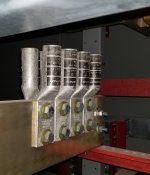
Why are 4 crimps needed if it’s only for equipotential bonding ?

Dale001289

Senior Member
Location
Georgia
We have 500kCMIL bare copper conductors attached to multiple copper ground busses stationed along a tunnel wall - they extend downward into ground rods and upward to the upper level for bonding of metal equipment none of which is current carrying . The client is complaint that a few of the Burndy compression, Nema 4 hole pads do not contain all 4 crimps - as recommended by Burndy—but rather 3. Given the application of equipotential bonding I don’t why this is a big deal if they only have three crimps since they will probably never see any current or voltage.
Can someone enlighten me on this ?
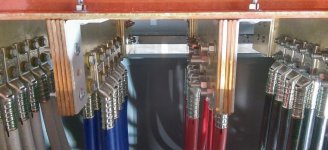
 
IMO one crimp on a compression connector is still better than a mechanical connector but as mentioned you should still follow either the spec or the manufacturer's instructions. This comes up often in the field, how many crimps do you want on the compression connector?

Typically these connectors will have lines on them so we would use that as the minimum number of crimps required. Some guys just crimp the connector from one end to the other and that ends the debate. With modern battery crimper a crimp takes less than 10 seconds so when in doubt more is better.

For something like this I would say a minimum of 4 crimps should be applied. When in doubt max it out.

Crimp terminals 001.jpgCrimp terminals 002.jpg
 
@infinity, that is beautifully done.

What is the purpose of the lines marked on the side of the cable and lug. Was that to align the crimp tool?
Thanks. Typically you'll have the terminal bolted to the bus and then you'll shape, cut, strip, and insert the cable. To keep the orientation of the terminal correct (so that it's not twisted in relation to the bus) we mark both the cable and the terminal. Then the bolts are removed and the terminal and cable end are pulled away from the bus to make room for the crimper head to fit. Then crimp and reinstall.
 
Top