Chapter 9 Note 7

Status
Not open for further replies.

Dennis Alwon

Moderator
Staff member
Location
Chapel Hill, NC
Occupation
Retired Electrical Contractor
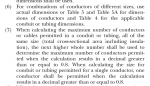
I just re-read Note 7 and I am perplexed by it. It seems to say that you round up when the calculation is .8 or greater rather than .5, however it also states this applies only when the conductors are all the same size. Therefore, I could not round up at all if I had different size conductors. Why would that be true?

When calculating the maximum number of conductors
or cables permitted in a conduit or tubing, all of the
same size
(total cross-sectional area including insulation),
the next higher whole number shall be used to
determine the maximum number of conductors permitted
when the calculation results in a decimal greater
than or equal to 0.8. When calculating the size for
conduit or tubing permitted for a single conductor, one
conductor shall be permitted when the calculation
results in a decimal greater than or equal to 0.8.
 
Therefore, I could not round up at all if I had different size conductors. Why would that be true?

I would guess and say if the conductor sizes are known the table accounts for the .2 margin of error. If conductors are a mix of unknown sizes its not practical to provide a threshold because the conduit fill could vary much more than the .2 fudge factor could account for. So they refer you tables 4 and 5.

Capture.PNG
 
In the past I didn't realize that it only referred to wires of the same size. I was tutoring my son via zoom on this and said--"Damn, I missed that all these years." LOL
 
If there's more than one conductor cross-sectional area involved, then which area are you dividing by? The rule only applies to the computation "# of conductors allowed = usable conduit internal area / conductor area," which only makes sense with a single conductor area.

I guess if you had multiple conductors sizes, you could express the smaller sizes as fractions of the largest size, so your sizes would be, after scaling, say A = 1, B = 0.7, and C = 0.5. Then you can do the division based on the largest size, and if you get, say 3.3, that would be good for 2 A + 1 B + 1 C. And you could extend the rule by say that you are allowed to go over by 0.2 times the smallest size, so that if the ratio were 3.1, you would still be good for 2 A + 1 B + 1 C. That would be hard to write as a footnote. : - )

It is interesting to note that if you want to run, say 4 conductors of 1 size and an additional conductor of area 0.9 times as large, then if your ratio came out as 4.8, you are not compliant with the rules as written. Even though 5 conductors of the larger size would be allowed. I don't imagine there's any reason to actually disallow the mixed case, though.

Cheers, Wayne
 
I didn't even realize this note existed. I thought 40% fill was a strict limit for 3 or more wires. The example the handbook has is for 28 #10's in 1.25"RMC. The exception allows 29 conductors, and the change in fill this allows is less than 1%.

I agree with the previous replies. I just don't know how someone could modify this rule to apply to multiple wire sizes in the same conduit.

It really seems like if 40% isn't the absolute upper limit on safe fill, just change that number and don't allow any rounding up.

Make it 41% fill for 3 or more conductors. And if a calculation says 10.999 conductors fit, that really means 10 only.
 
Make it 41% fill for 3 or more conductors. And if a calculation says 10.999 conductors fit, that really means 10 only.

Well the code allows us to go up so 5.8 wires means we can go to 6 wires. You are all right I was thinking cu.in round up not number of wire round up.... It makes sense.

Thanks all.
 
It used to be, in general, if you wanted to report 2 significant figures, like 2.3, you should carry four, like 2.324, in the intermediate calcs.

BTW, if you have 2.3 + 9.467 + 3, the answer must be to only 1 significant figure: 2, but everyone would report this as 15.

The tax code has a similar but simpler rule.

Spreadsheets let you report 3.14159xxxx but this is almost never correct, nothing in this work is known to that accuracy and precision.
 
My bad.
It's 20 but it's not two significant figures. The "0" is a "place holder".

2E1 notation is one significant figure meaning 20.
2.0E1 is two, meaning 20.
1.5E1 is two, meaning 15.
 
My bad.
It's 20 but it's not two significant figures. The "0" is a "place holder".

2E1 notation is one significant figure meaning 20.
2.0E1 is two, meaning 20.
1.5E1 is two, meaning 15.

That's the advantage of scientific notation. It gives you the advantage of always showing the number of significant figures in a number.

Show additional zeros after the decimal point, and it tells you that they are significant digits. Show zeros before the decimal point, and it is ambiguous whether they are significant figures or not. By default, they are place-value defining digits that don't count as significant digits. You either draw a line over the zero to identify it as significant, or you write it in scientific notation. This doesn't apply to defined (not measured) constants like 60 seconds in a minute, where exactly 60 seconds is the definition of a minute.
 
Status
Not open for further replies.
Top