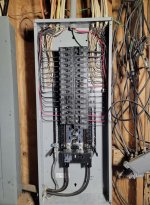
Who else would do it this way?

Status
Not open for further replies.
When the OP asks...
"Who else would do it this way?"

What is the "it" you speak of?
Would anyone do what this way?

It looks very early 80s to mid-90s except for the 5 newer home runs.

I'm guessing that since it's in a garage, the bottom of the panel piggybacks the meter can, and that's why the panel is upside down.

Jumpers missing, holes drilled wrong...that's normal stuff around here.
 
Can't tell for sure from picture as it doesn't blow up clear but it looks like there are a neutral and ground under a single screw. That is a violation. Obvious the wire originally (or at least some) had been long enough to reach the neutral bar so why not do it, rather than landing on an auxiliary ground bar. Not sure if the enclosure was or is ever intended to carry the neutral current.
No! I would never have conceived of doing the installation in this way.

violations aside, isn't main on bottom, circuits in top a safer install?

~RJ~
In the sense of if the service feeds are entering the bottom of panel then yes, rather than passing the service conductors all the way up the side.
Side note I have found not every panel is designed to be installed "upside down" with main on bottom. Some I have seen that are universal (installable in either direction) will have the interior labels readable from either installation direction with 2 labels. When not designed for "upside down installation it is a PIB to read the panel label.
 
I can not tell for sure from the resolution I get whether there are any neutrals doubled under one screw or sharing a screw with a ground. If not, I do not see anything exceptional except aesthetically.
They are using the cabinet as a path for neutrals back to the grounded conductor bus. Presuming the bonding screw is engaged, I think this is one of those type that comes with captive holding means but you must physically screw it rest of way in to complete bonding.

Guess I should have read through remaining posts before replying.
 
I'm really glad that so many of you agree that this installation was wrong. I saw this posted on social media by someone that I once worked for and respected. He was extremely proud of his work and even has a little jingle he uses, "If you don't want a fire, hire _______!" I don't want to use his name but it rhymes with fire.

I constantly remind myself that it's so easy to think that what you're doing is right when there's no one around to comment. I've been doing electrical work for 26 years and it doesn't make me ashamed to say that I learn something new almost daily. Unfortunately, knowing his personality, he would probably not be open for constructive criticism. The scarier thing is that this quite possibly was a permitted job and passed inspection...
 
Can't tell for sure from picture as it doesn't blow up clear but it looks like there are a neutral and ground under a single screw. That is a violation. Obvious the wire originally (or at least some) had been long enough to reach the neutral bar so why not do it, rather than landing on an auxiliary ground bar. Not sure if the enclosure was or is ever intended to carry the neutral current.
No! I would never have conceived of doing the installation in this way.


In the sense of if the service feeds are entering the bottom of panel then yes, rather than passing the service conductors all the way up the side.
Side note I have found not every panel is designed to be installed "upside down" with main on bottom. Some I have seen that are universal (installable in either direction) will have the interior labels readable from either installation direction with 2 labels. When not designed for "upside down installation it is a PIB to read the panel label.
The issue you may run into with an "upside down" load center is the main breaker being off in the up position 240.81. for example Siemens three phase load centers, the main breaker operates vertically and you need to reverse the breaker for main breaker down applications.
 
If a friend of mine posted something like that, I probably wouldn't blast him on his post. I would leave this comment....
🤔🤔🤔

Then seen if he inquires about what I'm thinking
 
I know inspectors that would red tag it simply because the unfused conductors are not as short as practical.
Where are they going though? Doesn't that factor in to what is practical?

NEC doesn't specify how long they can be just says nearest to point of entry or something very similar.

Some local jurisdictions do have additional requirements often being no more than a certain length of conductor such as 3, 5 maybe 10 feet.
 
Aside from the 200.2(B), It appears to be a PON panel as well. :rolleyes: Why if he didn't even use the neutral bar?
 
Where are they going though? Doesn't that factor in to what is practical?

NEC doesn't specify how long they can be just says nearest to point of entry or something very similar.

Some local jurisdictions do have additional requirements often being no more than a certain length of conductor such as 3, 5 maybe 10 feet.

The issue is the unfused would be shorter if the main was at the top vs running to a bottom main when the cable enters the top of the panel.
 
Status
Not open for further replies.
Top