

When each of our jurisdictions adopts the 2022 edition of the NEC if we alter the service equipment we will have to add the required emergency disconnect. I'm willing to bet that many of you have seen a meter enclosure which is installed as close to the ground as the US National Electric Code (NEC) and the Utility Service Standards allow. That leaves no room to put the emergency disconnect in line after the meter without getting into the expense and time of end to end LR or LL condulets and so forth. It seams some of the utilities are scrambling to negate the language in the 2022 NEC which allows that disconnect to be on the supply side of the meter.
So I go to install an as yet not required emergency disconnect on a home with a developmentally arrested adult child because getting that 22 year old 3 year old out of the building during an emergency is already going to be tough enough for the local fire department without worrying about electric shock. Inspector says "You cannot have a disconnect before the meter." I said "That cannot be possible because over half of the multiple family units in the county have just that. He says "it's not acceptable to the utility." Running out of patience but wanting to go the 62 miles and 1 hour + home to my own bed I say "You mean they have the county inspectors enforcing their service standards now?" while looking all shocked and amazed. He says "No but it's your problem when they refuse connection. I go home and to sleep. I get a call a week later from the utility's engineering office which after mutual introductions goes "About this house out on XXXXXXXXX Road. Me "Yes what about it." Engineer; "We don't like having a disconnect of any kind ahead of our meter." Me; I'll have to justify the additional work with the habitat people so I'll need chapter and verse from the (State Regulator) approved Service Standard." 30 seconds of silence follows. Engineer "That's pending approval" Me "I have a permit that is signed off as final inspection approved and ready for energizing." Another 30 seconds of silence. Engineer "Were going to ask that it be changed to comply with the service standard when it gets approved." Me "you can ask for anything of course but your legal department will tell you that no regulation approved after something is done can be enforced against existing installations. It's what the United States Constitution calls an "ex post facto" law and it is constitutionally prohibited and it doesn't get any more bomb proof than that." I give it fifteen seconds and say "I'm sure you don't want the mother of a disabled adult child going to State Senator XXXXXXX who as you may already know sits on the public service commission. So when can I expect service connection?" Totally exasperated engineer answers "Monday." Me "Great is there anything else. Engineer "No Good day" click. He was as good as his word. Connection occurred the following Monday. Rapid repartee is just not me! I had been rehearsing various forms of that conversation for days.
Next I will get the 3 Intermodal Bulk Containers (IBCs) for liquids,
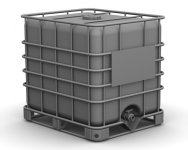
that hold 320 gallons apiece, set up on a ledge cut into the rock on one side of their basement. I have a friend who did fire sprinkler pipe fitting for much of his career. He and I are going to build them a limited water supply sprinkler system using that 960 gallons as the supply. It might not put a fire completely out but I'm confident that it will hold it in check long enough for the first due engine to get there and pull the two of them out. The house is insured.
So I go to install an as yet not required emergency disconnect on a home with a developmentally arrested adult child because getting that 22 year old 3 year old out of the building during an emergency is already going to be tough enough for the local fire department without worrying about electric shock. Inspector says "You cannot have a disconnect before the meter." I said "That cannot be possible because over half of the multiple family units in the county have just that. He says "it's not acceptable to the utility." Running out of patience but wanting to go the 62 miles and 1 hour + home to my own bed I say "You mean they have the county inspectors enforcing their service standards now?" while looking all shocked and amazed. He says "No but it's your problem when they refuse connection. I go home and to sleep. I get a call a week later from the utility's engineering office which after mutual introductions goes "About this house out on XXXXXXXXX Road. Me "Yes what about it." Engineer; "We don't like having a disconnect of any kind ahead of our meter." Me; I'll have to justify the additional work with the habitat people so I'll need chapter and verse from the (State Regulator) approved Service Standard." 30 seconds of silence follows. Engineer "That's pending approval" Me "I have a permit that is signed off as final inspection approved and ready for energizing." Another 30 seconds of silence. Engineer "Were going to ask that it be changed to comply with the service standard when it gets approved." Me "you can ask for anything of course but your legal department will tell you that no regulation approved after something is done can be enforced against existing installations. It's what the United States Constitution calls an "ex post facto" law and it is constitutionally prohibited and it doesn't get any more bomb proof than that." I give it fifteen seconds and say "I'm sure you don't want the mother of a disabled adult child going to State Senator XXXXXXX who as you may already know sits on the public service commission. So when can I expect service connection?" Totally exasperated engineer answers "Monday." Me "Great is there anything else. Engineer "No Good day" click. He was as good as his word. Connection occurred the following Monday. Rapid repartee is just not me! I had been rehearsing various forms of that conversation for days.
Next I will get the 3 Intermodal Bulk Containers (IBCs) for liquids,
that hold 320 gallons apiece, set up on a ledge cut into the rock on one side of their basement. I have a friend who did fire sprinkler pipe fitting for much of his career. He and I are going to build them a limited water supply sprinkler system using that 960 gallons as the supply. It might not put a fire completely out but I'm confident that it will hold it in check long enough for the first due engine to get there and pull the two of them out. The house is insured.


 , they are 330 gallons for the large ones (6 55 gallon drums) or 275 for the small ones (5 55 gallon drums).