rewiring a generator panel for 120v only?

Status
Not open for further replies.

JoeNorm

Senior Member
Location
WA
A client of mine want to buy a portable backup battery to feed into the generator panel. The battery unit only supplies 120V and the setup is currently wired like a "normal" 240v with a 2pole breaker feeding into the generator panel with an interlock. The only 240 load in the gen panel is the range that I would just move to the main panel.

I can make a 120V only panel by installing a jumper across the 2pole breaker. But I am wondering if there is anything in the NEC preventing this?

thanks
 
First, 120v from a battery? Or an inverter? AC or DC?

Second, you can, as long as you use an approved splitting method.

Don't forget the supply wiring could see double the breaker's rating.
 
There are two issues. One, the connection where the jumper is installed must be identified for use with two conductors, and second, each branch circuit must have its own neutral. Both are easy to resolve.

There is a provision in 710.15(C) to do this for "stand alone systems". While that does not apply for this installation, the concept is the same.
 
The currents drawn from the two hot buses would end up adding together in-phase on the neutral bus, and so it could overload it.
The neutral bus in these types of panels is designed for a 100% unbalanced load. Section 10.5.1 of UL 67 requires that the neutral bus of panelboards rated 200 amps and less have the same ampacity as the ungrounded bus.
 
The currents drawn from the two hot buses would end up adding together in-phase on the neutral bus, and so it could overload it.
That is a general statement though. Chances are we are dealing with 100 or even 125 amp rated bus here and a source that maybe can deliver only 20-40 amps at the most.
 
The neutral bus in these types of panels is designed for a 100% unbalanced load. Section 10.5.1 of UL 67 requires that the neutral bus of panelboards rated 200 amps and less have the same ampacity as the ungrounded bus.

But in this case, if each ungrounded bus is loaded to its ampacity then the current on the neutral bus will be 2X (i.e., 200%) of the current on each ungrounded bus.

That is a general statement though. Chances are we are dealing with 100 or even 125 amp rated bus here and a source that maybe can deliver only 20-40 amps at the most.

I agree that the issue can be taken care of by adequately sizing the panel. I was just bringing it up so that the OP was aware that the neutral bus could be overloaded.
 
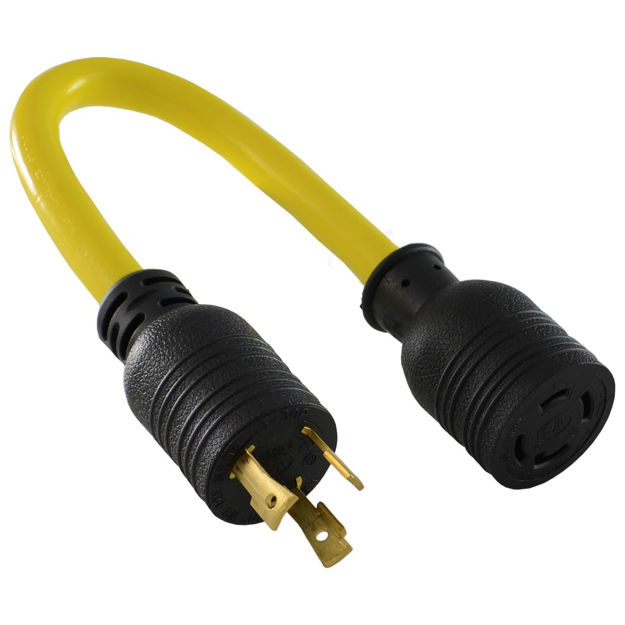
Leave the panel alone and supply the customer with a "both sides hot" adapter to use when plugging the battery unit in. Several manufacturers make listed ones of these. Depending on the source it will be something like a 5-15P or 5-20P or L5-30P to a L14-30C. So 3 prong male to a 4 prong female with both hots inside of the female jumpered.
 
Interssting. I did not know they had adaptors for this exact purpose. That will be the easiest in this case.
 
Leave the panel alone and supply the customer with a "both sides hot" adapter to use when plugging the battery unit in. Several manufacturers make listed ones of these. Depending on the source it will be something like a 5-15P or 5-20P or L5-30P to a L14-30C. So 3 prong male to a 4 prong female with both hots inside of the female jumpered.
Can you provide a link for this product if you know where they are supplied online? Thanks
 
Can you provide a link for this product if you know where they are supplied online? Thanks
Here is one example with a L5-30P to L14-30C you can google the p/n to find somewhere to purchase.

 
Interssting. I did not know they had adaptors for this exact purpose. That will be the easiest in this case.
Easiest AND it leaves the building wiring 'normal' so they have the flexibility of plugging in other generators as well.
 
Status
Not open for further replies.
Top