Willie Snyder
Co-Host High Voltage Live Podcast
- Location
- Denver, Co
- Occupation
- Electrical Foreman / Certified NICET II Fire alarm technician



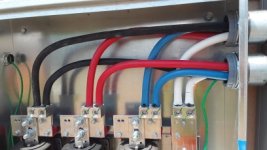
Fred, the conductors shown do not appear to be 1000 V or higher insulation.Bending radius of conductors and raceways are covered in NFPA 70 not necessarily the 70E. What are your specific safety concerns with the pictured installation that you feel should be a 70E concern related to bend radius?
The exert from the NFPA 70 (2017) (below) relating to general requirements are found in article 300.34 for bending radius. There are many other references to bending radius in other sections related to specific installation materials and methods.
300.34 Conductor Bending Radius. The conductor shall not
be bent to a radius less than 8 times the overall diameter for
nonshielded conductors or 12 times the overall diameter for
shielded or lead-covered conductors during or after installation.
For multiconductor or multiplexed single-conductor
cables having individually shielded conductors, the minimum
bending radius is 12 times the diameter of the individually
shielded conductors or 7 times the overall diameter, whichever
is greater.


It's true that nothing in the NEC would apply to the conductors in the photo. NEC bending radii are for the equipment not the field bending of the conductors themselves.Conductor bending radius is not mentioned in the NEC.
90.2(B) does not apply to the utilityWhat would 70E have to do with bending radii? It is a worker safety standard and not an installation standard.
Yes that's trueIt's true that nothing in the NEC would apply to the conductors in the photo. NEC bending radii are for the equipment not the field bending of the conductors themselves.

You mentioned 70E though, which is all about personnel and workplace electrical safety practices and not an installation code like NFPA 70 is.90.2(B) does not apply to the utility
70E has a 90.2(B)(2) and a 90.2(B)(4)that says:You mentioned 70E though, which is all about personnel and workplace electrical safety practices and not an installation code like NFPA 70 is.
(B) Not Covered.
This standard does not cover safety-related work practices for the following:
....
(2)Installations of railways for generation, transformation, transmission, or distribution of power used exclusively for operation of rolling stock or installations used exclusively for signaling and communications purposes ...
(4)Installations under the exclusive control of an electric utility where such installations:
a. Consist of service drops or service laterals, and associated metering, or
b. Are located in legally established easements or rights-of-way designated by or recognized by public service commissions, utility commissions, or other regulatory agencies having jurisdiction for such installations, or
c. Are on property owned or leased by the electric utility for the purpose of communications, metering, generation, control, transformation, transmission, or distribution of electric energy, or
d. Are located by other written agreements either designated by or recognized by public service commissions, utility commissions, or other regulatory agencies having jurisdiction for such installations. These written agreements shall be limited to installations for the purpose of communications, metering, generation, control, transformation, transmission, or distribution of electric energy where legally established easements or rights-of-way cannot be obtained. These installations shall be limited to federal lands, Native American reservations through the U.S. Department of the Interior Bureau of Indian Affairs, military bases, lands controlled by port authorities and state agencies and departments, and lands owned by railroads.