
You are using an out of date browser. It may not display this or other websites correctly.
You should upgrade or use an alternative browser.
You should upgrade or use an alternative browser.
Federal pacific
- Thread starter pedro1200
- Start date
- Location
- Wisconsin
- Occupation
- PE (Retired) - Power Systems
UL listing is "applied" as things leave the factory. Once somethings leaves the factory there is nothing you can do to change a listing. However, you can field modify a device so it no longer meets its listing requirements, or you can misapply it in a manner inconsistent with its listing.Do federal pacific panel and breakers still have a UL listing?Is there a way to find out its current status?
Federal Pacific got in trouble, almost 40 years ago, with its UL listing on a 2 pole plug on breaker. I have never heard of any of their other products being identified as not meeting their listing requirements.
Last edited:

- Location
- San Francisco Bay Area, CA, USA
- Occupation
- Electrical Engineer
UL actually took the extra step of RESCINDING the UL listing of the Stab-lok breakers and panels. So they are indeed no longer UL listed. This is what put them out of business.
There is a company, Connecticut Electric, who makes an aftermarket replacement breaker for FPE Stab-lok panels. It is UL “Classified”, which is slightly different from being “listed”, in that it can only be used in listed panels that it was tested with. CE tested them in MOST of the common FPE panels that were sold before the UL listing was rescinded, but not all, so you have to check (although nobody actually does). There are strong opinions on the inspection community as to the CE versions being no better than the originals though.
The thing is, many insurance companies are now refusing to underwrite homes with FPE panels in them, regardless of the breakers installed. So it’s often a waste of money to try to keep using an existing FPE panel, you are throwing good money after bad.
There is a company, Connecticut Electric, who makes an aftermarket replacement breaker for FPE Stab-lok panels. It is UL “Classified”, which is slightly different from being “listed”, in that it can only be used in listed panels that it was tested with. CE tested them in MOST of the common FPE panels that were sold before the UL listing was rescinded, but not all, so you have to check (although nobody actually does). There are strong opinions on the inspection community as to the CE versions being no better than the originals though.
The thing is, many insurance companies are now refusing to underwrite homes with FPE panels in them, regardless of the breakers installed. So it’s often a waste of money to try to keep using an existing FPE panel, you are throwing good money after bad.
That’s exactly why im asking… thanksUL actually took the extra step of RESCINDING the UL listing of the Stab-lok breakers and panels. So they are indeed no longer UL listed. This is what put them out of business.
There is a company, Connecticut Electric, who makes an aftermarket replacement breaker for FPE Stab-lok panels. It is UL “Classified”, which is slightly different from being “listed”, in that it can only be used in listed panels that it was tested with. CE tested them in MOST of the common FPE panels that were sold before the UL listing was rescinded, but not all, so you have to check (although nobody actually does). There are strong opinions on the inspection community as to the CE versions being no better than the originals though.
The thing is, many insurance companies are now refusing to underwrite homes with FPE panels in them, regardless of the breakers installed. So it’s often a waste of money to try to keep using an existing FPE panel, you are throwing good money after bad.
pipe_bender
Senior Member
- Location
- Boston
- Occupation
- Electrician
I think the company actually was split and sold before that happened, a Canadian and US split, the Canadian remained popular in for years, up until recently you could buy StabLok breakers at Homedepot in Canada made by the same company that makes square D. You could until recently have them shipped to your door here in the US (CSA listed). The US parent company is the one that had the bad breakers.This is what put them out of business.
This is true, they also now ask if you have any interior aluminum wiring no matter how old and they ask about knob and tube wiring.The thing is, many insurance companies are now refusing to underwrite homes with FPE panels in them, regardless of the breakers installed. So it’s often a waste of money to try to keep using an existing FPE panel, you are throwing good money after bad.
EDIT: I guess you still can
curt swartz
Senior Member
- Location
- San Jose, CA
- Occupation
- Electrical Contractor
The Stab-Lok line was bounced around to several other companies after FPE's demise. Challenger was selling the Stab-Lok line along side their "C" line in the mid to late 80's. Eventually Schneider took it on and was selling the line in Canada. Obviously once the the other companies took over they were able to get the products listed again.
- Location
- Wisconsin
- Occupation
- PE (Retired) - Power Systems
But that would apply from that point forward. I don't think you can rescind previously listed products.UL actually took the extra step of RESCINDING the UL listing of the Stab-lok breakers and panels.
So now you have to deal with existing listed panels and breakers from a third party. Are insurance companies accepting this?
curt swartz
Senior Member
- Location
- San Jose, CA
- Occupation
- Electrical Contractor
Insurance companies will not accept anything that is marked Federal Pacific or FPE including fusible switches.But that would apply from that point forward. I don't think you can rescind previously listed products.
So now you have to deal with existing listed panels and breakers from a third party. Are insurance companies accepting this?
brycenesbitt
Senior Member
- Location
- United States
To anyone repairing extending or evaluating an FPE system, under any of their various names read:
Published in: IEEE Access ( Volume: 6)
Page(s): 10062 - 10068
Date of Publication: 07 February 2018
Electronic ISSN: 2169-3536
DOI: 10.1109/ACCESS.2018.2803298
1. Molded-Case Circuit Breakers and Circuit Breaker Enclosures, Underwriters Laboratories Standard UL489, 2016 and prior editions.
2. “Exxon buys a scandal along with a company,” Business Week, p. 66, Jul. 1980.
3. J. Aronstein and R. Lowry, “Estimating fire losses associated with circuit breaker malfunction,” IEEE Trans. Ind. Appl., vol. 48, no., Jan./Feb. 2012, p. 45.
4. U.S. Consumer Product Safety Commission, Recall No. 14–134, Mar. 2014.
5. U.S. Consumer Product Safety Commission, Release No. 07–036, Nov. 2006.
6. J. Aronstein. ( Nov. 2017 ). Hazardous FPE Circuit Breakers and Panels. [online]. [Online]. Available: http://www.fpe-info.org/
7. J. Palmer, Report on First Meeting of Circuit Breaker Follow Up Program Ad Hoc Committee, W. Camp, Ed. GTE Sylvania, Jun. 1979.
8. R. W. Eckert, “Molded case circuit breakers—Oldies but goodies,” Elect. Construction Maintenance, Apr. 1982.
9. J. M. Maza-Ortega, E. Acha, S. García, and A. Gómez-Expósito “Overview of power electronics technology and applications in power generation transmission and distribution,” J. Mod. Power Syst. Clean Energy, vol. 5, no. 4, pp. 499–514, Jul. 2017.
===============
Note that one of the brands that worked poorly is.... Connecticut Electric.
The entire Stab Lok world is rotten: from the buses to the stabs to the breakers to the replacements.
===============
Insurance likes simple. And what age and factory made good of bad Stab-Lok breakers is just too hard for anybody to track,
especially insurance looking for a pat answer.
Published in: IEEE Access ( Volume: 6)
Page(s): 10062 - 10068
Date of Publication: 07 February 2018
Electronic ISSN: 2169-3536
DOI: 10.1109/ACCESS.2018.2803298
1. Molded-Case Circuit Breakers and Circuit Breaker Enclosures, Underwriters Laboratories Standard UL489, 2016 and prior editions.
2. “Exxon buys a scandal along with a company,” Business Week, p. 66, Jul. 1980.
3. J. Aronstein and R. Lowry, “Estimating fire losses associated with circuit breaker malfunction,” IEEE Trans. Ind. Appl., vol. 48, no., Jan./Feb. 2012, p. 45.
4. U.S. Consumer Product Safety Commission, Recall No. 14–134, Mar. 2014.
5. U.S. Consumer Product Safety Commission, Release No. 07–036, Nov. 2006.
6. J. Aronstein. ( Nov. 2017 ). Hazardous FPE Circuit Breakers and Panels. [online]. [Online]. Available: http://www.fpe-info.org/
7. J. Palmer, Report on First Meeting of Circuit Breaker Follow Up Program Ad Hoc Committee, W. Camp, Ed. GTE Sylvania, Jun. 1979.
8. R. W. Eckert, “Molded case circuit breakers—Oldies but goodies,” Elect. Construction Maintenance, Apr. 1982.
9. J. M. Maza-Ortega, E. Acha, S. García, and A. Gómez-Expósito “Overview of power electronics technology and applications in power generation transmission and distribution,” J. Mod. Power Syst. Clean Energy, vol. 5, no. 4, pp. 499–514, Jul. 2017.
===============
Note that one of the brands that worked poorly is.... Connecticut Electric.
The entire Stab Lok world is rotten: from the buses to the stabs to the breakers to the replacements.
===============
Insurance likes simple. And what age and factory made good of bad Stab-Lok breakers is just too hard for anybody to track,
especially insurance looking for a pat answer.
brycenesbitt
Senior Member
- Location
- United States
Reference for the future attached, for once Home Depot Canada redesigns their website, or blocks Amerikans.
Model # NC015CP Home Depot SKU # 1000110454
Schneider Electric STAB-LOK CIRCUIT BREAKER 120V 15A 1P - CONSUMER PACKAGE
Attachments
- Location
- Wisconsin
- Occupation
- PE (Retired) - Power Systems
FPE made lots of good products besides their StabLoc panels and breakers. But everyone, especially insurance companies and home inspectors, uses a broad bush and paints everything one color. So we are left with the current consensus of replace all FPE.
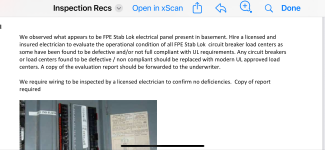
this is what they wrote. All I see is replacing the panel or since it doesn’t show any signs of danger at this time all you can do is thermo image it to make sure no hot spots are available, proper torquingof all connections and check for loose connections or oxidation. Any thoughts??????
Attachments
pipe_bender
Senior Member
- Location
- Boston
- Occupation
- Electrician
Looks like a inspection report, pretty common 3 phase panel, I would IR image the panel and look for any 'wiring deficiencies', like oversize breakers, missing k/o's, Then wait for what their insurance carrier asks for.
ModbusMan
Senior Member
- Location
- Cleveland, OH
- Occupation
- Building Automation Engineer
I love how the inspectors wrote "We observed what appears to be..." Almost as useful as our sales reps going "These guys showed up on the over-consumption report with a value of x. Could you give me another reading, using the historical database written by that exact same tool over the same time frame, to verify?"
brycenesbitt
Senior Member
- Location
- United States
That's not "appears to be" that is a Federal Pacific panel.this is what they wrote. All I see is replacing the panel or since it doesn’t show any signs of danger at this time all you can do is thermo image it to make sure no hot spots are available, proper torquingof all connections and check for loose connections or oxidation. Any thoughts??????
Replace it.
Done. Stab-Lok had it's time. It was a cost leader cheap panel now, and it did not last.
The danger is the breakers will jam when needed.
- Location
- San Francisco Bay Area, CA, USA
- Occupation
- Electrical Engineer
The danger is not that the breakers “jam” and it’s not that they used crappy aluminum bus (that was Zinsco). To clear up the misconceptions, I will share what I learned when I had access to internal documents from Reliance at one time, which laid it out in detail.
The problem with the US version of Stab-Lok breakers is that they can fail to trip when they are required to, which is their main function! Unfortunately, you will NOT KNOW THAT IT DOESN’T WORK UNTIL IT IS NEEDED! So people often say “I’ve never had a problem with Stab-Lok and I’ve had them for 50+ years”…, but that just means that fortunately for them, nothing has needed to trip in that expanse of time. Luck is, however, not a valid safety strategy…
This issue was discovered when Reliance (owned by Exxon at the time) was in the midst of buying FPE US, and discovered in their due diligence phase that there were numerous liability lawsuits against FPE for fires caused by the breakers failing to trip. Reliance did their own investigation and discovered that prior to the fires starting, FPE had made internal component and design changes to reduce costs, which triggered a requirement to undergo new expensive testing for UL listing, something every manufacturer must endure when making changes. But rather than incur that added cost and wipe out the meager savings they attained, someone decided to falsify the test reports by submitting copies of the PREVIOUS test reports from before the changes were implemented. They likely thought nobody would notice (my conjecture), but the subsequent fires messed up that plan. When Reliance discovered this, they immediately rescinded their purchase offer and did the right thing by informing UL of the fraud, who immediately pulled the UL listing of the entire Stab-Lok product line; panels and breakers (because they are listed together). With no buyer and no flagship product to sell, they declared bankruptcy.
The rest of this is just what I have learned over the years from other people who were reps for product lines involved. Challenger, who was a division of Westinghouse, did buy the rights to Stab-Lok for the US, thinking they could fix it, but having previously bought the other el-stinko product line, Zinsco, the effort failed before it even started and they themselves failed. When Eaton bought that part of Westinghouse and got Challenger with it, they immediately jettisoned the FPE and Zinsco lines so as to not have their stink follow into Eaton. All they kept was the old Sylvania C-Line breakers (not the panels) because Sylvania had taken the unusual and costly step of testing their breakers in most other similar panels, allowing them to be “Classified” by UL as universal replacements. Those breakers still exist as the Eaton CL line.
American Circuit Breaker bought the rights to Stab-Lok in the Challenger/Westinghouse dissolution and started to make a redesigned breaker for retrofit. ACB became United Breakers Inc. (UBI), who is now part of Connecticut Electric, who still sells those retrofit breakers.
While it was American Circuit Breaker/UBI, they successfully sued Federal Pioneer Canada to stop them from importing the Canadian Stab-Lok breakers (white versions, which had NOT been changed and never lost their CSA listing) into the US because they (UBI) owned the US rights to Stab-Lok. But for a couple of years, Federal Pioneer did sell the white Stab-Lok breakers here until that was stopped, so you can still come across them once in a while. Connecticut Electric still owns and enforces those rights, which is why Home Depot in Canada cannot ship the Fed. Pioneer version breakers to customers in the US. (I consulted on an unsuccessful lawsuit against Connecticut Elec. by another company that was going to make a classified Stab-Lok and Zinsco panel/breaker retrofit kit to go after all of the FPE and Zinsco panels in existing Federal housing projects, they did not prevail).
The problem with the US version of Stab-Lok breakers is that they can fail to trip when they are required to, which is their main function! Unfortunately, you will NOT KNOW THAT IT DOESN’T WORK UNTIL IT IS NEEDED! So people often say “I’ve never had a problem with Stab-Lok and I’ve had them for 50+ years”…, but that just means that fortunately for them, nothing has needed to trip in that expanse of time. Luck is, however, not a valid safety strategy…
This issue was discovered when Reliance (owned by Exxon at the time) was in the midst of buying FPE US, and discovered in their due diligence phase that there were numerous liability lawsuits against FPE for fires caused by the breakers failing to trip. Reliance did their own investigation and discovered that prior to the fires starting, FPE had made internal component and design changes to reduce costs, which triggered a requirement to undergo new expensive testing for UL listing, something every manufacturer must endure when making changes. But rather than incur that added cost and wipe out the meager savings they attained, someone decided to falsify the test reports by submitting copies of the PREVIOUS test reports from before the changes were implemented. They likely thought nobody would notice (my conjecture), but the subsequent fires messed up that plan. When Reliance discovered this, they immediately rescinded their purchase offer and did the right thing by informing UL of the fraud, who immediately pulled the UL listing of the entire Stab-Lok product line; panels and breakers (because they are listed together). With no buyer and no flagship product to sell, they declared bankruptcy.
The rest of this is just what I have learned over the years from other people who were reps for product lines involved. Challenger, who was a division of Westinghouse, did buy the rights to Stab-Lok for the US, thinking they could fix it, but having previously bought the other el-stinko product line, Zinsco, the effort failed before it even started and they themselves failed. When Eaton bought that part of Westinghouse and got Challenger with it, they immediately jettisoned the FPE and Zinsco lines so as to not have their stink follow into Eaton. All they kept was the old Sylvania C-Line breakers (not the panels) because Sylvania had taken the unusual and costly step of testing their breakers in most other similar panels, allowing them to be “Classified” by UL as universal replacements. Those breakers still exist as the Eaton CL line.
American Circuit Breaker bought the rights to Stab-Lok in the Challenger/Westinghouse dissolution and started to make a redesigned breaker for retrofit. ACB became United Breakers Inc. (UBI), who is now part of Connecticut Electric, who still sells those retrofit breakers.
While it was American Circuit Breaker/UBI, they successfully sued Federal Pioneer Canada to stop them from importing the Canadian Stab-Lok breakers (white versions, which had NOT been changed and never lost their CSA listing) into the US because they (UBI) owned the US rights to Stab-Lok. But for a couple of years, Federal Pioneer did sell the white Stab-Lok breakers here until that was stopped, so you can still come across them once in a while. Connecticut Electric still owns and enforces those rights, which is why Home Depot in Canada cannot ship the Fed. Pioneer version breakers to customers in the US. (I consulted on an unsuccessful lawsuit against Connecticut Elec. by another company that was going to make a classified Stab-Lok and Zinsco panel/breaker retrofit kit to go after all of the FPE and Zinsco panels in existing Federal housing projects, they did not prevail).
brycenesbitt
Senior Member
- Location
- United States
Jesse Arronstein's data suggests, or rather asserts, that even the best of the StabLok bunch still fail to trip at 200% of the rating.The danger is not that the breakers “jam” and it’s not that they used crappy aluminum bus (that was Zinsco). To clear up the misconceptions, I will share what I learned when I had access to internal documents from Reliance at one time, which laid it out in detail.
The problem with the US version of Stab-Lok breakers is that they can fail to trip when they are required to, which is their main function! Unfortunately, you will NOT KNOW THAT IT DOESN’T WORK UNTIL IT IS NEEDED! So people often say “I’ve never had a problem with Stab-Lok and I’ve had them for 50+ years”…, but that just means that fortunately for them, nothing has needed to trip in that expanse of time. Luck is, however, not a valid safety strategy…
That includes the Connecticut Electric line sold today.