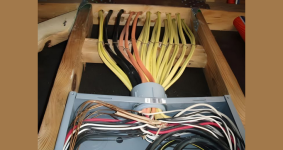
Separating distribution wires from single conduit entering subpanel

Merry Christmas

HiSpeed

Member
Location
Florida
Occupation
Home inspector
Florida 4-Point- Just bought this house and Insurance provider says the Challenger breakers have to be replaced in my panel (see pic). It's an Eaton panel, guessing about 10yo, and some jackwagon used old Challenger breakers (I've researched and see they are not liked by ins Co's so I don't want to get into the debate about Challengers).

I've got an electrician quoting me to change the breakers, he also has to separate the wires in the single conduit or he can't touch it. To just replace the breakers!?!?

I don't do what you guys do so I'm asking for a bit of guidance... is there a specific code that requires what he's saying? My basic research shows 300.3(C)(1) allows this installation. I understand new installs have circuits separated but this is an old install. The house is a 1961 condo in Pinellas County FL.

Thanks for any guidance and help understanding this situation. I just don't think I need to cut the wall open and re-route the wires just because the breakers have to be replaced in this situation.
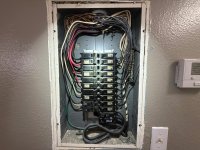
 

Attachments

  • image000000.jpg
    image000000.jpg
    220.3 KB · Views: 65
Around here (Kansas City) this panel job is par for the course. Mine are much cleaner. I see there are no grounds and neutrals bonded. That's good. What do you mean "separate". You mean clean it up?
 
Around here (Kansas City) this panel job is par for the course. Mine are much cleaner. I see there are no grounds and neutrals bonded. That's good. What do you mean "separate". You mean clean it up?
The electrician is saying the bundle of wires in the conduit up top must be separated (removed from the conduit and re-routed individually.
 
Agreed but two electricians have said the same thing. Do you know a code reference for what they are saying?
 
In the past the # of conductor in the conduit was often an overlooked item. Especially if the conduit is a sleeve, possibly if it is less than 24" long etc etc. Where does the other end of the conduit go?
 
In the past the # of conductor in the conduit was often an overlooked item. Especially if the conduit is a sleeve, possibly if it is less than 24" long etc etc. Where does the other end of the conduit go?
It’s a condo so I’m sure it goes up above the top plate and the wires disperse from there. Maybe 3ft in length.
 
First off some quick terminology. The box in the wall is a 'cabinet' and the metal back plane the breakers are on is a panelboard, together these are a loadcenter.
Agreed but two electricians have said the same thing.

Both those electricians looked at the 2" fitting and saw something they did not like.
Perhaps its not a conduit run with two dozen NM cables inside perhaps its just a 2" PVC fitting and thats it?
If it is a complete run of conduit to another electrical box ~2' away I would not replace it, and I dont think other EC's would want to either.
Do you know a code reference for what they are saying?
As others have pointed out its 312.5(C):
Code:
(C) Cables. Where cable is used, each cable shall be secured
to the cabinet, cutout box, or meter socket enclosure.
It's an Eaton panel, guessing about 10yo,
The panelboard yes looks newer, the cabinet in the wall looks older or original. possibly mismatched hard to tell.
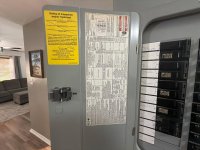
Post a photo of the panel cover on and a photo of the panel cover sticker if it still exists.
 
Last edited:
The installation passed inspection when it was constructed so the only issue I see is the breakers that the insurance company won't accept. Find another electrician to swap out the breakers.
I agree, find another electrician. You're only doing this for the Insurance Carrier and unless there was a real danger, bringing it up to current code is not required. The bigger concern would be the sloppy paint around the switch.
 
First off some quick terminology. The box in the wall is a 'cabinet' and the metal back plane the breakers are on is a panelboard, together these are a loadcenter.


Both those electricians looked at the 2" fitting and saw something they did not like.
Perhaps its not a conduit run with two dozen NM cables inside perhaps its just a 2" PVC fitting and thats it?
If it is a complete run of conduit to another electrical box ~2' away I would not replace it, and I dont think other EC's would want to either.

As others have pointed out its 312.5(C):
Code:
(C) Cables. Where cable is used, each cable shall be secured
to the cabinet, cutout box, or meter socket enclosure.

The panelboard yes looks newer, the cabinet in the wall looks older or original. possibly mismatched hard to tell.
Post a photo of the panel cover on and a photo of the panel cover sticker if it still exists.
 
great info. Bob 1 above directed me to 312.5(c) as well and I see what you are talking about. Not sure if it was an internal parts replacement or full panel change. You would definitely know more about that. The panel cover is an Eaton.
Thanks so much for the help and education.
 

Attachments

  • image000001.jpeg
    image000001.jpeg
    192.3 KB · Views: 12
The installation passed inspection when it was constructed so the only issue I see is the breakers that the insurance company won't accept. Find another electrician to swap out the breakers.
a 1961 install around were I am would not have had inspection by a second party back then. Likely wouldn't have had one as late as about 1990 or so in a single family dwelling.
 
In the past the # of conductor in the conduit was often an overlooked item. Especially if the conduit is a sleeve, possibly if it is less than 24" long etc etc. Where does the other end of the conduit go?
There is no fill requirements that apply to a protective sleeve.

Ampacity adjustments still apply if conductors are "bundled" for more than 24 inches though.

There been some changes over the years on the rules when bringing a common sleeve like that into a panelboard like that, we need more detail to know whether it complies with rules or not, as well as needing to know which NEC edition applied at time of install.
 
Top